Is That An Aerator in Your Pocket or Are You Just Happy to See Me?

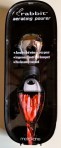
When my husband came home the other day and told me he’d just bought me a ‘rabbit’, I had to think about my response. If you ever watched early episodes of Sex and the City you’ll know what I mean. If you haven’t then, yes, I was concerned about the small, furry animal with the twitchy nose. In this case, he meant the Rabbit aerator.

When you aerate wine, you expose the wine to oxygen. Like decanting, there are clear reasons why:

  • When wine has been closed in a bottle over time, they need a little boost to open up the bouquet or flavors ~ exposing wine to oxygen will help the wine to ‘open’ more quickly.
  • If the wine is heavily tannic, it may be quite strong and unpleasant for the first tastes. The amount of time the wine is exposed to oxygen softens this quality Aeration helps to soften the wine more quickly so you can enjoy the wine at first sip.
  • Wines constantly change after bottling, which is why they are aged but the resulting chemical reactions can produce a gas that may be unpleasant. Different varieties can produce this gassy by-product, noticeable upon first opening ~ yet doesn’t mean the wine has turned. Aeration can help to separate the developed wine from the off-putting gas. I think the rule here is: Classy, not gassy.
  • Aeration can substantially bring out the complexity and expression of a wine that just pouring in a glass (guilty) never can. And it can do it more quickly than letting sit in a decanter or in your glass.

As a caveat: if the wine you’ve poured has, in fact, turned ~ aerating won’t help. We tried that with a recent bottle and it just made it worse.

A Matter of Style

Like decanters, the choice is yours. You can find a multitude of aerator styles, all that work on the same principle: fully oxygenating the wine.  When I go to wineries, most are using them and are loyal to the ones they use ~ and sell~ in the tasting room.

Glass vs. Plastic ~

The choice should be obvious, glass makes sense. Would you prefer wine served in a glass or plastic goblet? There are many expensive aerators fashioned in hand-blown glass and they are beautiful. Being the wine noob that I am, I have plastic.

Keep them separated ~

Do you really need a separate aerator for white and red wine? Many experts agree that decanting should be used for all wines; oxygenation can clearly benefit all. So, too, does aeration. But I wondered if having two different aerators was more marketing tool than necessity. In thinking it through, it would make sense; over time and use, you’d have residue from the red wine that might transfer flavours to any whites that are poured through. That wouldn’t be as much of an issue with glass, as it would rinse more completely. But if you have plastic, better get two.

We decided to take advantage of the wine we had on hand for Thanksgiving and put the aerators to the test. This wasn’t very scientific, we didn’t do a double blind tasting but we did have the two main variables, some nice wine to try. Carefully rinsing between tastings, we each had two glasses, one to try the unaerated and one poured through the Rabbit, then the Trudeau.

  Rabbit Trudeau Classic
Vineland ~ Pinot Meunier 3 0
Strewn ~ Cab Merlot 2 1
Inniskillin ~ Cab Shiraz 3 0
Lailey ~ Vidal 3 0
     

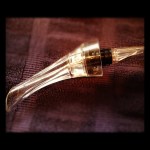
I admit, I was somewhat skeptical about how the aerators could actually affect the taste of the wine. When we tried the Vidal through the Rabbit, it immediately opened up, making the wine more complex and flavourful.  After testing three other wines, it was almost unanimous (except for Strewn) that the Rabbit was the better aerator. Clearly, design made all the difference: The Rabbit was almost shower head like; allowing rivulets to flow down and slide off the curve of the bowl to cascade more specifically in the glass. While the Trudeau brought good amount of air into the pour, it streamed in a way that was similar to just a straight pour from the bottle.

I didn’t know what to expect from my aerator experiment. To taste a distinct difference in one sip after aeration was really surprising and cool. And I enjoy being surprised out of my skepticism, even if this Rabbit was very different from what I expected.

Cheers!

Decant ~ Be Serious

I’ve been a bad girl. Not in the Fifty Shades way but as a wine student. Lately, I’ve found myself simply popping a cork and pouring my reds just in the glass. No decanting, no mandatory two hour plus wait time. Sometimes, I aerate but not every time. Most aficionados would slap my wrist (ooh!) and tell me that by not decanting, or at least aerating, my wine is not all that it could be. And they’d be right. So I dusted off my crystal decanter and became very curious about decanting and why it’s important.

Historically, decanters were important because most wines weren’t filtered prior to entering the bottle, sediment was more prevalent and needed to be separated out before drinking. Wine drinkers of yore probably didn’t want crunchy bits in the wine they sipped. Who would?

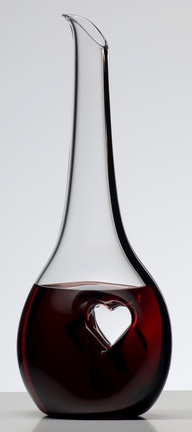
i heart decanter - image via lh5.googleusercontent.com

i heart decanter – Image via lh5.googleusercontent.com

Decantation is used for the separation and transfer of mixtures. Especially consequential with reds, the wine is separated from sediments or crystals that are a natural component of aging. Another benefit is the removal of any unwanted bitterness and pungent flavors. A certain amount of oxygenation will happen with the transfer from bottle to decanter but it isn’t the same as aeration, which intertwines oxygen into the wine to improve the taste. I’ll write more about aeration in my next post.

Decanting can be applied to white wine but it isn’t as necessary as decanting reds, especially those aged 5+ years that require more delicacy when serving. There usually isn’t as much sediment in younger wines but they can benefit greatly from decanting by enhancement of the flavours, bouquet, and by bringing the character into full effect.

Slow and steady ~ the art of the pour

As important as the decanter is, the way in which wine is poured matters. I’m sure that even doing the quick pour can provide some of the required oxygenation, it might not leave the all sediment out. The slower pour is more deliberate and accurate. And don’t forget, you want to hit that sweet spot, or the curve of the decanter, for maximum distribution.

Joseph Nase from New York Magazine recommends decanting all wines, even whites and that younger wines can be poured directly into the decanter and left to sit for as short a time as 20 minutes. But if you want to do it the old school way you’ll need two items, as well as the wine:

  • a wine cradle
  • a light source such as a flashlight or candle(very old school and romantic)
      • place wine in the cradle and carefully open the bottle ~ Nase says if the mouth stays above the level of liquid it shouldn’t spill
      • begin to rotate the cradle and slowly pour wine into the decanter while shining the light on the neck of the bottle ~ you should see sediment begin to creep up the neck
      • stop pouring! At this point, the wine in the decanter should be clean and clear

An easier approach involves using a wine funnel and sieve.

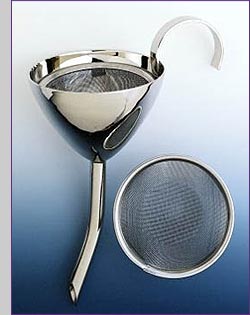
Wine Funnel and Sieve - Image via Artisans on Web

Wine Funnel and Sieve – Image via Artisans on Web

  • Insert funnel with sieve into the decanter
  • pour and let stand
  • enjoy

The sieve will take care of any sediment and bits of cork that may have found their way into the bottle. The funnel is usually shaped with a gentle curve to cascade the wine towards the sweet spot of the decanter. The slower the pour, the more oxygenation and the better the release of the flavors and character of the wine. You can also swirl the wine inside the decanter to provide more aeration before serving.

Keeping it Clean:

Don’t use detergent. The design of most decanters makes it very difficult to rinse away the residue. And any that remains may effect the taste of the next vintage you pour into it. You pay enough for a good bottle and don’t want it tainted with soapy residue. Ew.

All you need is some coarse sea salt (I’ve used fine equally well) and crushed ice. Place both in the decanter and shake (or swirl) until it’s clean.

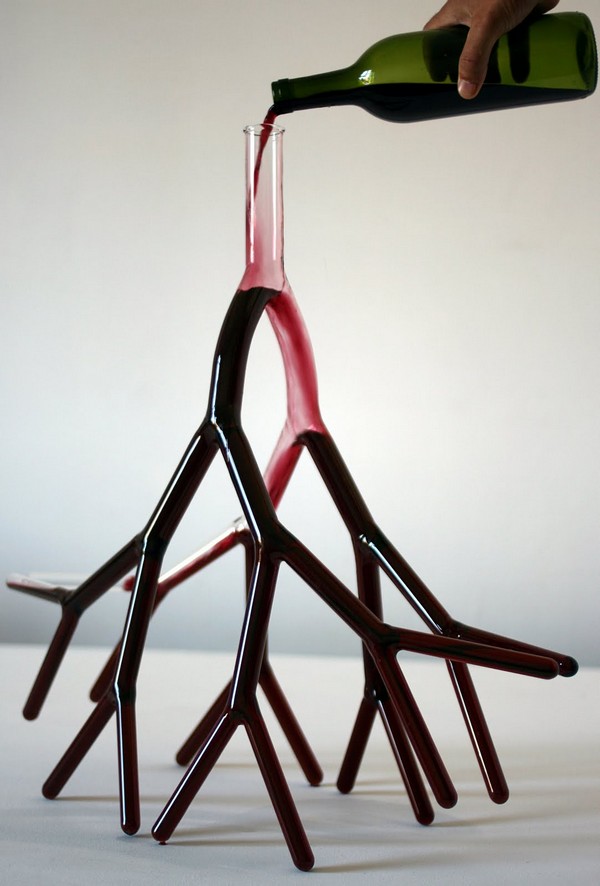
Decanters come in myriad shapes, styles and colors from the classic to the bizarre. I once saw one that had the unfortunate shape of a hand-held urinal, so I  just couldn’t buy it. It’s usually recommended that clear crystal or glass is best, that way you can see the color and clarity, but the choice is up to you.

Also works as a Vuvuzela - image via Riedel.co.uk

Also works as a Vuvuzela – Image via Riedel.co.uk

Antlers or Arteries? - Image via Etienne-Meneau

Antlers or Arteries? – Image via Etienne-Meneau

Wine is a thing of beauty and meant to be enjoyed at a slower pace, not rushed through. Part of the experience is the presentation of your chosen wine, slowly poured and displayed in a decanter that reflects your individual taste and style.

Cheers!