This is the weekend of flowers, sparkly things and Momosas (see what I did there?). But sometimes we like to change things up a little. I recently featured Mimosa on my Instagram so…
What if we made a Bellini this year? But first:
What is the difference between Bellini and Mimosa?
Mimosa – originally created in 1921 at Buck’s Club in London. Bartender Pat McGarry mixed two parts orange juice and one part Champagne (and maybe a splash of grenadine).
Jump ahead to 1925; a French version was born at the Hotel Ritz (bartender Frank Meyer) using equal parts orange juice and Champagne. It was named for a pretty yellow flower common in French gardens. 🌼
Over the years, many variations have arisen featuring many sparklers such as Prosecco or Spanish Cava, as well as the addition of Cointreau or Triple Sec for a little kick.
Bellini – an Italian cocktail named for the 15th-century artist Giovanni Bellini. Originally created by Giuseppe Cipriani at Harry’s Bar in Venice, it is sparkling wine with a simple peach purée. Traditionally, Prosecco is in the mix but any sparkler will do the trick.
The beauty of these two is that there are no hard and fast rules; there are so many variations that can please every palate.
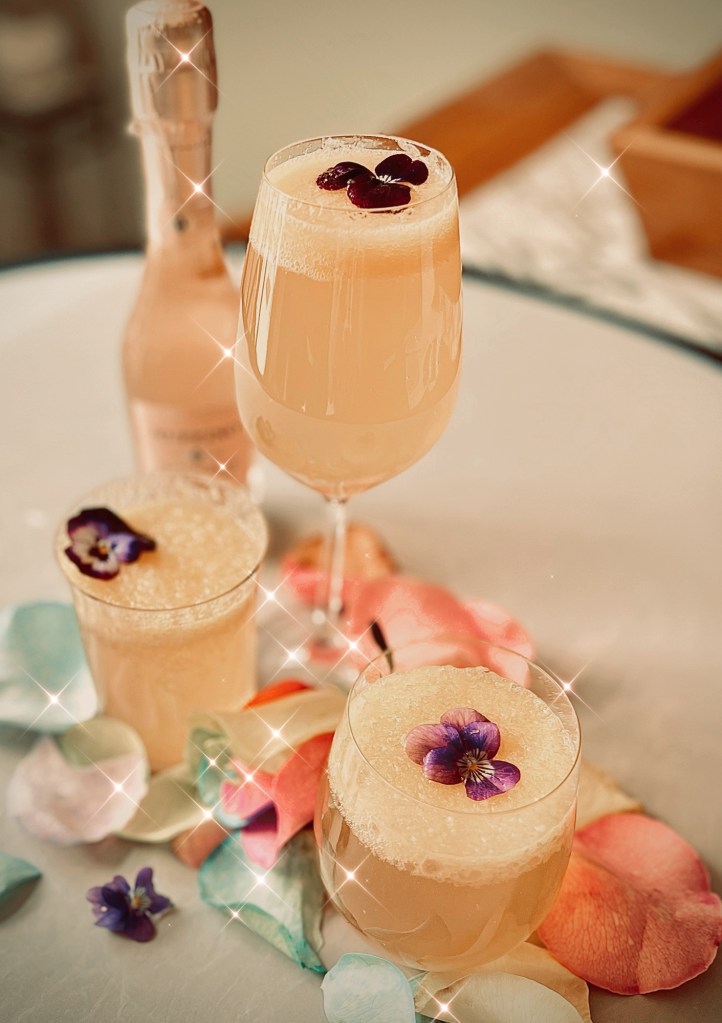
This year, I wanted to go with the trad Bellini with a wee twist: sparkling Rosé Prosecco!
The pink bubbles are so pretty in the glass and create a cool glow mixed with the peach puree. And I can tell you that it took a while to find any fresh peaches!
Easy Peasy Rose Peach Bellini:
• 6oz Sparkling Rosé (Prosecco if you’re a purist)
• 1 oz peach puree (blend of fresh, peeled peach, splash of fresh lemon juice & honey)
• Squeeze of fresh lemon juice
Instructions:
• Add peach purée to a flute glass (but any pretty glass will do), squeeze a little lemon juice to taste, then top it off with sparkling rose. Garnish with edible flowers.
• Enjoy!
Pair with brunch or sip all on its own.
Here’s to all the hard-working Moms out there, and to the memories of moms who are no longer with us. We toast you, and hold space in our hearts for you all.💜
We’ve all been there. It’s almost zero hour, almost go time. But wait! You suddenly remember that your primo bottle of bubbly is… still sitting on the counter. At room temperature. Damn. What to do?
If you’ve got 30 minutes, you’ve got it covered!
Your first instinct might be to put your bubbly in the freezer. If you do, make sure to watch your time! The reason? Pressure in the bottle can build up quickly. Any more than 30 minutes in the deep freeze, and you might have some premature poppage, and no one wants that. So maybe try this as a last resort.
And you don’t want to open it warm because you’ll shoot your eye out (or someone else’s). Part of the reason sparkling wine is chilled is to decrease some of the internal pressure; making opening the bottle easier, and less dangerous to everyone around you. Also: who wants to drink warm sparkling wine?
But the clock is ticking, and you don’t have time! Actually, you do. I got you.
The best, quickest, and safest method is an ice water bath.
Click the video below to find out more!👇
Ice Water Bath:
• Fill an ice bucket, pail, deep tray or sink half way with cold water
• Place bottle(s) in the container
• Fill the rest of the way with ice and add some salt.
• Leave 30 minutes (or a little longer if you can). Be sure to turn the bottle occasionally to ensure an all-over chill.
Adding salt to the ice water lowers the freezing point of the water, making the mixture much colder. The ice will melt more slowly because the water’s freezing and melting points have been lowered by the addition of salt. This also helps keep the cold temperature consistent.
When I worked the wine show last fall, we quickly cooled our sparkling wines using ice water baths. It only took about 30 minutes or so to efficiently chill the bottles so they could be opened safely, and were cold enough to drink.
• 2 1/2 oz Kinky Pink Liqueur – I used Mango, Passion Fruit + Blood Orange (chilled)
• Prosecco or Sparkling Wine (or no-alcohol sparkler)
• Fresh raspberries
• Lemon twist for garnish
Directions:
Pour tbsp Mathilde Cassis liqueur into a champagne flute (or pretty glass – Mom always deserves a pretty glass). Add Kinky Pink liqueur. Fill rest of glass with your choice of ice cold Prosecco, sparkling wine or favorite no-alcohol option.
Garnish with raspberries and twist of lemon. 🍋
Enjoy!
To all the hard working moms out there, take a some time just for you, and have a very happy Mother’s Day!💖
With this February being what it is, we probably want to be cozying up under a soft, warm blanket, with a fire or candle glowing and enjoying a glass or two of something nice.
The pickings this year were a little slim in terms of wines marketed specifically to Valentine’s Day. This could be due to the current and pervasive supply chain issues. Whatever the reason, I managed to find a couple that looked fun and holiday ready.
Check out the video I made for a little more info on these fun wines!❣️
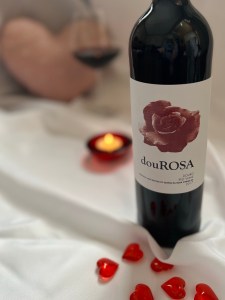
Made in the Douro region of Portugal, this is a luscious red blend from Portugal comprised of 35% Touriga Nacional, 35% Touriga Franca, and 30% Tinta Roriz grapes. Hand-picked and quietly left to mature for two years in stainless steel tanks, it is deep in color with an intense dark berry, blueberry vibe with both leathery and hint ‘o’ mint qualities. Younger wines have more of a violet vibe on the nose and they tend to have a dry and grippy mouthfeel due to bolder tannins.
The Douro region has a drier climate, with very warm summers. Because of an unusually dry, warm summer in 2017, harvest was a little early; mid – August, when the fruit was at its peak.
Tasting Notes:
• Deep ruby color – rich and clear – so beautiful in the glass
• Hints of violet (a soft, powdery raspberry vibe on the top) and caramel on the nose
• Dark, rich raspberry and blackberry w/a lush mouthfeel
• Medium tannin and mid-hi alcohol
• Paired beautifully with vegetarian pizza and fresh ripe blackberries
• Decant for at least an hour to open flavors
$19.99
Santero Villa Jolanda I Love You Extra Dry Spumante – This is one of the cutest damn bottles I’ve seen so far. Santero comes up with seasonal cool graphics; Halloween (which always sells out so I can never get my hands on one ), Christmas, and Valentine’s Day.
That’s part of the reason to check it out, and as an affordable sparkler, this is a fun offering. Especially if you’ve spent some of your cash on flowers, chocolate, and dinner, it adds up. Your sparkling wine should never leave you with a negative balance. Some might disagree on that statement. And while it is true, the sky can be the limit on what you can pay for a beautiful sparkling wine, feel free to adjust your Valentine’s budget accordingly.
Tasting Notes:
• Light yellow straw color – lots of pretty bubbles
• Nice acidity, not too sweet
• Flavors of honeydew melon, pear, cream
• Lighter body, refreshing mouthfeel,
• No decanting needed (don’t want to lose those bubbles)
• Serve ice cold
• Pairs: Anything
• $15.99
I hope you all have a happy and safe Valentine’s Day!💝
Please enjoy responsibly, and if you can’t be the with wine you love, love the wine you’re with!🥰
With the holidays fast approaching, we’re all turning our attention to fun, festive wines to fill our goblets. Even if our evenings may still be a little on the quiet side, enjoyable sparklers are out there to lift your spirits. But finding the right one can take little prep and planning; there are so many options to choose from. Where to begin? Not to worry! In this 3-part series, we’ll explore several to help you decide which sparkling wines might make your holiday a little brighter.
So what IS the difference between Champagne and other sparkling wines? What glass should I serve it in? I don’t want to serve it with the same old tidbits…what’s unique and fun? These are the burning questions. We have a bit of ground to cover so… settle in and check out the little video below for a crash course!👇
Let’s take a closer look at four types of sparkling wines: Champagne, Prosecco, Cava, and Asti.
Champagne: Champagne can only be called Champagne if it’s made in the Champagne region of France. No other place. Everything else is sparkling wine and as we’ll see, there are many, many bubbling options. Made in the Traditional Method, and using a blend including Chardonnay, Pinot Noir (and Pinot Meunier), grapes are picked by hand, then quickly and gently pressed in whole bunches to mininmize any skin contact with the juice – leading to unwanted color or tannin in the end product.After press, it goes through a settling process to remove any solids. Primary Fermentation: is much like still wine at a temperature of 64-68F. The fermentation vessel can be stainless steel tanks, concrete egg vessels, oak vats or barrels. It’s here that many go through malolactic fermentation (where good bacteria convert the hard malic acid (green apple like) to the softer lactic acid (a creamier vibe) which lowers the overall acidity of the wine. The still wine is then aged, sometimes clarified by filtering, fining or centrifugation. The wine can also be aged on the lees (or dead yeast left over from fermentation). This is what gives the sparkling wine it’s bready or biscuity flavor and creamier mouthfeel. A pink color can be achieved by adding back some red wine, or giving the still wine a small amount of contact with the red grape skins. After the addition of sugar, nutrients and yeast (liquer de tirage) bottling occurs – here is where the sparkling magic happens! Once bottled, it’s capped with what looks like a bottle cap so that the secondary fermentation can occur. This occurs at a cooler temperature (50-54F) – and a longer process than before. At the end of secondary fermentation, the bubbles have formed, and as the yeast has gobbled up all the sugar, it dies and decomposes. Bottles are then moved to storage where the now sparkling wine will rest on the yeast (lees) for a desired amount of time.
While resting, the bottles are gently and gradually rotated over time until they are in a vertical position – neck of the bottle upside down -to bring any sediment into one smaller area. At this point, the neck of the bottle is placed in a shallow freezing solution of liquid nitrogen and the semi-frozen sediment ‘plug’ is then propelled out of the bottle by the built up pressure. The beauty is that very little liquid is lost, and all of the dead yeast and sticky sediment is gone from the sparkling wine.
The bottle is then topped up with a small mixture of wine and sugar (dosage) to provide the desired amount of residual sugar, which acts to balance the high acidity of the wine. Bottles are then corked, secured with a wire cage, and ready to ship or cellar. Traditional method is why there is a higher alcohol content, and it’s why Champagne can be cellared for many years. A true luxury item, this takes considerable time, skill, and craft to create what goes into your glass, and explains why many are so expensive. Flavors: citrus, yellow apple, cream, almond, toast. Brands: Veuve Clicquot, Moet & Chandon, Louis Roederer, and the big daddy, Dom Pérignon. **Keep your eyes open for Blanc de Blanc ~ Champagne made from 100% Chardonnay.
Prosecco: Like Champagne, Prosecco can only be a true version if it is produced in Veneto region, Italy, the some of the best being from the sub-region of Valdobbiadene. Primary grape is Glera (though it is often blended) and it’s made in the Charmat or single tank method. Here, the base wines are added together with the sugar and yeast in a large stainless steel tank. As the wine goes through it’s secondary fermentation, CO2 is released causing the tank to pressurize. The wines are then filtered, then bottled without aging. Prosecco generally has a fresher character (with only minor secondary yeast flavors) and should be enjoyed young, within 2-3 years of bottling. Sweetness levels: Brut: Dry, little or no detectable sweetness. 0-12 grams of sugar/litre. Most Champagne is Brut. Extra Sec (Extra Dry): Some detectable sweetness/sugar. 12-17 grams/litre residual sugar Sec (Dry): Noticeable sweetness/sugar. 17-32 grams/litre Flavors: green apple, honeydew melon, pear, lager, cream.
Brands: Toresella, Ruffino, Tesoro Della, LaMarca
Cava: From Spain, and made in the Traditional Method, this is made from three varieties; Xarello, Macabeo, Parellada. This is a very earthy, rich and complex wine, can be cellared. Flavors: marzipan, white chocolate, brioche. Brands: Freixenet, Segura Viudad Brut Reserva, Elyssia.
Asti: Another notable offering from Italy, Asti is produced in Piedmont using the Moscato Bianco grape. It’s made sparkling by single tank fermentation, giving it a bright and crisp quality, and is sweeter and lower in alcohol than the other three types. Flavors: tangerine, apricot, peach and pear. Brands: Martini & Rossi, Spumante, Risata.
This gives you a little more to think about when going to purchase your fun wines for the holidays.
Next post, we’ll explore which is the best glass to truly showcase the look and flavors of your sparkler!🥂
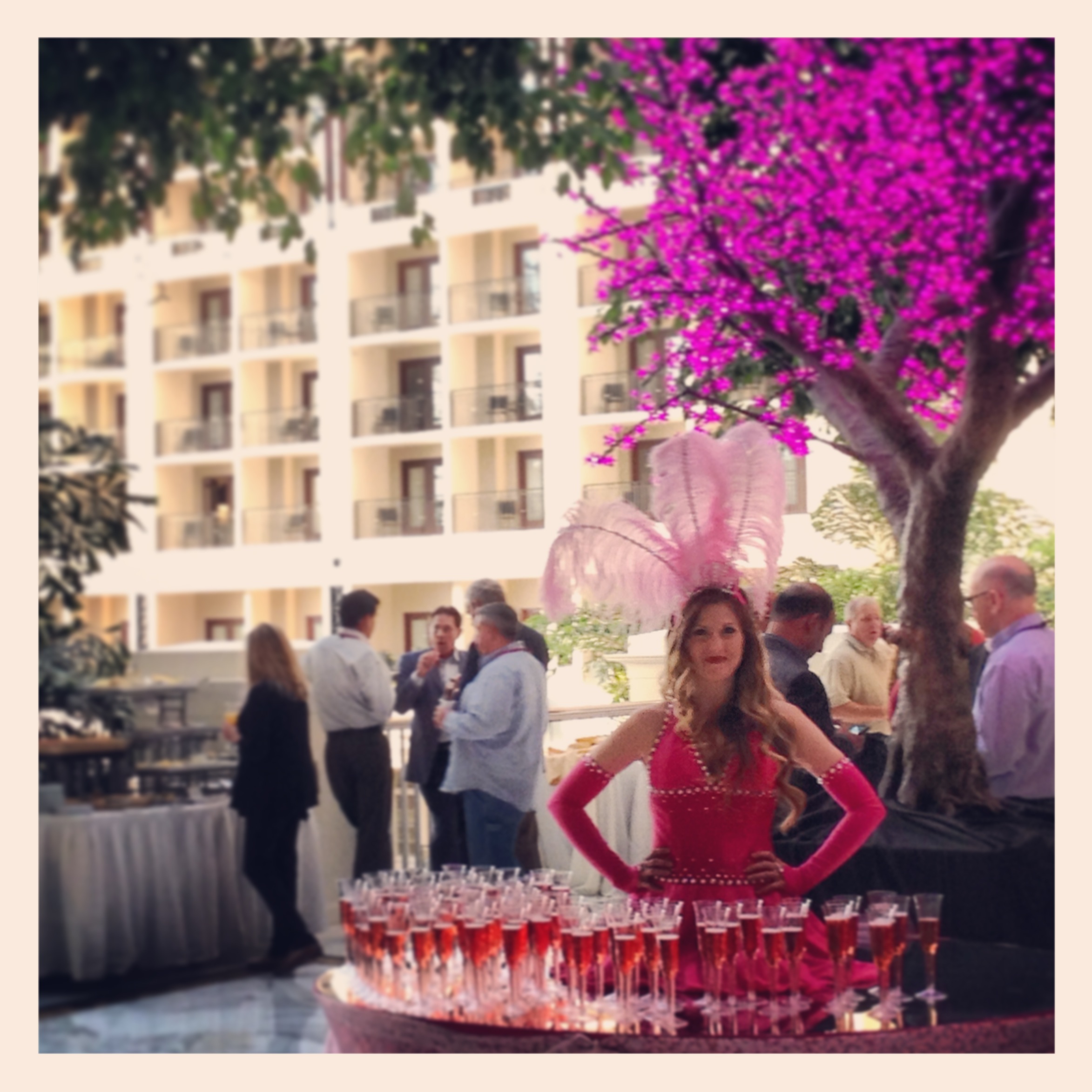
Bubbly and fun, this lovely girl was serving aPink Prosecco Party Punch. She was working an event I attended this past weekend in DC. While it wasn’t specifically a wine event, there was always a glass of fermented fun nearby. Which is good, since it usually helps to loosen the tie of even the stuffiest stuffed shirt.
Prosecco is a sparkling wine from, most notably, the region of Veneto in North Eastern Italy. Pink Prosecco is just what it sounds like. What makes it pink? Skin contact with the Pinot Nero (Noir) grape. According to WineSearcher.com the varietal blend is: 85% Prosecco (Glera) ~ the 15% remaining may include: Bianchetta Trevigana, Perera, Chardonnay, Pinot Grigio, and Pinot Noir (if you want it pink). Some notable brands worth sampling: Ruffino ($12), Canella ($17), Bisol Bel Star ($20). For mixing in punch, you might want to stick with the lower priced offerings. If you’re going to spend $20 on a bottle, it’s best to keep it the star of the show.
I find that sparklers like Prosecco go right to my head, so my rule of thumb is: One glass to feel dreamy ~ two or more and it’s lights out. But when combined with one of the first warm evenings of spring, it prompted me to start thinking, and anticipating, a great season ~ alfresco and under the stars.
After a month of what felt like nonstop eating and drinking, and happy to not be exhibiting any visible signs of gout, I wanted to celebrate with a fun wine that would help me toast the end of a very good year. The Champagne tasting at Royal Park Fine Winesin Strongsville was a great place to meet friends and try a variety of wines for the season.
Royal Park Wines owner, George Zaboura, featured six Champagne/sparkling wines starting with the Santa Margherita Prosecco from Italy. This was a nice wine to begin the evening with and it boasted aromas of peach, apple and delicate citrus. It was light and refreshing and whet my appetite for the next offering:Freixenet Elyssia Rose from Spain. I found this one a little disappointing; it didn’t have much flavor. Even after pairing it with some strawberries and chocolate, it didn’t really jump out of the glass.
The next offering was the Piper Heidsick Cuvee Sublime from France. This was much sweeter and flavorful. It boasted a touch of violet, which was subtle and noticeable at the finish.
On to the Mumm Brut Prestige, Napa Valley. This had an almost creamy mouth-feel with pronounced a melon essence and a finish that lingered (in a good way) after your final sip.
Next up was the Perrier Jouet Grand Brut. It proved to be a lively wine with a subtle green apple and pineapple vibe that would be a great stand alone sparkler for toasting and enjoying throughout the night.
We finished with aBanfi Rosa Regale from Italy. This was a semi-dry wine that offered a sweet strawberry raspberry flavor. The color was a beautiful, light claret and it was good but very sweet.
Our choice: The Mumm Brut Prestige. Yum. I’m looking forward to popping the cork, sipping it slowly with some chocolate and strawberries and welcoming a brand new year.



 ), Christmas, and Valentine’s Day.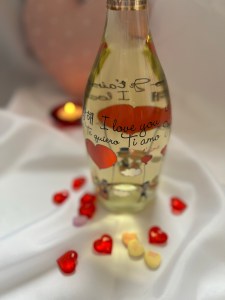




 The Wine Student