We’ve all been there. It’s almost zero hour, almost go time. But wait! You suddenly remember that your primo bottle of bubbly is… still sitting on the counter. At room temperature. Damn. What to do?
If you’ve got 30 minutes, you’ve got it covered!
Your first instinct might be to put your bubbly in the freezer. If you do, make sure to watch your time! The reason? Pressure in the bottle can build up quickly. Any more than 30 minutes in the deep freeze, and you might have some premature poppage, and no one wants that. So maybe try this as a last resort.
And you don’t want to open it warm because you’ll shoot your eye out (or someone else’s). Part of the reason sparkling wine is chilled is to decrease some of the internal pressure; making opening the bottle easier, and less dangerous to everyone around you. Also: who wants to drink warm sparkling wine?
But the clock is ticking, and you don’t have time! Actually, you do. I got you.
The best, quickest, and safest method is an ice water bath.
Click the video below to find out more!👇
Ice Water Bath:
• Fill an ice bucket, pail, deep tray or sink half way with cold water
• Place bottle(s) in the container
• Fill the rest of the way with ice and add some salt.
• Leave 30 minutes (or a little longer if you can). Be sure to turn the bottle occasionally to ensure an all-over chill.
Adding salt to the ice water lowers the freezing point of the water, making the mixture much colder. The ice will melt more slowly because the water’s freezing and melting points have been lowered by the addition of salt. This also helps keep the cold temperature consistent.
When I worked the wine show last fall, we quickly cooled our sparkling wines using ice water baths. It only took about 30 minutes or so to efficiently chill the bottles so they could be opened safely, and were cold enough to drink.
• 2 1/2 oz Kinky Pink Liqueur – I used Mango, Passion Fruit + Blood Orange (chilled)
• Prosecco or Sparkling Wine (or no-alcohol sparkler)
• Fresh raspberries
• Lemon twist for garnish
Directions:
Pour tbsp Mathilde Cassis liqueur into a champagne flute (or pretty glass – Mom always deserves a pretty glass). Add Kinky Pink liqueur. Fill rest of glass with your choice of ice cold Prosecco, sparkling wine or favorite no-alcohol option.
Garnish with raspberries and twist of lemon. 🍋
Enjoy!
To all the hard working moms out there, take a some time just for you, and have a very happy Mother’s Day!💖
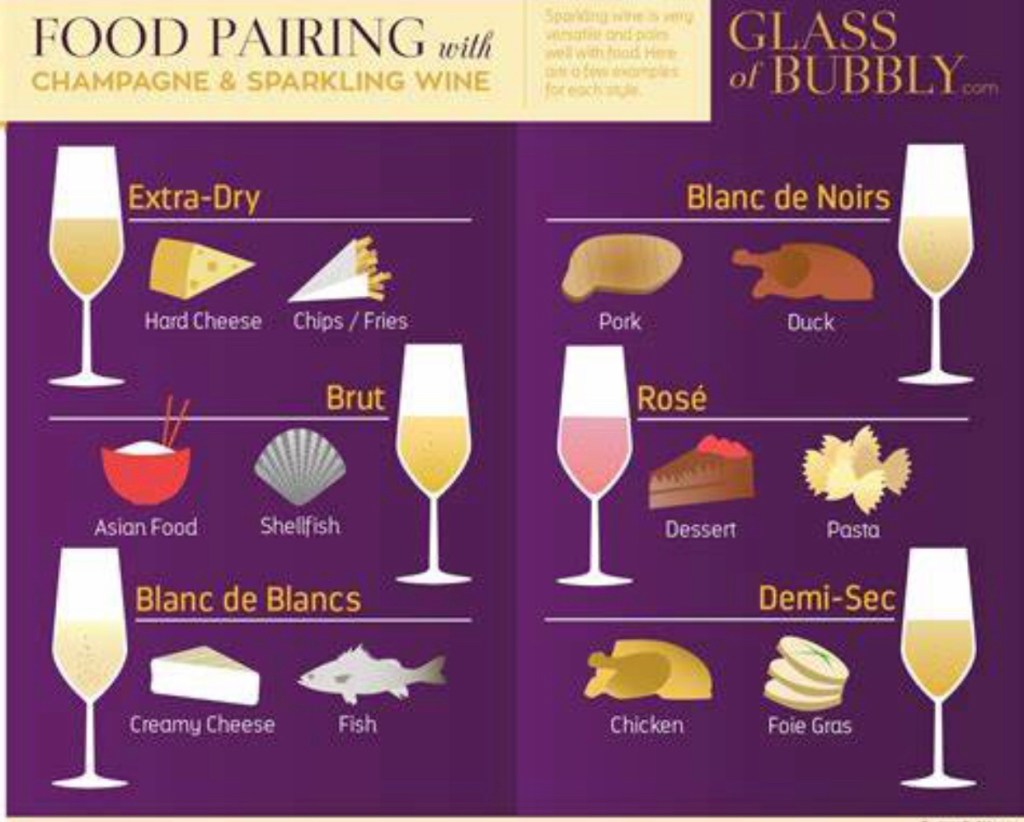
The general rule of thumb for pairing sparkling wines – fish, cheese, chicken.
But what if you’re not feeling that? What if you’re feeling adventurous and want to be free of all rules?
I say, go for it. For the most part, the sky’s the limit, just keep a few tiny guidelines in mind:
Serve your sparkler well chilled – the bottle opens easier and more safely when it’s cold. Allow a bit of time for the bubbly froth to settle and the delicate aromas to unfold.
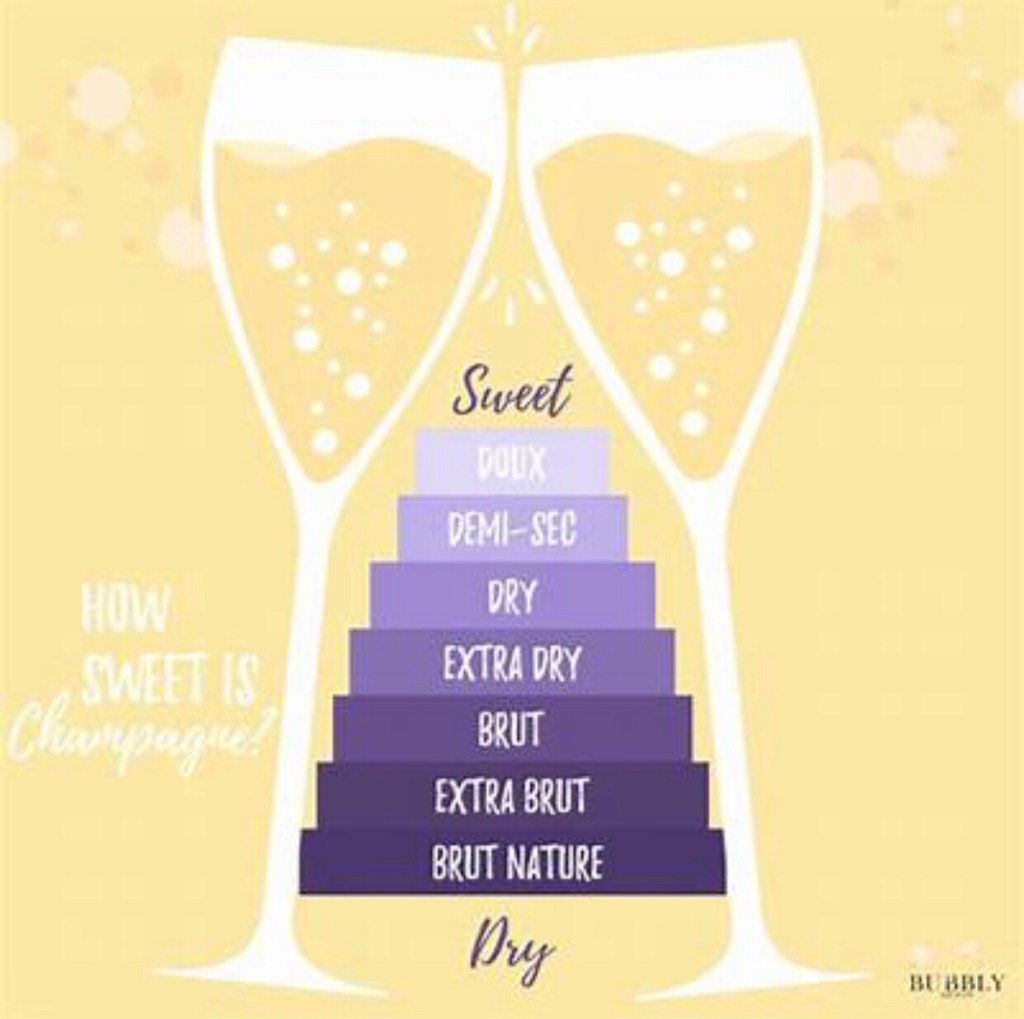
Here’s a great chart from bubblysideoflife.com gives the levels of sweetness to look for when choosing. Not all sparklers are the same.
And the answer is usually right on the label!
Sweetness Levels🥂 [Image via Bubbly Side of Life]
From dry to sweet, when pairing all wines, not just sparkling, you want to:
Match Flavor and Texture – For the most part, you don’t want your food to overpower your wine, or vice versa. You want both to compliment each other; bringing out each other’s best. Intensity of food and wine means its weight, which includes things like, salt, sweet, acidity, spiciness, etc. You want balance. For instance, I don’t enjoy a delicate, low tanninPinot Noir with a hearty, fatty, juicy steak. The steak, (especially if served with a smoky or spicy sauce) overpowers the delicate flavours of the Pinot Noir, which doesn’t have enough tannins to cut through the robust fattiness of steak. It’s not that the wine is bad, it just doesn’t match with the weight of the food.
A beefy, hearty Cabernet Sauvignon, with it’s higher tannin and alcohol punches within its weight class, and matches the steak sip for bite.
Likewise, pairing a Cab with a delicate white fish, overpowers the flavor and weight of the fish so all you taste is the Cab.
When pairing sparkling wines with food, the same principles apply. Lighter, brighter effervescent wines provide a delicate acidity, and in the case of Champagne, have some richness and aged flavors that give you a different experience. I’ve paired Prosecco with a rich, creamy buttery orecchietti pasta dish that was amazing. The bright, fruitiness and acidity cut through the heavy cream of the dish, cleansing the palate with each sip. So if you’re craving mac and cheese (with any combination of cheeses), do it! Experiment! See what you like!😍
The key is matching the prominent aspects of the food and the wine.
Traditional Pairings [Image via Glass of Bubbly.com]
Sweet with Heat – To avoid feeling the burn, pair spicy fare with a sparkling wine that has some residual sugar in it. Sugar cools down the heat of your dish, creating balance.
⚠️Avoid pairing spicy foods with wines that have high alcohol. These will ramp up the heat, creating a three alarm blaze in your mouth. 🔥Most of us don’t enjoy sweating our way through dinner. 🥵 Going spicy? Choose a sparkler that has Extra-Dry, Dry, Demi-Sec or even Doux on the label.
Acid with Fat – Fatty or fried foods play well with high acid wines like Champagne. The acidity cuts a swath through the fat and fried, salty goodness; cleansing your palate for the next bite!
Try fried chicken or french fries, or put out a bowl of potato chips and watch them disappear!
Smoke ‘n’ Oak – Pair gently charred foods with sparklers aged in oak. Think traditional method Brut or Extra-Brut. And keep the meat on the lighter side; chicken, shrimp. Grilled foods tame the oak intensity and bring out the fruity aspects of the wine.
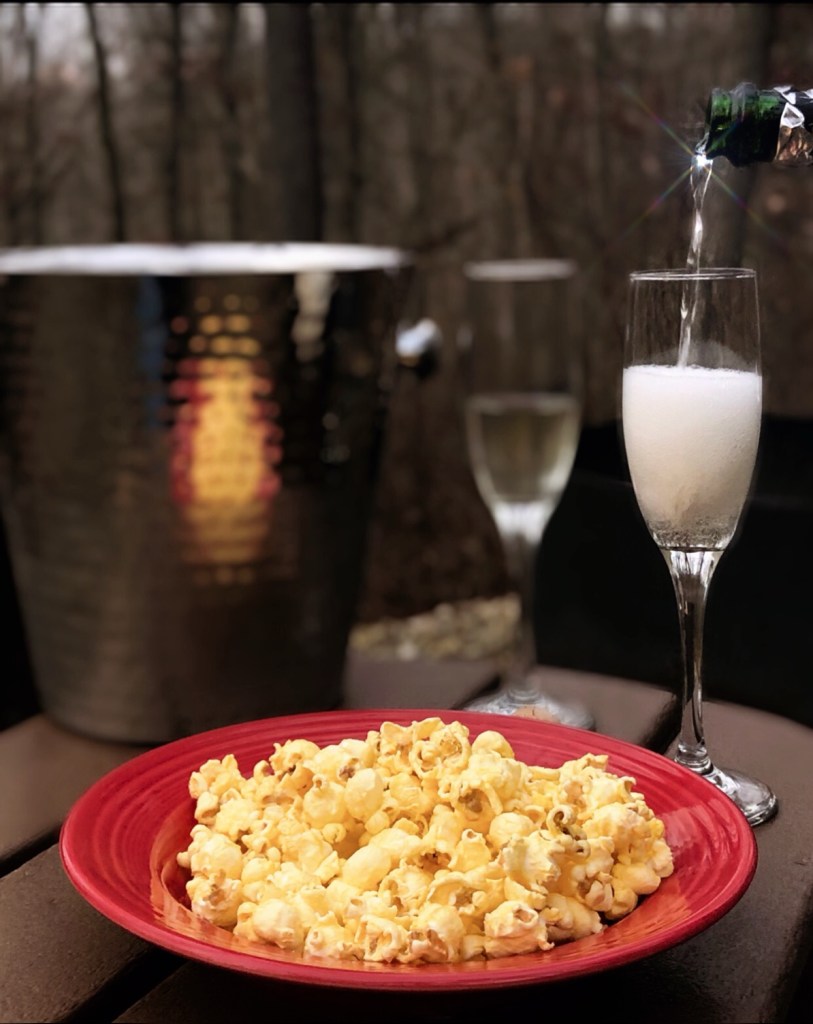
Sweet and Salty – If you love Chicago Mix popcorn (cheddar cheese and caramel blend) you know what’s going on here. Pairing salty foods with a sweet or almost sweet wine makes sweet wine more fruity (and less sweet), and salty foods more savoury. Try… corn dogs! Think about it – you have the gentle smokiness of the sausage inside, combined with the subtle sweetness of the corn bread on the outside, deep fried, and the sauce you put on top (dijon mustard, sweet bbq, ketchup) can change the vibe even more.
I like to keep it classy!😉
Sweet for the Sweet – with dessert, pair a wine that’s at least as sweet, if not sweeter. Sweet wines tend to highlight the sweet aspects of food. If your food is sweeter than your wine, the wine will fade, and seem dull. Again, go for sparkling wines that are higher on the sweet list; Dry, Demi-Sec or Doux.
Pair it with leftover Christmas cookies, Kit Kats, ice cream.🍪🍫🍨
Whatever sparkler you choose, whatever glass you have, whatever food you pair it with, please have yourself have a very happy, safe and healthy New Year!🎉🥳🍾
**Don’t forget to join me tomorrow, Thursday, December 30th, 11:00am on 900CHML’s Bill Kelly Show -with guest host Shiona Thompson!🎙
With the holidays fast approaching, we’re all turning our attention to fun, festive wines to fill our goblets. Even if our evenings may still be a little on the quiet side, enjoyable sparklers are out there to lift your spirits. But finding the right one can take little prep and planning; there are so many options to choose from. Where to begin? Not to worry! In this 3-part series, we’ll explore several to help you decide which sparkling wines might make your holiday a little brighter.
So what IS the difference between Champagne and other sparkling wines? What glass should I serve it in? I don’t want to serve it with the same old tidbits…what’s unique and fun? These are the burning questions. We have a bit of ground to cover so… settle in and check out the little video below for a crash course!👇
Let’s take a closer look at four types of sparkling wines: Champagne, Prosecco, Cava, and Asti.
Champagne: Champagne can only be called Champagne if it’s made in the Champagne region of France. No other place. Everything else is sparkling wine and as we’ll see, there are many, many bubbling options. Made in the Traditional Method, and using a blend including Chardonnay, Pinot Noir (and Pinot Meunier), grapes are picked by hand, then quickly and gently pressed in whole bunches to mininmize any skin contact with the juice – leading to unwanted color or tannin in the end product.After press, it goes through a settling process to remove any solids. Primary Fermentation: is much like still wine at a temperature of 64-68F. The fermentation vessel can be stainless steel tanks, concrete egg vessels, oak vats or barrels. It’s here that many go through malolactic fermentation (where good bacteria convert the hard malic acid (green apple like) to the softer lactic acid (a creamier vibe) which lowers the overall acidity of the wine. The still wine is then aged, sometimes clarified by filtering, fining or centrifugation. The wine can also be aged on the lees (or dead yeast left over from fermentation). This is what gives the sparkling wine it’s bready or biscuity flavor and creamier mouthfeel. A pink color can be achieved by adding back some red wine, or giving the still wine a small amount of contact with the red grape skins. After the addition of sugar, nutrients and yeast (liquer de tirage) bottling occurs – here is where the sparkling magic happens! Once bottled, it’s capped with what looks like a bottle cap so that the secondary fermentation can occur. This occurs at a cooler temperature (50-54F) – and a longer process than before. At the end of secondary fermentation, the bubbles have formed, and as the yeast has gobbled up all the sugar, it dies and decomposes. Bottles are then moved to storage where the now sparkling wine will rest on the yeast (lees) for a desired amount of time.
While resting, the bottles are gently and gradually rotated over time until they are in a vertical position – neck of the bottle upside down -to bring any sediment into one smaller area. At this point, the neck of the bottle is placed in a shallow freezing solution of liquid nitrogen and the semi-frozen sediment ‘plug’ is then propelled out of the bottle by the built up pressure. The beauty is that very little liquid is lost, and all of the dead yeast and sticky sediment is gone from the sparkling wine.
The bottle is then topped up with a small mixture of wine and sugar (dosage) to provide the desired amount of residual sugar, which acts to balance the high acidity of the wine. Bottles are then corked, secured with a wire cage, and ready to ship or cellar. Traditional method is why there is a higher alcohol content, and it’s why Champagne can be cellared for many years. A true luxury item, this takes considerable time, skill, and craft to create what goes into your glass, and explains why many are so expensive. Flavors: citrus, yellow apple, cream, almond, toast. Brands: Veuve Clicquot, Moet & Chandon, Louis Roederer, and the big daddy, Dom Pérignon. **Keep your eyes open for Blanc de Blanc ~ Champagne made from 100% Chardonnay.
Prosecco: Like Champagne, Prosecco can only be a true version if it is produced in Veneto region, Italy, the some of the best being from the sub-region of Valdobbiadene. Primary grape is Glera (though it is often blended) and it’s made in the Charmat or single tank method. Here, the base wines are added together with the sugar and yeast in a large stainless steel tank. As the wine goes through it’s secondary fermentation, CO2 is released causing the tank to pressurize. The wines are then filtered, then bottled without aging. Prosecco generally has a fresher character (with only minor secondary yeast flavors) and should be enjoyed young, within 2-3 years of bottling. Sweetness levels: Brut: Dry, little or no detectable sweetness. 0-12 grams of sugar/litre. Most Champagne is Brut. Extra Sec (Extra Dry): Some detectable sweetness/sugar. 12-17 grams/litre residual sugar Sec (Dry): Noticeable sweetness/sugar. 17-32 grams/litre Flavors: green apple, honeydew melon, pear, lager, cream.
Brands: Toresella, Ruffino, Tesoro Della, LaMarca
Cava: From Spain, and made in the Traditional Method, this is made from three varieties; Xarello, Macabeo, Parellada. This is a very earthy, rich and complex wine, can be cellared. Flavors: marzipan, white chocolate, brioche. Brands: Freixenet, Segura Viudad Brut Reserva, Elyssia.
Asti: Another notable offering from Italy, Asti is produced in Piedmont using the Moscato Bianco grape. It’s made sparkling by single tank fermentation, giving it a bright and crisp quality, and is sweeter and lower in alcohol than the other three types. Flavors: tangerine, apricot, peach and pear. Brands: Martini & Rossi, Spumante, Risata.
This gives you a little more to think about when going to purchase your fun wines for the holidays.
Next post, we’ll explore which is the best glass to truly showcase the look and flavors of your sparkler!🥂
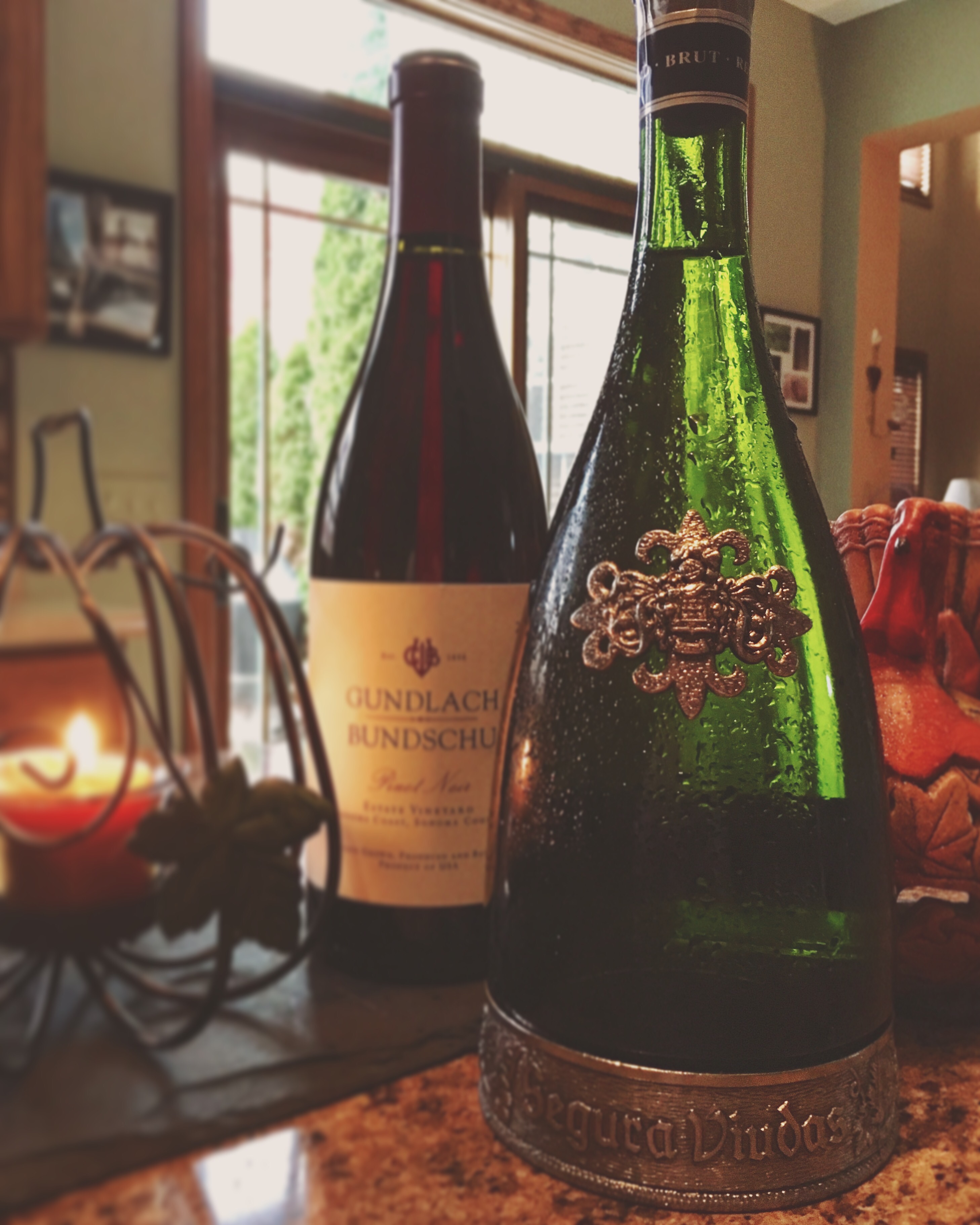
This Thanksgiving, I wanted to shake things up a little. Instead of serving three wines; a bubbler, white and a red, I’ve narrowed the field to two: Segura Viudas Reserva Heredad Cava and a 2013 Gundlach Bundschu Pinot Noir.
But wait…what is Cava?
Cava is a dry sparkling wine that is produced in Spain using traditional, indigenous grapes from a several select growing regions. The most renown is North-East Spain, particularly Penedès. It is made from 2-3 grape varietals: Macabea (the Viura of Rioja), Parellada, and the earthier Xarel-lo. While most wines are named after their growing region, Cava gets its name from the type of wine. Unlike other sparkling wines, it’s made in ‘Mètodo Tradicional’ or the traditional method used in creating Champagne.
I’ve written before about how sparkling wines are made but here’s a little review: The traditional method allows for the fermentation of wine in the bottle for months (and sometimes years). Bottles have a crown cap (think beer cap) to withstand the considerable buildup of pressure (corks would just pop at this phase and no one likes premature popping). Bottles are then slanted downward and kept in this postion to allow the yeast to settle in the neck. After a time, the next phase occurs where just the bottle necks are submerged in a freezing solution; freezing just those few inches of wine that contains the yeast. An ice plug is formed trapping the yeast. At this point, the bottle is turned upright, crown cap removed and the pressure from the gas inside the bottle expells the ice plug (don’t try blaming the dog). What remains is the sparkling bottle of perfection which is then corked and cellared. A painstaking process, it takes great care to make sure it all comes out the way it should.
This is how the traditional method differs from other approaches to making wine sparkle. Non-traditional method means the wine goes through its fermentation in large metal tanks, is then bottled and carbon dioxide added to the mix.
Cava vs Prosecco
Cava has flavors of lemon flavors with a slightly bitter, nuttier quality on the finish with a more full bodied mouth-feel, and floral notes similar to Champagne. It has many qualities similar to Champagne except that it has a more affordable price point. Feel free to put two in your grocery basket.
Proseccooriginates from around the Valdobbiadene region of Italy and is a dry, slightly sweeter, complex bubbler. It’s fermented in steel tanks and has light, crisp flavors of pear, peach, yellow apple, and apricot. Like Cava, it is an inexpensive way to get your bubble on and can be mixed without guilt in a bevy of cocktails.
Whatever you choose to celebrate this Thanksgiving, I wish you all a happy and safe holiday!
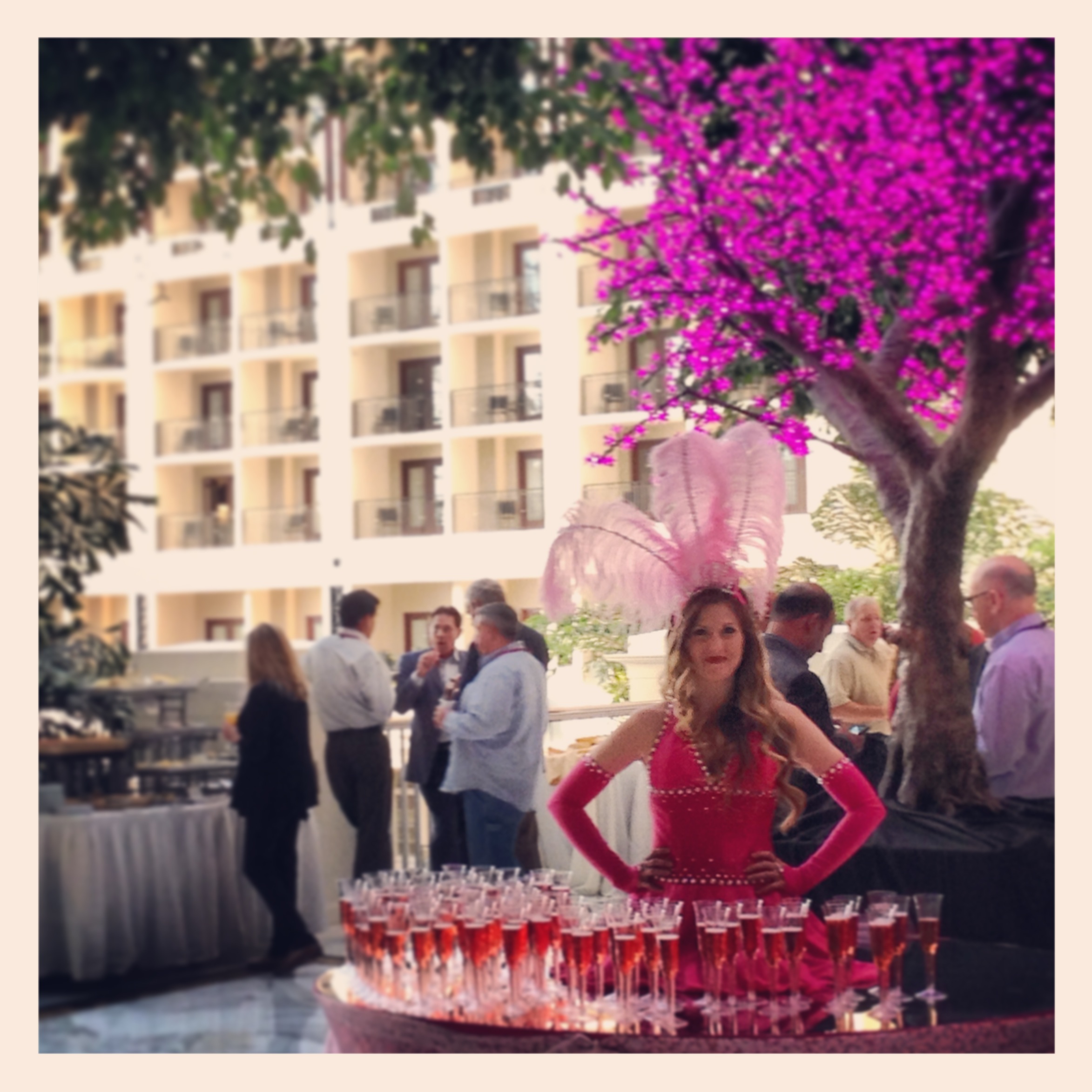
Bubbly and fun, this lovely girl was serving aPink Prosecco Party Punch. She was working an event I attended this past weekend in DC. While it wasn’t specifically a wine event, there was always a glass of fermented fun nearby. Which is good, since it usually helps to loosen the tie of even the stuffiest stuffed shirt.
Prosecco is a sparkling wine from, most notably, the region of Veneto in North Eastern Italy. Pink Prosecco is just what it sounds like. What makes it pink? Skin contact with the Pinot Nero (Noir) grape. According to WineSearcher.com the varietal blend is: 85% Prosecco (Glera) ~ the 15% remaining may include: Bianchetta Trevigana, Perera, Chardonnay, Pinot Grigio, and Pinot Noir (if you want it pink). Some notable brands worth sampling: Ruffino ($12), Canella ($17), Bisol Bel Star ($20). For mixing in punch, you might want to stick with the lower priced offerings. If you’re going to spend $20 on a bottle, it’s best to keep it the star of the show.
I find that sparklers like Prosecco go right to my head, so my rule of thumb is: One glass to feel dreamy ~ two or more and it’s lights out. But when combined with one of the first warm evenings of spring, it prompted me to start thinking, and anticipating, a great season ~ alfresco and under the stars.
Once in a full, blue moon, you may find yourself with a dilemma: How to be two places at once. A while ago, I bought a ticket to the Corks and Cupcakes pop-up event by Emerging Chefs atShaheen Gallery in downtown Cleveland. I had my ticket, made a mental note and went on to other things. My daughter came home several days later to remind me of when she was going to debut in her school play. Both events were on the same night.
As it happened, I was able to attend both, but to make it on time to the play, I could only stay for a brief moment at the event. To make the most of my time, I balanced my camera, purse, notebook and the first offering: Amuse Bouche: ‘Lure Me In’. This consisted of a strawberry thyme shortbread with lemon curd, red wine caviar.The pairing: A lively BTA Extra-Dry Prosecco. The Prosecco was a lighter alternative to Champagne; it didn’t seem as heavily sweet as many sparkling wines tend to be. When paired with the lemon curd and shortbread, it gently awakened the senses in preparation for what was to eventually come. The other ‘courses’ included a cheddar cupcake with Lugana Base pairing, cannoli cupcake with Sangue Di Giuda, salted caramel cupcake with Pinot Nero Rose, finishing with a dark chocolate and bacon cupcake paired with Giome.
The menu of delectable sweets and fine Italian wines looked so incredible, part of me wanted to stay just a little bit longer, hoping they’d make a mistake and bring out the salted caramel cupcake with Pinot before they should. They didn’t. And like Cinderella at the stroke of midnight, my faithful friend,Terri, and I dashed out and off to the play.
This event had all the makings of a fantastic evening out; great music, sweet escapes and wine. I hope to find something like it again, and soon.
But while it was great to attend, albeit briefly, it would never be as special watching my daughter step out on stage for the first time.
I must say that I had a little trouble finding Vegan wines, ready to buy, here in the Cleve. While the wine stores I went to were happy to order it for me, I got myself into a conundrum for time; I wanted to post the comparison tasting soon after the initial post. So I took a little trip over to World Market Exploreron the West side, where I found a ’10 Pinot Noir from McManis Family Vineyards.
According to the vegan beer, wine and liquor site, Barnivore, McManis is vegan friendly and uses onlyDiatomaceous earth and paper filtration.
Commenter Natural Ed had some great suggestions and I did take a road trip out the Whole Foods to try to find them. It felt a little like the Amazing Race for wine. Unfortunately, both stores didn’t have any of them in stock. I was pressed for time to order online, so I stayed with the McManis for the tasting. I had wanted to find two of the same varietal, but it was tricky enough to find a Vegan wine much less two Zins. I know that comparing Pinot and Zinfandel is a little like comparing apples to oranges, but I tried to keep an open mind about the quality of the wine itself. That said, I happen to like both Pinot Noir and Zin. For me, I didn’t taste any tangible difference between the organic and traditional; when they’re good, they’re good. And I’d expect the opposite is equally true.
DirtySpicyBerry
We began with the Vegan Pinot Noir from McManis. The first impression was that it appeared a bit cloudy almost opaque in the glass. It had such a light bouquet that all of us had to get our noses far into our glasses to detect the light berry essence on the nose (which, for me, actually ended up on my nose). Shelly found a spicy, berry vibe that she thought was good. Cindy described a ‘dirty berry’ taste, while Terri found it to have a ‘Gurdy’ or astringent feel as it went down. I thought it tasted grippy, very earthy, young and thin. As a Pinot, I wasn’t expecting it to be as full as a Zin or Cab, and maybe I’ve been spoiled by Pinots from Oregon and Washington, but it did seem too simple and light for one hailing from California. I sipped more to see if it would evolve and gain some depth and it did, slightly, when I paired it with a little green pepper and tomato.
Smooth Operator
Yes, I know it’s a Sade song, but I think I accurately describes the Organic Zin from Bonterra. It was much richer in color (which is true of most Zins when compared to Pinot), with a full bouquet of rich berry that we could smell when I poured. It was a smooth and well-balanced with a flavor of deep blackberry, and a pepper kiss on the finish. Cindy described its quality as ‘full and creamy’ which it was. We agreed that it was very smooth with no bite; more complex by comparison. It was enjoyable on its own or paired with vegetables or crackers and hummus.
I know that our experiment had its flaws; comparing two different vintages and varietals being the most glaring. While we thought the McManis Vegan Pinot tasted young, the Zin had an extra year which could account for the complexity and richness.
The earthy overtones in the Vegan Pinot might be due to the fining process itself: could the earthy clay used to filter the wine, increase that quality in the taste?
My take away from this was that I was not put off Vegan wines at all; I’d like to try more. I’d also like to test my hypothesis of clay fining’s influence on the final taste of vegan wine.
I enjoy trying new things and this study hall didn’t disappoint. It was a great night to experiment and to catch up with some great friends.
My next posts will be about the wonderful world of Icewine. With old man winter blowing into the Cleve tonight, it seems quite timely.
Cheers!
Thank you to Natural Ed for his great suggestions:
[From Whole Foods:
Pizzolato Prosecco made with Organically grown grapes & Vegan http://bit.ly/a0oSWW
Pizzolato Organic Italian Cabernet No Sulfites Added & Vegan http://bit.ly/a64esp
Biokult Austrian Grüner Veltliner – made with Organically grown grapes & farmed biodynamically http://bit.ly/a1e00e Spartico Organic Spanish Tempranillo No Sulfites Added & Vegan http://bit.ly/cHbDz8
From Trader Joe’s:
ALBERO, Spanish Wines made with Organically grown grapes & Vegan http://bit.ly/eOQIFu




















 The Wine Student