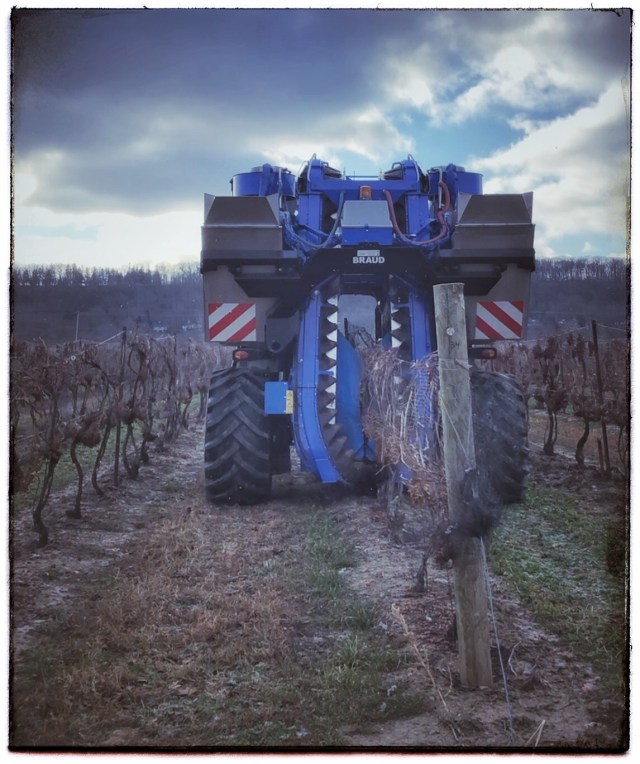
It was cold. It was crisp. And as we exhaled, our breath turned to ice crystals before floating to the ground. It was perfect weather to harvest some ice wine grapes!
And on this bitterly cold morning, I was visiting friends in Niagara during the Ice Wine Festival, and saw several harvesters heading out to a nearby vineyard. If you recall my previous posts on ice wine, you’ll remember that many rigorous standards have to be met to be considered a true Ice wine: It must picked at consistent sub-zero temps, immediately pressed outside in those sub-zero temps to keep the grape temperature (and sugar content) consistent. AND… the frozen grapes should, ideally, be hand-picked since the grapes are extremely delicate. Hand picking is preferred so as to not damage the berries. So how does the machine fit into the picture?
The simple answer is: Volume.
Geographically, the Niagara region produces some of the largest volume of ice wine in North America. Wineries, most notably, Pilliteri Estates Winery in Niagara-on -the-Lake, have to keep up with the ever increasing demand. Therefore, the increase in machine harvest is due to the vast expansion of the number of vineyards that now produce ice wine. Typically, a machine can pick one acre in less than an hour. And it is difficult, especially when it’s cold enough to freeze your nose hairs, to entice people to hand pick grapes at sub-zero temperatures, in the middle of a cold winter’s night.
Timing is everything, and there is a very narrow window of time available to pick, and process ice wine grapes. And while much of the quality control can be done in the vineyard with hand harvest, you run the risk of losing much of your yield because of the considerable amount of time it takes to harvest by hand. Machine is much more efficient to get the grapes from vineyard to press.
The technology itself has dramatically improved. According to Wine Enthusiast, the argument against machines was that the quality of the wine would suffer. In the past, machines would shake the vines so harshly that “material other than grapes (MOG)” would get into the mix.“ That material could include stems, leaves, or birds and small animals.“ To avoid this, innovative technology now allows de-stemming and sorting while on board the harvester, which then makes hand sorting and grading at the winery much easier. MOG is efficiently taken care of.
But what about all that shaking going on with the grapes? Don’t the grapes get damaged? Machine harvesters are now programmable, and can be selectively calibrated to provide a more gentle shake for grapes that need more TLC, and to pick specific grapes rather than “every single grape.”
There is a definite freshness advantage to machine harvest because the grapes are delivered more quickly to the sorting tables and presses. At the winery, ice wine grapes are still sorted and pressed outside, as in the time-honoured tradition.
With respect to this year’s harvest, Pilliteri Estates Winery’s Social Media Rep, [via direct message] stated, “We currently machine harvest all our Icewine now and this year’s yield looks good. We lost about 30% to 40% to birds because of the warm start to winter but the grapes that we pulled in look great and we are looking forward to another excellent Icewine vintage.”
Check out the video below to see the harvester in action! 👇🚜🍇 Hopefully, the sound will work. If not, the pics are pretty!
Is there any real difference in the quality of wine produced after machine harvest?
Most wine producers are finding that there is very little difference in the resulting product whether it’s harvested by human or machine. And when time is of the essence (especially with ice wine), efficiency is everything.
While newer technology has changed the traditions a bit, especially in response to drastic increases in demand, ice wine remains a true luxury item. And, ultimately, it’s in the winery that humans can never be replaced; creating, and fine-tuning the liquid gold vintages that swirl in your glass.🥂
Cheers! 🚜🍇🍷
©️Copyright, TheWineStudent, 2020

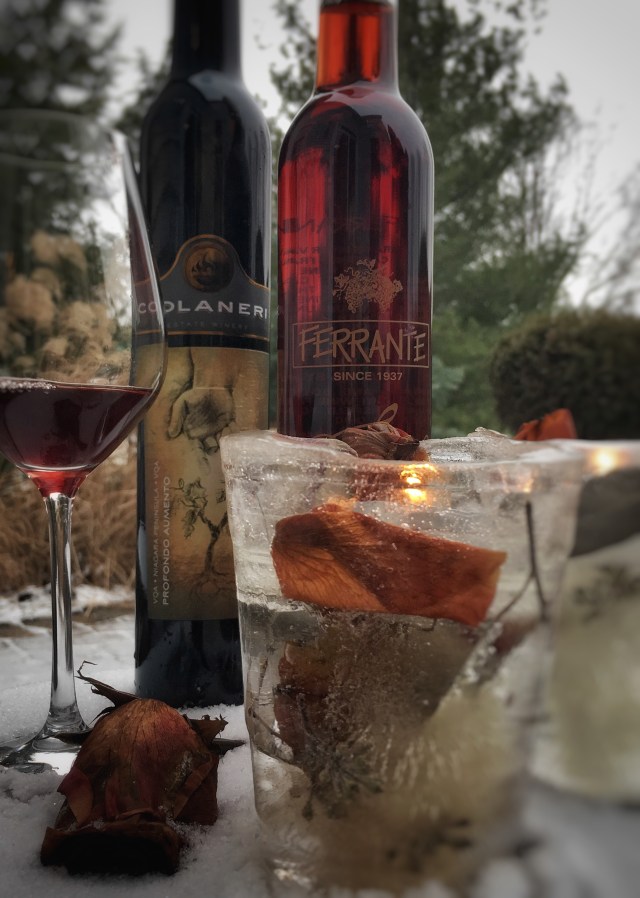 If I can’t make it to the
  chocolate, fruit, and a little Brie as a savory contrast. And as an added treat, our friend, Shelly brought a bottle she’d bought back on our trip to Niagara a couple of years ago, a 2010 Pilliteri Estates Cab Franc Icewine. More yum! It tasted

 The Wine Student