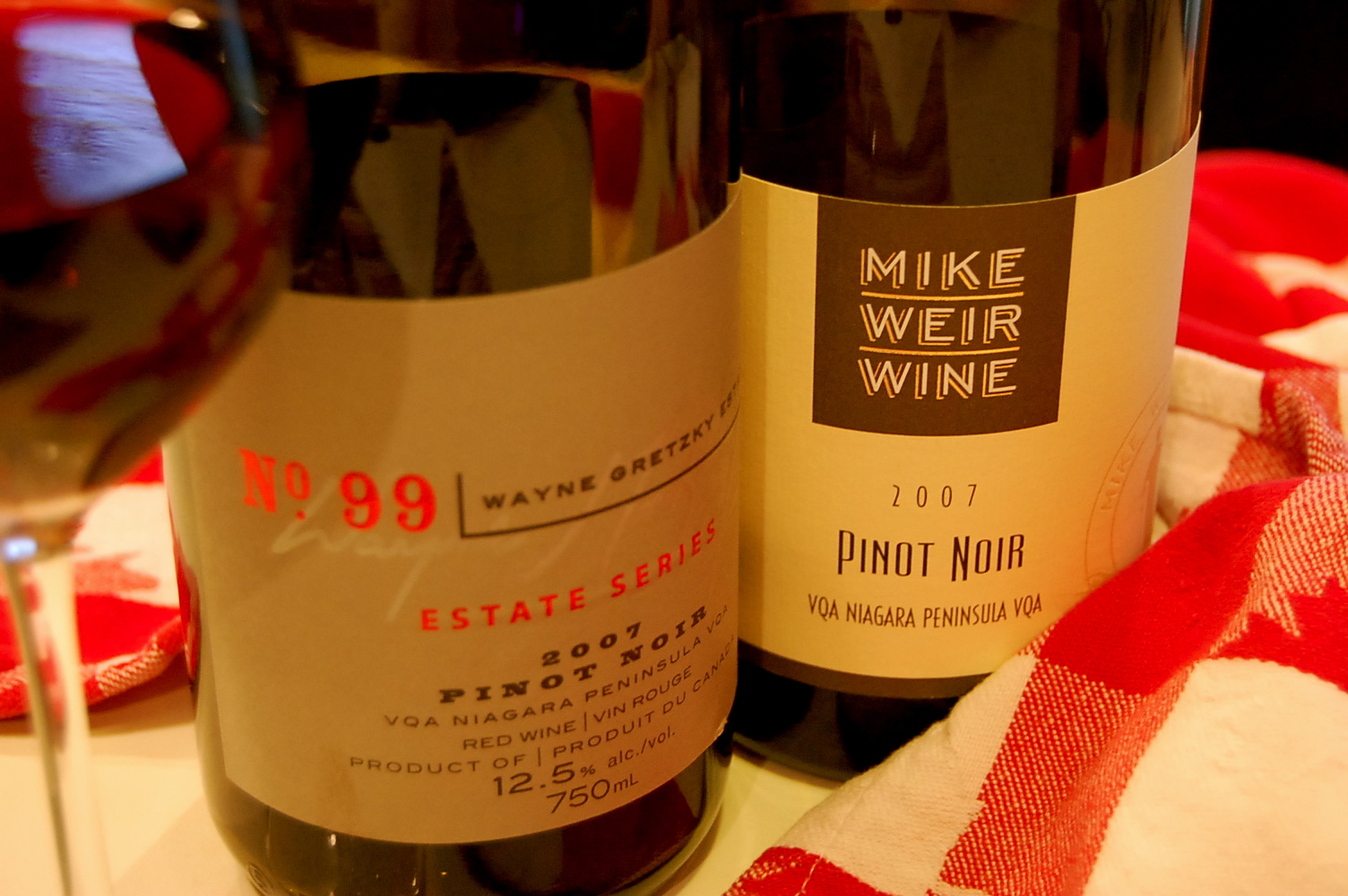
2007 Wayne Gretzky Estate/ Mike Weir Wine Pinot Noir
Last night, I had a little tasting with my friends Judy and Terri and I wanted it to be as unbiased as possible. Since I’m an ex-pat from the Niagara region, I’m partial to many wines from that area, not just the Icewine that it’s noted for. Maybe I’m feeling a little homesick especially since it’s Grape and Wine Festival time. Sigh. I know it’s called ‘The Niagara Wine Festival‘ now, but it’ll always be ‘Grape and Wine’ to me.
For years, I’ve enjoyed the whites and particularly liked what had been coming off the vine from Mike Weir Wine. Having never sampled anything from Wayne Gretzky Estates, I wanted to try something different and compare the two. To keep things on equal footing, I chose the same type and vintage, otherwise it could be like comparing apples to oranges, and not really a fair fight. We poured both through an aerator since we didn’t have time to decant.
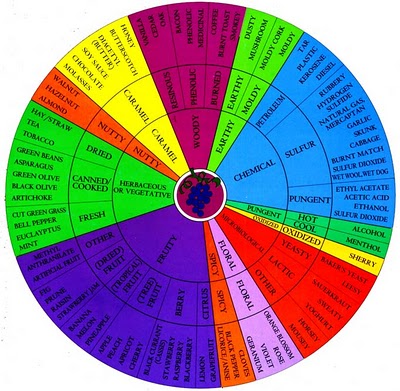
Armed with both the Wine Aroma Wheel and Mouth-feel Wheel, we started with the 2007 Mike Weir Wine Pinot Noir. The color ranged from a burgundy (Terri) to light claret (me) to garnet (Judy). We all agreed that, sadly, there didn’t seem to be much on the nose. As for mouth-feel, it seemed to be a bit thin and watery; as if it could’ve been cellared longer. We found the taste to be more tart berry; Judy thought it had a grippy, alcohol feel. Terri thought it had more of a chemical, bitter feel. She described it as ‘gird-y’: for her, it produced more of a burn-like sensation going down. Overall, it wasn’t bad, it just tasted quite young. I wondered if pairing it with something like Brie and fruit might have brought out more of its depth.
On to the 2007 Wayne Gretzky Estates (Estate Series) Pinot Noir. By comparison, the Gretzky was richer in color; a deep garnet with nice floral notes on the nose. The mouth-feel was warm, satin-y and supple with a viscous, mouth coat texture (yes, ‘mouth coat’ is listed in the wheel). Terri found it had a smoother, softer, fuller texture compared to the Weir. It tasted of rich cherry, sulfur with a light smoky, butter finish, and would probably pair well with a nice filet or roasted chicken. We thought it was a nice wine to drink all on its own, from start to finish.
Looks like, for now, No.99 is still the Great One.
Cheers!


 The Wine Student