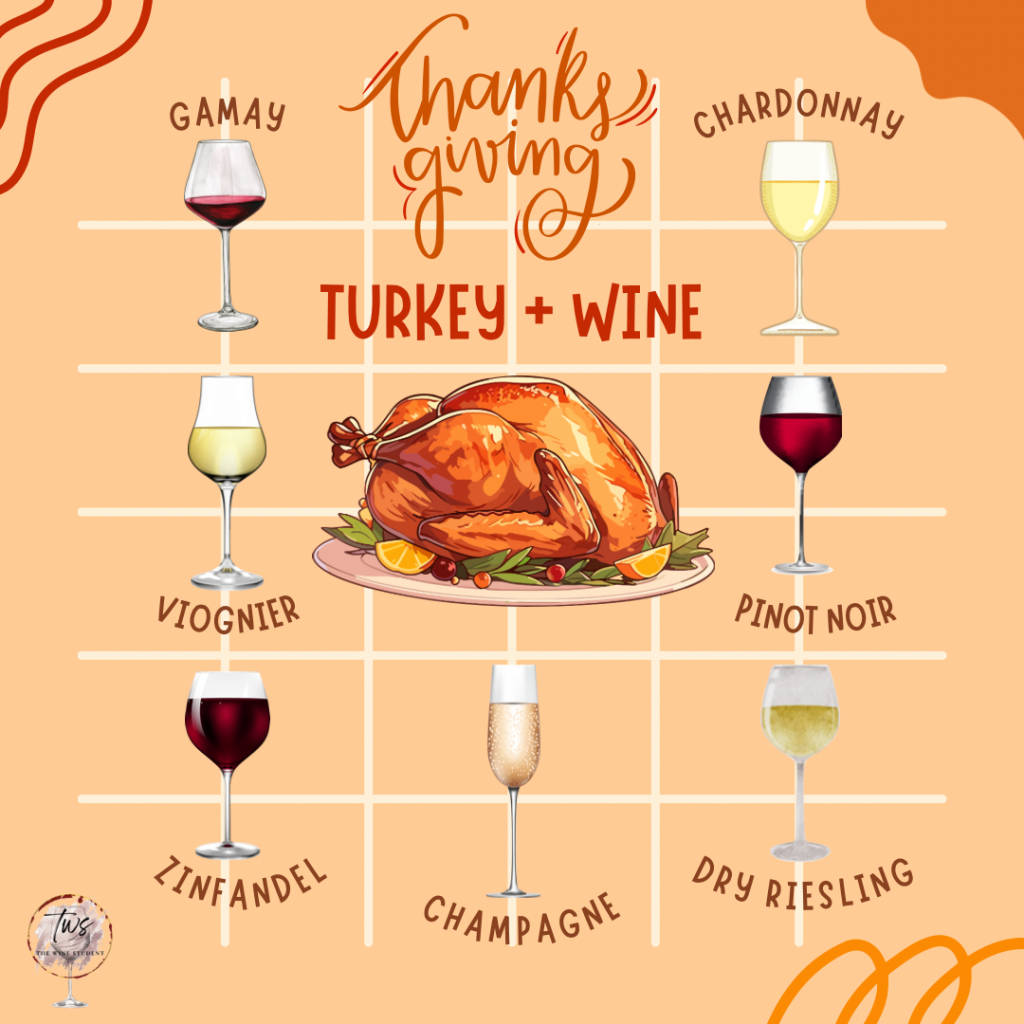
Turkey Time Wine! đŸˇđŸŚƒ

Now I know you’re not going to have just a turkey on your table. But I wanted to keep it simple and spotlight the star of the show (though maybe it’s a featured player, as we all know the real star is you).✨

According to Food and Wine magazine, turkey’s rich flavor profile; light and dark meat, and its juicy texture matches well with a wide variety of wines and traditional side dishes.

Keep in mind that what’s good for the turkey is probably going to be good for the side dishes.

•Dry Riesling– OK… wait a minute, this isn’t the sugar bomb you think it is. Many have the view that riesling always equals cloyingly sweet. But this dry offering is the riesling you never knew you wanted. High acidity and plentiful minerality make this a most agreeable turkey companion.

•Chardonnay – Sometimes chosen because of its name recognition, Chardonnay can be a wonderful pairing with turkey. Crisp acidity, and fuller-bodied vibe make it a pleasure to sip. Old World offerings, particularly from France, are more citrus-forward with a stalwart mineral heart. New World Chards from the US, Australia and South America have a juicier, stone fruit vibe.
Hint: Add a little to the turkey as you baste.

•Gamay – The Beaujolais grape, but skip past the Nouveau and head straight for a more mature offering to enjoy. Pleasant high acid, lo tannin, and a satisfying grippy mouthfeel make this wine one of the best pairings with turkey.

•Pinot Noir – A classic, Pinot Noir’s playful flavors of cherry make this a great pairing for both turkey and your favorite sides. Pinots from France have a grounded, earthy, mushroom-y, tart cherry gravitas where New World Pinots brings forth a brighter complex cherry vibe. 🍒

•Viognier – An excellent, but not as well known match, Viognier’s whispers of honey and rich ripe stone fruit essences are wonderful with the tender turkey. Look for amazing offerings from Northern Rhone, South Africa and Australia.

•Zinfandel – Jammy, juicy and fruit forward, this wine is a boss pairing with both light and dark turkey meat, and many traditional Tgiving sides.
A big hit on turkey day, you might want to splurge and buy a couple of bottles. 😉

•Champagne – Bubbles and high acidity make this wine a merry treat to cut through the richness of the turkey and all side dishes.
And it makes your holiday table scape even more festive and fun! 🥂

When all is said and done, these are simply suggestions to dial back some of the guesswork when picking your wine. In the end, it’s really about sharing time with family and friends. And whatever wine(s) you choose to adorn your Thanksgiving table this year, I hope you have happy and healthy holiday!🧡

Cheers!🍷🦃

©️ Copyright. The Wine Student. 2023

Snug as a Lady Bug🐞

“The Ladybug wears no disguises. She is just what she advertises. A speckled spectacle of spring, A fashion statement on the wing…. A miniature orange kite. A tiny dot-to-dot delight.”- J. Patrick Lewis

During the busy days of summer, it’s easy to forget the little things; a warm evening breeze, toes in the sand, glass of wine in your hand. If the past two years have taught us nothing else, it’s the simple pleasures that we need to pay attention to. Little things sometimes have the biggest impact.

Lady bugs are little, but they are mighty.

Farmers and gardeners love the lady bug. According to ThoughtCo.com, the lady bug (beetle) are beneficial predators who munch on many pests of the garden such as scale insects, whiteflies, mites and especially, aphids. Over the course of a day, a lady bug can scarf down 50 aphids, over a lifetime (about a year), they can consume over 5,000. They really are the ladies who lunch.

Too much of a good thing, though, can become a challenge for growers; an overpopulation can mean that many bugs can snuggle up in the fruit. And this can subsequently taint the wine if they’re not sorted out at pressing.

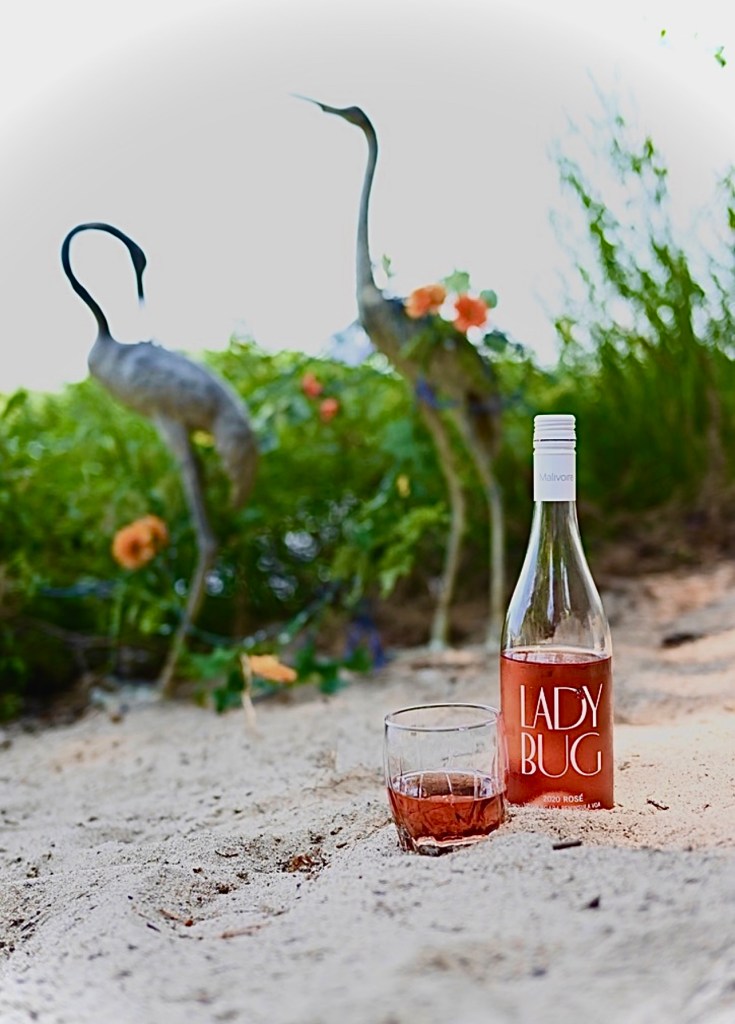
Searching for a nice light wine to pair with my evening chicken stir fry, I discovered this little but mighty gem: 2020 Malivoire Lady Bug. Located in Beamsville, ON, Malivoire is a Certified Sustainable winery. Made from a blend of 56% Cabernet Franc, 36% Gamay, 8% Pinot Noir, and cultivated especially for this wine, the grapes are harvested when sugars are at 19.5 Brix. The crushed grapes then soak in free-run juice ( juice that runs freely out of the tank by gravity) between two and twelve hours before press. After cold-fermentation and stabilization, the wine is transferred to stainless steel tanks to rest before bottling.

This lady bug had a surprising complexity, revealing different layers of flavor with each sip. Many single varietal roses are good but one-dimensional.

Check out the video below for more summer fun!🏖

Some tasting notes for ya!

• bright berry on the nose – flavors of red raspberry, strawberry,

• cherry, pomegranate – nice burst of tart flavor that sparkled down into a tangy tart that lingered on the finish.

• bouncy mouthfeel makes it great to sip on its own yet it paired beautifully with a gently spiced chicken stir fry with jasmine rice.

Recommended pairings:

Lighter meats such as:

• Butter Chicken

• Pork Roast

• Baked Ham

• Charcuterie

• Mussels

• White Bean Salad

•Available at LCBO – $17.99

Whether you’re sipping on a beach or dining al fresco with friends, please enjoy responsibly!

Cheers!🍷

©️Copyright. 2022 The Wine Student

Turkey Lurking

I hope you all had a good Thanksgiving! Mine was crazy busy with lots of family, friends, good food ~ and wine, natch! I spent the better part of today finishing up converting the last of the leftover turkey into something edible and available for a quick heat-up over the next few weeks. I also found myself with a leftover bottle of Beaujolais Nouveau.

We tried a bottle with our Thanksgiving dinner and found it was an interesting choice. And I mean that in all honesty. It was interesting. Not in the way doing the MC Hammer dance at a formal wedding is ‘interesting’ but…intriguing. On the first sip, I found it to be simple and super sweet with a quick flash of bitter that disappeared as as quickly as it emerged. I knew that pairing it with the turkey and cranberry/hot sausage stuffing would be necessary; this wasn’t a stand alone, quaffable wine. I’ve enjoyed Gamay before with turkey and it’s usually a nice, light alternative to other reds; present but not overpowering. But again, this is a superyoung wine. Sipping after the next bite helped increase the berry essence and made it much more pleasant.

Since I can’t keep the bottle for longer than 3-6 months, I’ll have to give it another go pretty soon. I wonder how it will fare with turkey casserole?

Cheers!

Š Heidi Thompson and TheWineStudent, 2012.

Youth in Revolt: Beaujolais Nouveau

DuBeouf and Drouhin 2012 Beaujolais Nouveau

DuBeouf and Drouhin 2012 Beaujolais Nouveau

Tonight, while most of us are our beds quietly dreaming or, if you’re like me ~ drooling on your pillow, cases of Beaujolais Nouveau are being crated up and shipped hundreds of thousands of miles to worldwide destinations. With the release at 12:01am on the third Thursday of November, the frenzy begins to get this extremely young wine to market. The release is highly anticipated and lauded, traditionally, to celebrate the end of harvest.

Beaujolais Nouveau is the result of a quick reap, fast fermentation and whirlwind bottling. Grapes are generally hand-picked helping to ensure that they are the healthiest with unbroken skins. The must is pressed a mere three days post-harvest. It’s hard to think that you’d get any kind of product at all worth drinking. And some would sniff that what you’re getting psyched for is little better than fermented grape soda. Yet Beaujolais can be surprising. Even in a wine so young, it can have some chops. The 2009 vintage, in particular, trashed the reputation that un-aged wine was merde. There’s no denying,  it runs the risk of being severely compromised by less than subtle chaptalization, and a hurried process to get the product out to consumers. Sometimes, satisfying the masses with high quantities of wine can negatively effect the quality of the wine. That said, I predict many will jump on the Beaujolais party train this weekend, quaff thoroughly and not particularly care about how quickly it took to produce.

Beaujolais is produced from the Gamay varietal; a cross between a Pinot Noir and Gouais, a white from Central Europe. It thrives in the granite laden, acidic soils of Beaujolais. In the days of old, Beaujolais celebrations were local events until the French government found out and wanted to end the party at 11 by putting restrictions in place in 1938.  By 1951, the restrictions were revoked by the Union Interprofessional des Vins de Beaujolais (UIVB) who instituted a November 15th release date. In 1985, the date was changed to the third Thursday of November, which ties it to the weekend ~ thus only ending the party when the police show up to take you in for a drunk and disorderly.

There are four premier types of Beaujolais:

Nouveau/Primeau ~ the youngest of the Beaus ~ very fruit forward with a cherry-berry-floral vibe that should be served lightly chilled and within 6 months of release.

Villages ~ This one can be  has more spice/pepper on the palate and can be cellared between 2-3 years.

Blanc ~ The tall blonde from the North Beaujolais district, it gets its depth from 3 types of soil: granitic, siliceous-clay, limestone-clay. Also an early drinkable.

Cru ~ From one of the finest regions of Beaujolais, it is the creme de la creme. It has the highest character and complexity and can be cellared the longest. Jancis Robinson has said that she enjoyed one that had been cellared 40 years. Cru can be confusing because it seldom says Beaujolais on the label. To find Cru, you’ll be looking for Broully, Chiroubles, Fleurie, St~Amour, to name just a few. Most Beaujolais is produced by Georges DuBoeuf who distribute much of the 65 million bottles that will hit the shelves in 24 hours time. Although, according to Randy Ruitenberg( via Bloomberg Businessweek), this year’s production of Beaujolais and Champagne will be down about 20% due to weather damage and disease.

So what does it taste like? Since there is so little time between harvest, press, bottling and pour into your glass, it will be fruit forward with very little tannin; simple and relatively immature. It pairs very well with lighter fare such as turkey, so is an ideal choice for a traditional Thanksgiving dinner. Many liken a mature Beaujolais to a Pinot Noir, which makes sense. If you like big, beefy, tannic reds, you might want to pass. However, it’s a great transitional choice for white wine drinkers who want to try a reds but are intimidated by the heavy duty varietals.

I’m all set to try my 2012 vintage. I bought a DuBoeuf and a Joseph Drouhin to compare. And I’ll let you know whether they can hold their own against my roast turkey with all the trimmings.

Cheers!

O Tannin Bomb

At dinner with friends the other night, the subject of tannic wine came up. “Tantric wine?” I asked, “That sounds like fun!” I thought it meant we’d just take a really, really, really long time to enjoy a bottle of red. I’ve been to tastings, seminars and parties where one will take a sip and proclaim that the wine is very tannic. But what does that even mean?

The term tannin comes from the long time practice of using plant extracts to ‘cure’ leather. In winemaking, tannins are compounds that bind to proteins ~ proteins that exist both in other chemical components of  wine as well as the salivary proteins within the mouth. This is a very basic description of a very complex process but you get the idea. This complexity is also what makes studying tannin quite difficult as these bonds break and reform several times before the nectar ever comes close to hitting your belly.

You can liken wine tannin to steeping tea ~ look at 4 cups of tea in various stages of brew. The first one is after a few moments, the next after 3 minutes, next after 5 and after 8-10. You’ll notice significant differences in how the tea looks (light to tar-like) and tastes (weak to very strong). A wine high in tannin will look darker and taste stronger.

There are two classes of tannins: one coming from the oak barrels the wine is aged in and grape-derived.

Green and Mean ~

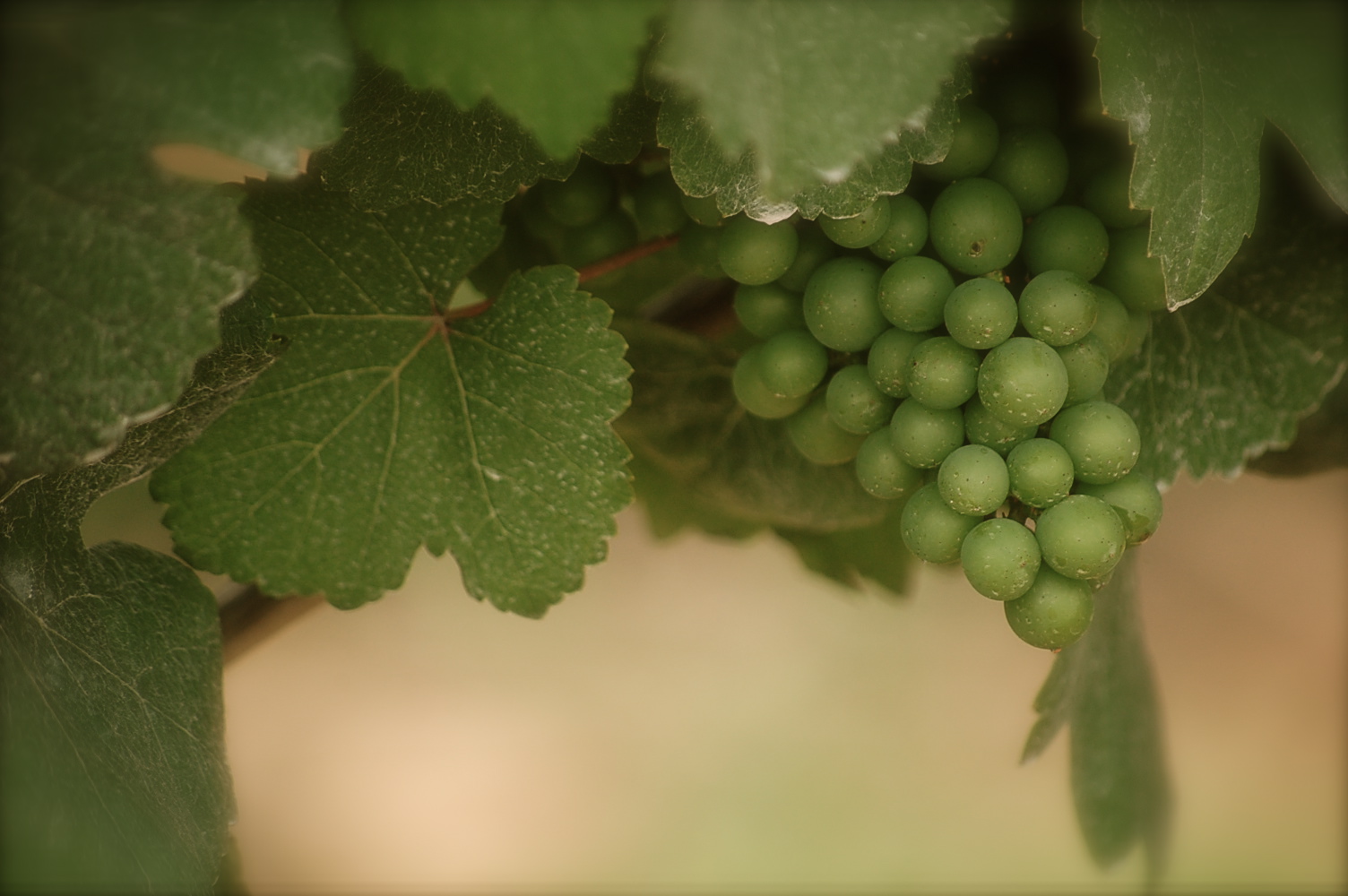
In nature, tannins serve as a kind of defense for the plant. It gives plants an unpleasant taste, discouraging animals from consuming them, allowing them to grow to maturity. Grapes begin tiny and  green in order to match the new stems and are extremely bitter ~ it also keeps the birds from dining too soon. These berries are where the developing seeds are housed, undisturbed until they go to college, hit a few keg parties and then graduate to become adult grapes. When birds consume the mature grapes, they eventually deposit the digested seeds and re-propagation of grapes begins anew. Unless of course the deposits end up on your car. Since the seeds also contribute a great deal of tannin to red wine, they can have a very nasty effect if they are unripe.

 Bitter is the New…Bitter ~

Here we can pull out our trusty mouthfeel wheel. Tannins contribute to both astringency and bitterness; with bitterness being sensed by taste bud receptors located on the very back of the tongue and soft palate.

Rather than being able to smell tannins, it’s more of how it feels on your tongue. Astringency is the feeling because the tannins bind with proteins in saliva, thereby increasing the friction between the mouth surfaces leading to a sensation of dryness or roughness. On the wheel, you might see words like furry, cottony or wooly ~ that’s what astringent ‘feels’ like.

Style meets Substance ~

Light ~ lighter in color and on the palate , thin consistency. Good examples: Gamay, Beaujolais Nouveau

Medium ~ a little more tannin, is richer on the palate and is  not as beefy.  Good examples: Merlot, Pinot Noir, Shiraz

Full ~   has the highest tannin content, more pucker on the palate,  creamy consistency with usually a higher alcohol content. Good example: Cabernet Sauvignon

With high tannic wines, what you see will generally be what you get. You’ll find wines rich in color; deep ruby or claret, purple and maroon.

For many who enjoy wine, tannin really isn’t an issue unless it adversely affects the taste. Choosing wines that have high or low tannin depends entirely on your preference. Just make sure you take a really, really long time to enjoy them.

Cheers!