My Wild Irish Wine šŸ·šŸ€šŸ§šŸ»ā€ā™€ļø

With the luck o’ the Irish at yer back, may you find health, happiness and a pot of gold. Okay, that’s not really a blessing but a mashup of a few.

St. Patrick’s Day is a sure sign that spring is on its way. And spring is often viewed as a season of magic and alchemy. Wine is also a blend of magic and alchemy. Especially Irish wine.

Growing conditions in the Emerald Isle can pose many challenges to winemaking. And that’s where the magic comes in.

I first wrote about my quest for the 2015 Lusca Cab/Merlot in 2018 so this is a bit of a fun throwback.

Established in 2002 by fruit alchemist David LLewellyn, Lusca cultivates several varieties of grapes including Cabernet Sauvignon Merlot, Dunkelfelder and Rondo – a grape that can heartily withstand Ireland’s damp, misty weather.

Click the video to learn more about Irish wine and how its made!šŸ‘‡šŸ€

A few years ago I was determined to find my little pot of gold, and I did. To read more about my search click here. Since then this lucky bottle has remained, relatively undisturbed, in my little cellar wine fridge. I hope it’s been enough to ensure its good condition. All told, it has aged about 9 years. I had many thoughts before opening: has it already peaked? Is it a delightful vinegar? But maybe luck would be on my side.

There was only one way to find out…

Time to release the wine!

To be safe, I decanted for about 2 hours. I wanted to let it open up as fully as possible to make a fair assessment. So how was it?

It didn’t turn to vinegar! I wasn’t as concerned about the wine as my storage. I don’t have a fancy wine cellar, and occasionally had to move the bottle around. I had been worried that after all this time, maybe some oxygen had gotten inside. But I was so happy that all seemed to be well. Magic!

It was a lighter bodied Cab/Merlot. I enjoyed delicate notes of blackberry, dried herbs, and a pleasant, earthy cedar undercurrent. I found myself swirling my glass often to coax out every essence. It had a clear, deep ruby color giving way to a slight brownish rim variation (the outer edge of the wine). This suggests aging of the wine. I didn’t notice any nutty or toffee flavors that indicate an oxidized wine.

As I tasted, I noticed the sun was shining – here in the Cleve we catch it while we can- so I bundled up, sipped my glass outside.

To find out more or to order a bottle visit: The Celtic Whiskey Shop & Wines on the Green. They are super friendly and helpful.

I send you all the blessings to have a safe, fun and magical St. Patrick’s Day! ✨

SlĆ”inte!šŸ·šŸ€

Yes•No•Maybe: My Top Wine Picks for Valentine’s! šŸ·šŸ’ŒšŸ·

On the hunt for Valentine’s wines, I naturally look for fun label art. It’s something I’ve grown accustomed to over the past few years. Each season, I’d find a few to choose from that were on display, (and sometimes on special) to celebrate the lovey holiday. This year seemed a bit, well … skimpy on the label art front.

So I had to really search for wines that caught my eye, and would be a good choice in the glass. I found…two.

And with that, I did a little tasting with HubbyDoug to find our best match. Kind of like ā€˜The Dating Game’ but with wine. Getting out our Wine Aroma | Flavor Wheel, we were going to attempt educated assessments in our sampling (as opposed to just saying, ā€œYep, that’s good!ā€). We’ll see who gets a yes, a no, or a maybe.

Check out the fun slow jam video below for some more info about these wines! šŸ‘‡šŸ·

Prophecy 2015 Red Blend ~ I loved the beautifully romantic label but damned if I can tell you what’s in it. Any research led me nowhere about the specific varietals in the bottle. I can tell you that it is a conscious coupling of grapes from both Washington State and California, which is a good start.

Spinning the flavor wheel, here’s what we found:

•Color: Deep Purple

•Nose: vanilla caramel vibe

•Flavors: dark chocolate cherry w/ a pleasant whisper of smoky tobacco on the finish.

•Mouthfeel: Creamy smooth,

•Price point $10.99- $14.99. We found this was a little drier than the Intrinsic. But that was ok. And with gorgeous label art from Victo Ngai, it’s a… yes!

Intrinsic 2016 Cabernet Sauvignon ~ 96% Cab Sauv and 4% Cab Franc. Produced in Columbia Valley, WA, this wine is fermented for a limited time in concrete tanks, which give a mineral character to the wine, then transferred to barrel where it’s aged 12 months. When Dougie found out it was a Cab, he gave the eye roll (he likes Cab only slightly better than Merlot). But here’s what we discovered:

  • • Color: Bright Ruby
  • • Aroma: Pepper, Stewed Plum
  • • Flavors: Black Currant Jam, hints of Leather w/ a pleasant sweetbitter finish
  • • Mouthfeel: Velvety, Silky
  • • Price point: $22.99

The big feature for us was that it seemed like a Cab with Pinot envy; lighter with delicate flavors – not so ā€˜in-your-face’ as some Cabs have a tendency to be. So that was a nice surprise for our Pinot fan. We have another… yes!

For Valentine’s fun here are two wines that are as nice on the inside as they are on the outside. And, really, isn’t that what we want from a Valentine’s date? ā¤ļø

Happy Valentine’s Day! šŸ’ŒšŸ’‹

Cheers!šŸ·

Ā©ļøCopyright, TheWineStudent, 2020

O Tannin Bomb

At dinner with friends the other night, the subject of tannic wine came up. ā€œTantric wine?ā€ I asked, ā€œThat sounds like fun!ā€ I thought it meant we’d just take a really, really, really long time to enjoy a bottle of red. I’ve been to tastings, seminars and parties where one will take a sip and proclaim that the wine is very tannic. But what does that even mean?

The term tannin comes from the long time practice of using plant extracts to ā€˜cure’ leather. In winemaking, tannins are compounds that bind to proteins ~ proteins that exist both in other chemical components ofĀ  wine as well as the salivary proteins within the mouth. This is a very basic description of a very complex process but you get the idea. This complexity is also what makes studying tannin quite difficult as these bonds break and reform several times before the nectar ever comes close to hitting your belly.

You can liken wine tannin to steeping tea ~ look at 4 cups of tea in various stages of brew. The first one is after a few moments, the next after 3 minutes, next after 5 and after 8-10. You’ll notice significant differences in how the tea looks (light to tar-like) and tastes (weak to very strong). A wine high in tannin will look darker and taste stronger.

There are two classes of tannins: one coming from the oak barrels the wine is aged in and grape-derived.

Green and Mean ~

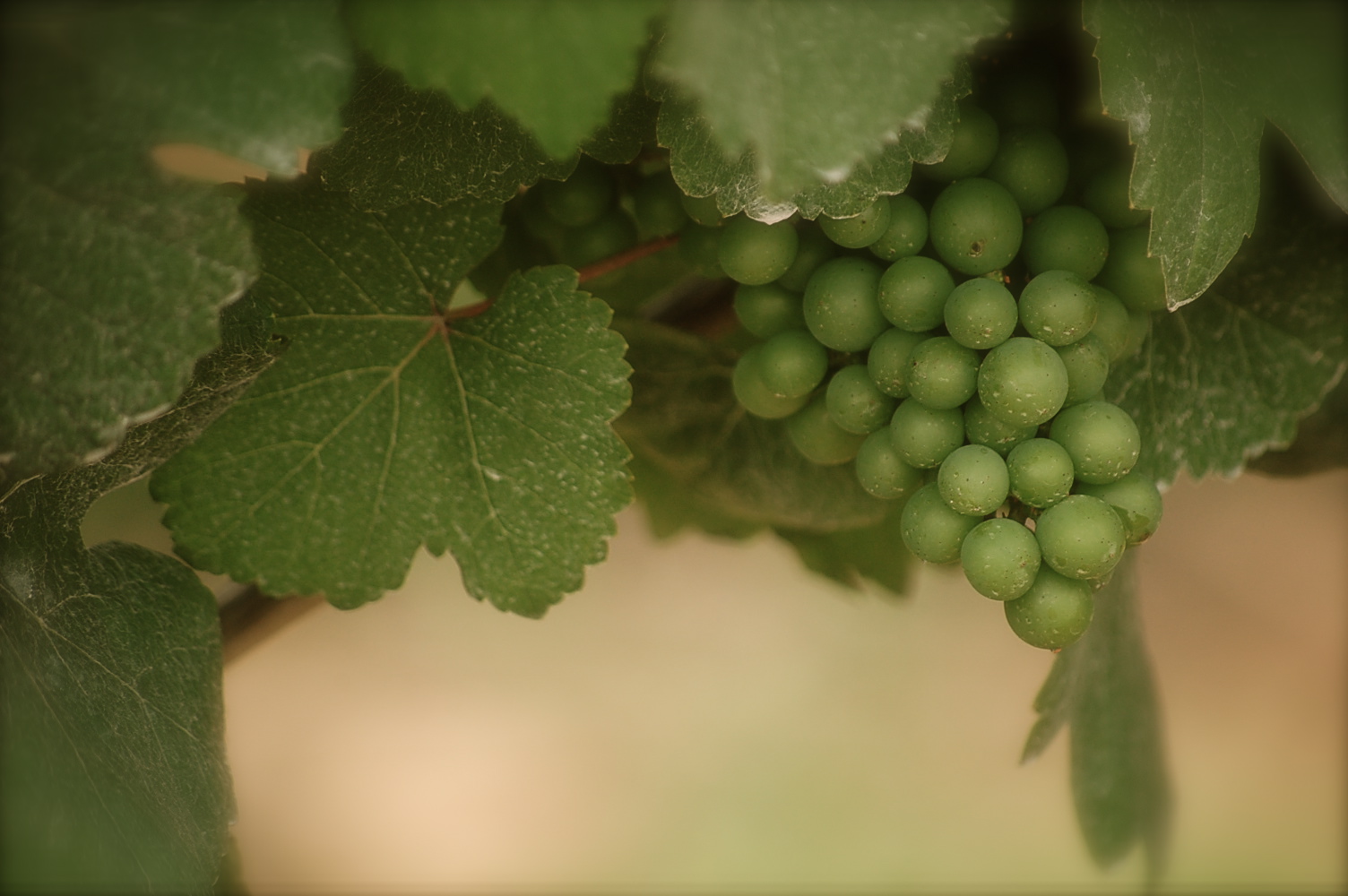
In nature, tannins serve as a kind of defense for the plant. It gives plants an unpleasant taste, discouraging animals from consuming them, allowing them to grow to maturity. Grapes begin tiny andĀ  green in order to match the new stems and are extremely bitter ~ it also keeps the birds from dining too soon. These berries are where the developing seeds are housed, undisturbed until they go to college, hit a few keg parties and then graduate to become adult grapes. When birds consume the mature grapes, they eventually deposit the digested seeds and re-propagation of grapes begins anew. Unless of course the deposits end up on your car.Ā Since the seeds also contribute a great deal of tannin to red wine, they can have a very nasty effect if they are unripe.

Ā Bitter is the New…Bitter ~

Here we can pull out our trusty mouthfeel wheel. Tannins contribute to both astringency and bitterness; with bitterness being sensed by taste bud receptors located on the very back of the tongue and soft palate.

Rather than being able to smell tannins, it’s more of how it feels on your tongue. Astringency is the feeling because the tannins bind with proteins in saliva, thereby increasing the friction between the mouth surfaces leading to a sensation of dryness or roughness. On the wheel, you might see words like furry, cottony or wooly ~ that’s what astringent ā€˜feels’ like.

Style meets Substance ~

Light ~ lighter in color and on the palate , thin consistency. Good examples: Gamay, Beaujolais Nouveau

Medium ~ a little more tannin, is richer on the palate and is Ā not as beefy. Ā Good examples: Merlot, Pinot Noir, Shiraz

Full ~ Ā  has the highest tannin content, more pucker on the palate, Ā creamy consistency with usually a higher alcohol content. Good example: Cabernet Sauvignon

With high tannic wines, what you see will generally be what you get. You’ll find wines rich in color; deep ruby or claret, purple and maroon.

For many who enjoy wine, tannin really isn’t an issue unless it adversely affects the taste. Choosing wines that have high or low tannin depends entirely on your preference. Just make sure you take a really, really long time to enjoy them.

Cheers!

Cool Yule

Tonight, I’m off to visit friends for a Christmas dinner party and I wasn’t sure what wine to bring. I don’t really know what’s on the menu, and I didn’t know how to ask without sounding wrong somehow.
I want to bring something nice and friendly; not too sweet but not too bombastic, either. Since I’m still learning, and haven’t accrued the knowledge yet to blindly pick a winner, I’ve narrowed it down to two: an 09 Santa Cristina Sangiovese and an 08 Cloudline Pinot Noir. This Sangiovese is blended with 10% Merlot and 5% Cab Sauv, and that’s interesting to me, but the Cloudline boasts that it is “rich, charming and harmonious.” Who wouldn’t want to take that to a dinner party?
I dunno. I’ve been puzzling and puzzling…and now my puzzler is tired.
Oh what the hell, I’ll bring them both. And I’ll let you know how they were.
Cheers!

Hell’s Bells ~ AC/DC launches collection of… fine wines?

Ā AC/DC, my favorite metal band, is set to launch a new collection of wines with Warburn Estate, an Australian winemaker. I have to admit when I think of fine wines, AC/DC doesn’t immediately jump into my head but their varietal names are pretty cool: ā€˜Highway to Hell’ Cabernet Sauvignon, ā€˜You Shook Me All Night Long’ Moscato, ā€˜Hell’s Bells’ Sauvignon Blanc and ā€˜Back in Black’ Shiraz.

Brian and Angus in Toronto. (QMI AGENCY).

Brian and Angus in Toronto. (QMI AGENCY).

That said, the names might be catchy, and the artwork totally righteous (although I haven’t seen it yet), the real proof will be what’s in the bottle. I’ve tried some celebrity wines in the past only to be a little disappointed with what ended up in my glass.

Warburn EstateĀ is an independent, family-owned winery that started in the 1950’s, so it’s a good bet that they know a few things about producing a quality product. They also seem to beĀ  very clear about their approach: that wine is for drinking. Sounds good to me. I can throw on my ‘Dirty Deeds Done Dirt Cheap’ vinyl, pop open a ‘Highway to Hell’ Cab Sauv and see whether it shakes me all night long.

The AC/DC collection of wines launch in Australia at the end of this month and should hit our fair shores in the US by the end of the year.

Cheers! Ā http://nyp.st/oFTexJĀ 

I just found a picture of the bottles:

AC/DC Fine Wines (Warburn Estate)

AC/DC Fine Wines (Warburn Estate)