Field Trip ~ Colaneri Estate Winery, Niagara.on.the.Lake ON

@ Colaneri Estate Winery

@ Colaneri Estate Winery

One of the things I love about going home to Niagara for the holidays; apart from seeing family and friends, is picking a new winery to try. Since I left almost 5 years ago, there has been an explosion of great wineries with something to please every palate.

When HubbyDoug and I were walking the main street we slipped into a little bar for a glass to take away the chill. We were treated to a Colaneri Estate Winery ’09 Cabernet Corposo. I noticed a distinctive richness and old world vibe from the very first sip. To be honest, my experience with many Niagara reds has been somewhat disappointing. They have a tendency towards a lightness and a green, vegetal quality that I don’t always care for. While they eventually settle into a pleasant flavor, it’s generally when you get to the bottom of the glass. I like a red to look me in the eye as it gently takes me by the collar and eases me back into my chair. This wine winked as it looked me in the eye.

I had to find out what made it so unique. A trip to the winery became my top priority.

Colaneri wines are made using an appassimento process that dates back to ancient Roman times. Harvested grapes are hung to dry before winemaking, to remove any excess water, thus shriveling the grapes. And why would you want this kind of shrinkage? All the better to concentrate the sugars and flavors in the resulting wine.

  • Recioto ~ also an ancient style of winemaking and also incorpporating the drying of grapes to concentrate the sugar content. Recioto may be red or white, dry or sweet. The dryer wines in this style are Amarone which can be intense at 16% alcohol.
  • Ripasso is a style that means to revisit or go over. It involves a double fermentation process in which additional dried grape skins are added. The sugar content has been heightened by drying and this increases the final alcohol and phenolic content in the wine which is known as passito.

Our winery guide, Pam, explained that Colaneri was one of only three Niagara region wineries to use this process. Their wines are kiln-dried, using both greenhouses with industrial fans and tobacco kilns. ”Since the kilns were no longer being used to dry tobacco, they have been put to use in winemaking”, she said. In the tobacco kilns, the fans push air up through the floor; where the greenhouse fans circulate the air around the fruit. The drying process can take up to two months with skin contact completed within 7-10 days.

After harvest, the grapes for Amarone and Recioto are set aside to dry in trays in kilns, or are hung in lofts ~ the hanging and careful placement in trays allows for complete air circulation so no mold develops. There they stay for approximately four months after which the semidried grapes are crushed and fermented with the grape skins. The grapes not used for Amarone or Recioto are crushed and fermented to be used later.

Once prolonged skin contact has finished, the wine is stored for aging. The additional wine (that had been fermented seperately) is introduced by being pumped over the Amarone | Recioto skins, thus starting the second fermentation. The saturated skins are still quite full of unfermented sugars, making them high in aromatics and tannins.

It was time to began our tasting with a spectrum of lighter fare: Pinot Grigio, Sauvignon Blanc, Gewurtztraminer, Chenin Blanc. The Chenin Blanc was my favorite; it had a taste of pear, pineapple and cotton candy (yum) with lots of citrus on the nose. Pam then took us into the reds starting the Red Blend ~ a combination of Cab Sav, Syrah, Merlot, Cab Franc and Petit Verdot. She mentioned that it was their everyday wine that pairs well with everything from pizza to red meats to chocolate.

We then turned our attention to the Cabernet that we had enjoyed the day before. The scent of rich molasses was prominent on the nose with sweet tobacco, blackberry and raspberry resonating on the palate. Awesome.

The Cabernet Franc was rich and flavorful, with an distinct essence of plum. Pam mentioned that some who tried it but don’t enjoy prunes/plums weren’t always fans. She recommended pairing with tomato-y dishes to counterbalance the prune essence.

We spend a good part of the afternoon sipping and learning a lot about some very special wines. Pam was friendly, knowledgeable and made the field trip to Colaneri so much fun.

I came away from the trip feeling happy to have discovered a jewel of a Niagara wine. I’ll make a point to look for more wines created using this time-honored method.

Cheers!

©TheWineStudent, 2013

Shhhhh!

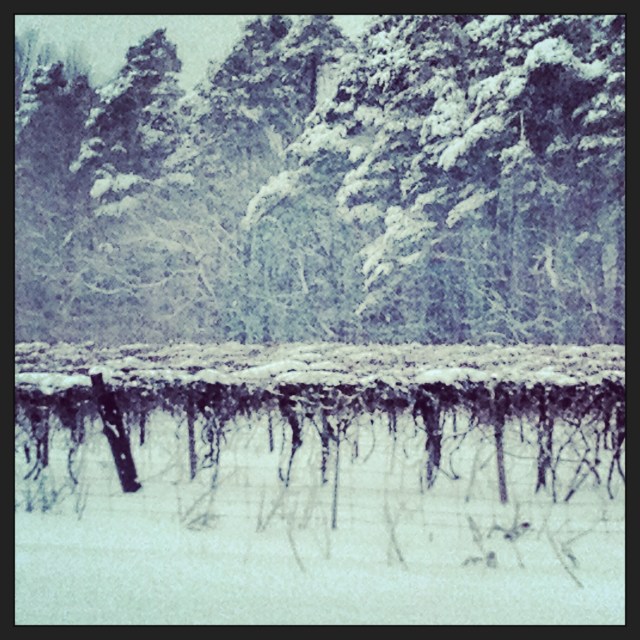
New Years Day: A time for  the making of resolutions and gentle reflection on the year that was. Who am I kidding? It’s a time to sleep and walk around in your jams, drink an awful lot of water and reflect on the night that was. If you’re a grape vine, you’ll be doing some of that today. While you won’t be trying to remember who you kissed at midnight, you’ll probably be sleeping ~ deeply. Your jams will be extra soil or straw, and your water will be the snow accumulating around you.

In the weeks prior to winter, grape vines prepare themselves for the approaching icy blast by ‘hardening off‘.  This is where the shoot of the vines begin to harden up, turn brown and shut their processes down after retrieving/storing nutrients they’ll need for the coming dormant months. The plants goes into energy conservation mode to keep itself intact. A good portion of pruning occurs at this time to get the plant set for the spring and the next growing cycle. If the vines are not properly prepared and pruned through the dormant winter months, the next harvest might be seriously compromised.

So if you’re driving past vineyards this winter, go quietly. You don’t want to disturb what might become your next great bottle.

Cheers!

©2013TheWineStudent

Happy New Year!

Happy New Year!

Happy New Year!

It’s been another busy holiday season! I’ve had a great time visiting friends, family and enjoying the opportunity to taste some fantastic new wine. I’ve been working on some posts for the new year, and have felt much more energized by the past few days.

I want to wish you all a very Happy New Year and I hope that your 2013 is full of good things, wonderful friends and great wine.

Cheers!

Cool Yule

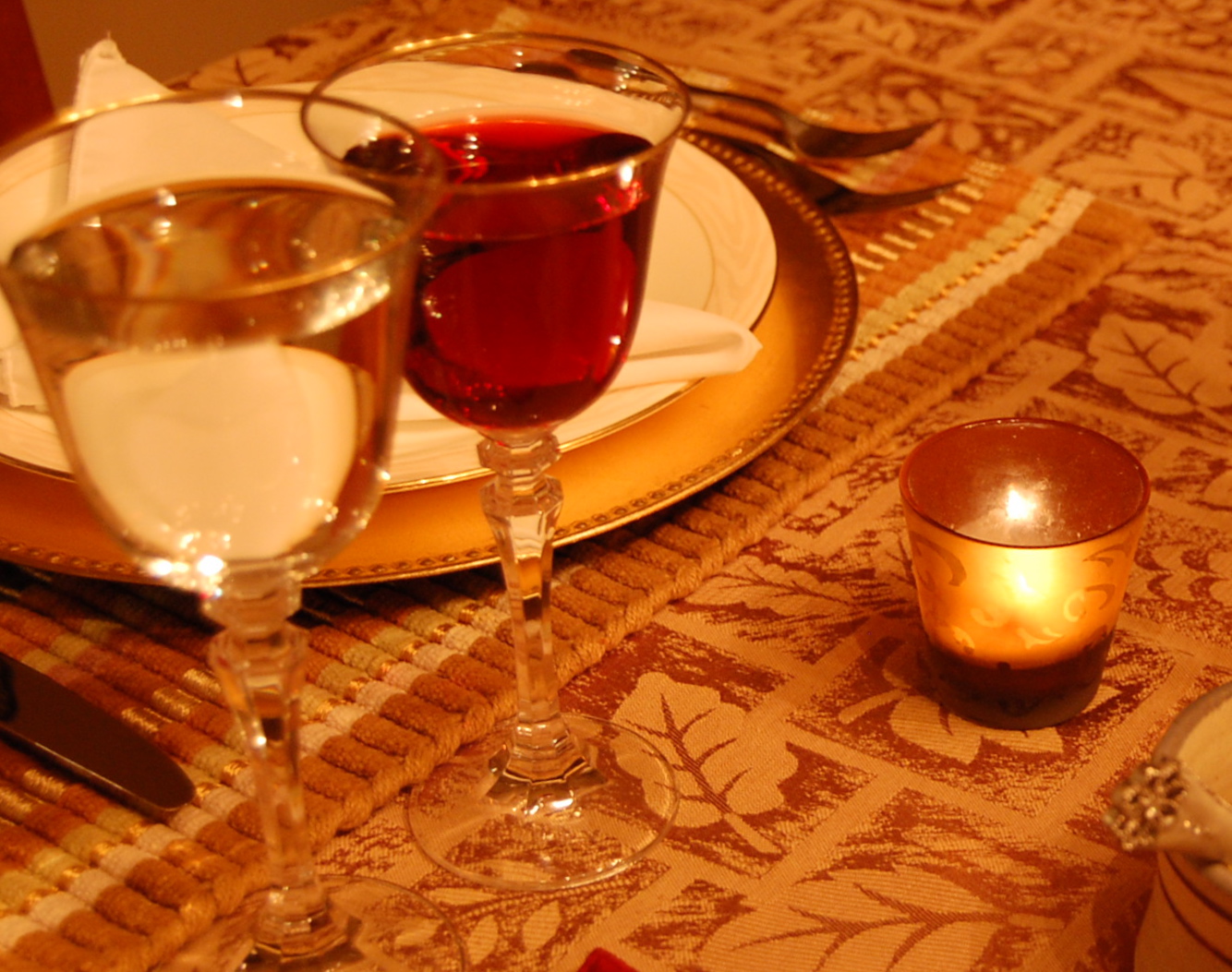
It’s Christmas Eve! And this year I’m giving a nod to my Canadian roots by making a traditional homemade Tortiere. Since it’s a pie that combines both ground beef and pork, I had to think about the type of wine I wanted to pair it with. We’re also going to have steamed crab and caramelized brussels sprouts, so there are going to be a few taste sensations going on. To my way of thinking, ground beef isn’t heavy enough to warrant cracking a brawny Cabernet. And coupling it with the ground pork would steer me to a lighter but flavourful Pinot. Throw the crab into the mix and you see my dilemma. Some might say that Chardonnay would be de rigueur.

I’m generally not one to stick to the rules so I looked at our little collection and chose…an 07 Chateau Bianca Pinot Noir from Willamette Valley. It was a thoughtful gift from our friend Jeff and 07 was a good year for Pinot in the valley. I have a difficult time drinking white wine this time of year. And it may be because I associate whites with summer (narrow-minded, I know). Or maybe there’s enough white on the ground without it being in my glass.

I want to take this time to wish you all a very Merry Christmas! I hope that you are able to gather close to those you love and share the joy of the season.  And if there are those you love who have left for more heavenly places, I’ll join you in raising a glass to them.

Cheers!

Wine and Dine

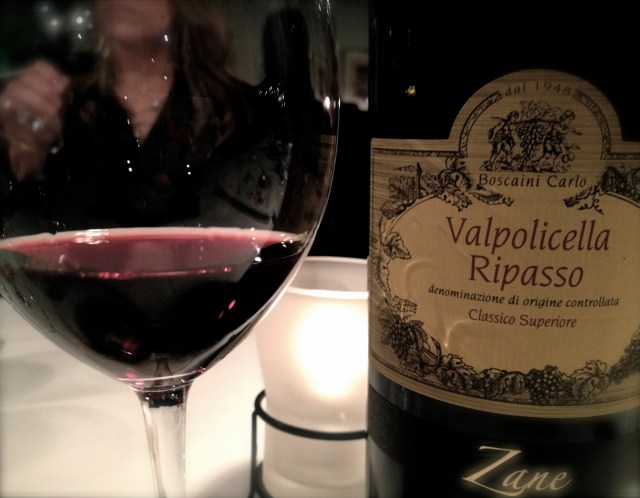
It’s holiday time and there’s nothing better than celebrating with a dinner out with good friends. Our pick for the night was a lively Boscaini Carlo Valpolicella Ripasso. While it was somewhat astringent on the nose, it had a hint of something…but what exactly was it? Our friend, Nick, nailed it: Anise ~ similar to black licorice, though not as heavy. The first taste was of a bold, black cherry that gradually swirled into a delicate chocolate finish. It provided a smooth, mellow compliment to my steak and crab cake entree.

I love the holidays. They give everyone a great opportunity to slow down, enjoy a few moments together and create new memories to savor. In light of the most recent tragic events, this becomes even more important. And if you can include a great bottle of wine, so much the better.

Cheers!

Turkey Lurking

I hope you all had a good Thanksgiving! Mine was crazy busy with lots of family, friends, good food ~ and wine, natch! I spent the better part of today finishing up converting the last of the leftover turkey into something edible and available for a quick heat-up over the next few weeks. I also found myself with a leftover bottle of Beaujolais Nouveau.

We tried a bottle with our Thanksgiving dinner and found it was an interesting choice. And I mean that in all honesty. It was interesting. Not in the way doing the MC Hammer dance at a formal wedding is ‘interesting’ but…intriguing. On the first sip, I found it to be simple and super sweet with a quick flash of bitter that disappeared as as quickly as it emerged. I knew that pairing it with the turkey and cranberry/hot sausage stuffing would be necessary; this wasn’t a stand alone, quaffable wine. I’ve enjoyed Gamay before with turkey and it’s usually a nice, light alternative to other reds; present but not overpowering. But again, this is a superyoung wine. Sipping after the next bite helped increase the berry essence and made it much more pleasant.

Since I can’t keep the bottle for longer than 3-6 months, I’ll have to give it another go pretty soon. I wonder how it will fare with turkey casserole?

Cheers!

© Heidi Thompson and TheWineStudent, 2012.

Spending an Evening with an Icon

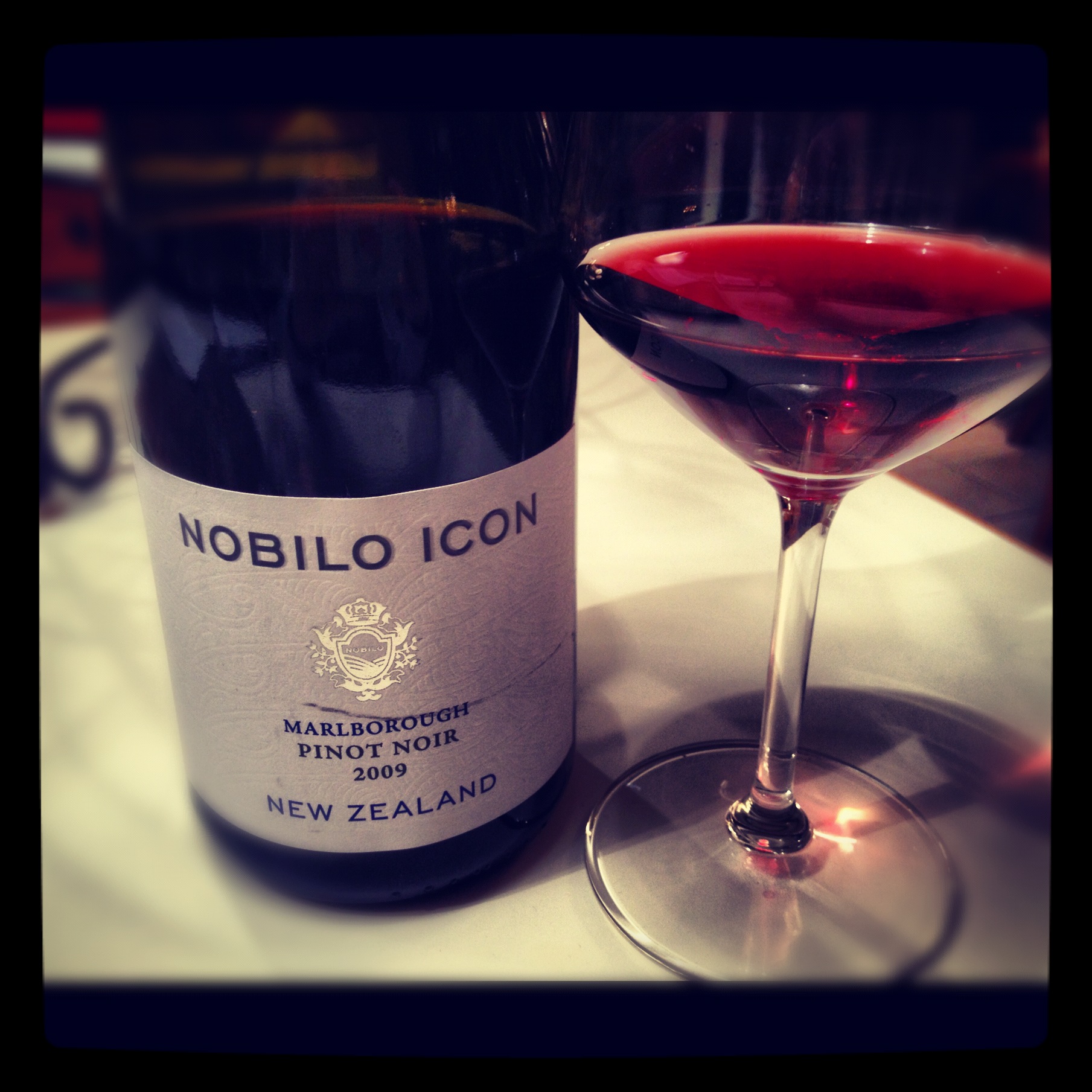
I was celebrating the end of an amazing day in the Cleve. It was sunny, warm and beautiful. As I came in from my late afternoon walk I happened to look up at the treeline, just as the sun’s last rays reflected burnt orange off the remaining leaves. I knew it was a day I might not see again for quite some time. So to shake off the chill and toast the day, I decided to do a random pick from my wine rack. I chose a 2010 Nobilo Icon Pinot Noir from New Zealand.

It was a bit lighter on the nose with subtle vanilla notes that I had sniff a few times to really define. It was like when you know what a scent is but can’t quite place it. The color was a bright claret but the most interesting thing was the lingering essence that I’ve never experienced before: Licorice. And it wasn’t something that I really became aware of until about halfway through the first glass. The licorice vibe provided a really pleasing warmth and gave a little more zest to the wine experience.

I thought it was a great little find to celebrate the remains of a great little day.

Cheers!


Youth in Revolt: Beaujolais Nouveau

DuBeouf and Drouhin 2012 Beaujolais Nouveau

DuBeouf and Drouhin 2012 Beaujolais Nouveau

Tonight, while most of us are our beds quietly dreaming or, if you’re like me ~ drooling on your pillow, cases of Beaujolais Nouveau are being crated up and shipped hundreds of thousands of miles to worldwide destinations. With the release at 12:01am on the third Thursday of November, the frenzy begins to get this extremely young wine to market. The release is highly anticipated and lauded, traditionally, to celebrate the end of harvest.

Beaujolais Nouveau is the result of a quick reap, fast fermentation and whirlwind bottling. Grapes are generally hand-picked helping to ensure that they are the healthiest with unbroken skins. The must is pressed a mere three days post-harvest. It’s hard to think that you’d get any kind of product at all worth drinking. And some would sniff that what you’re getting psyched for is little better than fermented grape soda. Yet Beaujolais can be surprising. Even in a wine so young, it can have some chops. The 2009 vintage, in particular, trashed the reputation that un-aged wine was merde. There’s no denying,  it runs the risk of being severely compromised by less than subtle chaptalization, and a hurried process to get the product out to consumers. Sometimes, satisfying the masses with high quantities of wine can negatively effect the quality of the wine. That said, I predict many will jump on the Beaujolais party train this weekend, quaff thoroughly and not particularly care about how quickly it took to produce.

Beaujolais is produced from the Gamay varietal; a cross between a Pinot Noir and Gouais, a white from Central Europe. It thrives in the granite laden, acidic soils of Beaujolais. In the days of old, Beaujolais celebrations were local events until the French government found out and wanted to end the party at 11 by putting restrictions in place in 1938.  By 1951, the restrictions were revoked by the Union Interprofessional des Vins de Beaujolais (UIVB) who instituted a November 15th release date. In 1985, the date was changed to the third Thursday of November, which ties it to the weekend ~ thus only ending the party when the police show up to take you in for a drunk and disorderly.

There are four premier types of Beaujolais:

Nouveau/Primeau ~ the youngest of the Beaus ~ very fruit forward with a cherry-berry-floral vibe that should be served lightly chilled and within 6 months of release.

Villages ~ This one can be  has more spice/pepper on the palate and can be cellared between 2-3 years.

Blanc ~ The tall blonde from the North Beaujolais district, it gets its depth from 3 types of soil: granitic, siliceous-clay, limestone-clay. Also an early drinkable.

Cru ~ From one of the finest regions of Beaujolais, it is the creme de la creme. It has the highest character and complexity and can be cellared the longest. Jancis Robinson has said that she enjoyed one that had been cellared 40 years. Cru can be confusing because it seldom says Beaujolais on the label. To find Cru, you’ll be looking for Broully, Chiroubles, Fleurie, St~Amour, to name just a few. Most Beaujolais is produced by Georges DuBoeuf who distribute much of the 65 million bottles that will hit the shelves in 24 hours time. Although, according to Randy Ruitenberg( via Bloomberg Businessweek), this year’s production of Beaujolais and Champagne will be down about 20% due to weather damage and disease.

So what does it taste like? Since there is so little time between harvest, press, bottling and pour into your glass, it will be fruit forward with very little tannin; simple and relatively immature. It pairs very well with lighter fare such as turkey, so is an ideal choice for a traditional Thanksgiving dinner. Many liken a mature Beaujolais to a Pinot Noir, which makes sense. If you like big, beefy, tannic reds, you might want to pass. However, it’s a great transitional choice for white wine drinkers who want to try a reds but are intimidated by the heavy duty varietals.

I’m all set to try my 2012 vintage. I bought a DuBoeuf and a Joseph Drouhin to compare. And I’ll let you know whether they can hold their own against my roast turkey with all the trimmings.

Cheers!

O Tannin Bomb

At dinner with friends the other night, the subject of tannic wine came up. “Tantric wine?” I asked, “That sounds like fun!” I thought it meant we’d just take a really, really, really long time to enjoy a bottle of red. I’ve been to tastings, seminars and parties where one will take a sip and proclaim that the wine is very tannic. But what does that even mean?

The term tannin comes from the long time practice of using plant extracts to ‘cure’ leather. In winemaking, tannins are compounds that bind to proteins ~ proteins that exist both in other chemical components of  wine as well as the salivary proteins within the mouth. This is a very basic description of a very complex process but you get the idea. This complexity is also what makes studying tannin quite difficult as these bonds break and reform several times before the nectar ever comes close to hitting your belly.

You can liken wine tannin to steeping tea ~ look at 4 cups of tea in various stages of brew. The first one is after a few moments, the next after 3 minutes, next after 5 and after 8-10. You’ll notice significant differences in how the tea looks (light to tar-like) and tastes (weak to very strong). A wine high in tannin will look darker and taste stronger.

There are two classes of tannins: one coming from the oak barrels the wine is aged in and grape-derived.

Green and Mean ~

In nature, tannins serve as a kind of defense for the plant. It gives plants an unpleasant taste, discouraging animals from consuming them, allowing them to grow to maturity. Grapes begin tiny and  green in order to match the new stems and are extremely bitter ~ it also keeps the birds from dining too soon. These berries are where the developing seeds are housed, undisturbed until they go to college, hit a few keg parties and then graduate to become adult grapes. When birds consume the mature grapes, they eventually deposit the digested seeds and re-propagation of grapes begins anew. Unless of course the deposits end up on your car. Since the seeds also contribute a great deal of tannin to red wine, they can have a very nasty effect if they are unripe.

 Bitter is the New…Bitter ~

Here we can pull out our trusty mouthfeel wheel. Tannins contribute to both astringency and bitterness; with bitterness being sensed by taste bud receptors located on the very back of the tongue and soft palate.

Rather than being able to smell tannins, it’s more of how it feels on your tongue. Astringency is the feeling because the tannins bind with proteins in saliva, thereby increasing the friction between the mouth surfaces leading to a sensation of dryness or roughness. On the wheel, you might see words like furry, cottony or wooly ~ that’s what astringent ‘feels’ like.

Style meets Substance ~

Light ~ lighter in color and on the palate , thin consistency. Good examples: Gamay, Beaujolais Nouveau

Medium ~ a little more tannin, is richer on the palate and is  not as beefy.  Good examples: Merlot, Pinot Noir, Shiraz

Full ~   has the highest tannin content, more pucker on the palate,  creamy consistency with usually a higher alcohol content. Good example: Cabernet Sauvignon

With high tannic wines, what you see will generally be what you get. You’ll find wines rich in color; deep ruby or claret, purple and maroon.

For many who enjoy wine, tannin really isn’t an issue unless it adversely affects the taste. Choosing wines that have high or low tannin depends entirely on your preference. Just make sure you take a really, really long time to enjoy them.

Cheers!