Wherefore art thou Zinfandel?


Tonight, I had the great opportunity to take my daughter to the Great Lakes Theater’s production of ‘Romeo and Juliet’. She’d read it last year and will probably tackle it again next year. I wanted her to have the experience of seeing it up close ~ with the hope that the text would magically become real.

Dinner before the show was a special tradition I loved when I was growing up; it made going to the theater more of a special event. We found a little place downtown to settle in for a leisurely bite before curtain. The waiter suggested I try a Monster Zinfandel by Norman Vineyards which sounded scary but proved to be a creamy, full-bodied, fruity gem. I sipped slowly and enjoyed it with a light meal of mozzarella caprese ~ with tomato and fresh basil on a garlic baguette. Managing to save the last few drops for  a dessert of carrot cake was worth the challenge, as the jammy essence of the wine brought out the sweet richness of the cake. Yummy.

In days of yore, you could pick your poison ~ Romeo and Juliet certainly did. And it’s a tragedy they couldn’t have tasted this vintage. They might have lived happily ever after.

Cheers!

Earth, Wind and Wine

 Happy Earth Day, everyone!

A while ago, I wrote about vegan and organic wines and in that post touched on sustainable farming and winemaking.

While a good portion of sustainable winemaking is in California, I wanted to find out whether any wineries here in Ohio were making the move to being sustainable.


For a vineyard to be sustainable it has to meet much if not all of the following criteria:

  • Changing from power usage to solar power, thereby cutting energy consumption.
  • Reusing and recycling all water and making their own compost as fertilizer.
  • Practicing Integrated Pest Management: Using owls, bats, hawks or other wildlife, as well as cover crops to help control insects. Also using weed control/ border management by goats or sheep to cultivate the vineyards instead of traditional chemical pesticides and herbicides.
  • Using low-gravity flow techniques to move wine steadily downward through the winemaking process, decreasing the use of energy consuming conveyor belts and equipment in the process.
  • Recycling all materials used in the winemaking process.
  • Erecting or modifying buildings to make them energy efficient.
  • Using biofuel or alternately powered farming equipment; preferably using horsepower instead of tractors when workable.
  • Ensuring that workers, employees are fairly treated, paid and housed (when necessary). If you’re going to go sustainable, you need cover all the bases.

Maple Ridge Vineyard in Madison, OH appears to be one of the only sustainable wineries in North East Ohio. They have been certified by the Ohio Ecological Food and Farm Association since 1997 and along with specializing in European style wines, cultivate vegetables, flowers, herbs, eggs and maple syrup that is sold to local farmer’s markets. According to their website, their grapes are hand-picked and processed manually and they use minimal filtration, with some wines being 100% unfiltered. Their winery is a fairly small, exclusive operation, with small production and yield, which would account for why I couldn’t find their wines stocked on any local wine store’s shelves.

At this time of year, their hours are very sporadic; I was unable to get my schedule to work with when they were open. But I’m looking forward to making it a stop on my North East Ohio summer winery tour.

There are benefits to the philosophy of winemaking, be it traditional or exclusively sustainable. For the wineries that have it as their inherent philosophy ~ and the consumers who mirror it ~ the choices about wine become very clear.

I’d like to think that in the future, we’ll see most wineries incorporate sustainability as much as possible into their winemaking practices: For themselves, for the earth and for all of us.

Cheers!A little love from the Earth...in every drop :)

Maddicted With a Little French Kiss

It’s been said that confession is good for the soul, so I will tell you quite candidly: I’m a Maddict. And I have been going a little batty these past 17 months, waiting on my Victorian fainting couch for the premier of season 5 of Mad Men.

I dusted off my cocktail shaker, rescued my best Betty/Joan dress from its plastic dry cleaning bag, and dug my pearls out of the jewel case.

But what wine-based cocktail could I enjoy tonight? Luckily, I didn’t have to look any further than the Mad Men cocktail guide. With a short scroll down, I found the French 75, a kicky concoction of simple syrup, lemon, gin and Champagne.It seemed like a hip little mix to enjoy while watching the show.

I have to admit that when I make a cocktail, I like to shake it. It feels more…cocktail-y. Even though the recipe didn’t call for it, I shook up the first three ingredients and then topped off the glass with sparkling Dibon Cava Brut Reserve. While it wasn’t a true Champagne, the price point of $9.99 combined with the delicate, bubbly character made it very easy to pop my cork over. To make the simple syrup, I took equal parts water and sugar and…shook. And shook some more. About 2-3 minutes of vigorous shaking did the trick, and gave me a nice little workout. You can make the syrup a little richer with 1.5:1 ratio of sugar to water. That way you can have the same sweetness with less water in your cocktail.

The sparkling wine took enough of the sweetness off the rest of the cocktail, and provided a good balance with the gin, of which I’m not usually a fan. You could probably try this with vodka and it would be really fab.

I’m so excited for tonight’s premier, and I can’t wait to see what will become of Sterling Cooper Draper Pryce. A few more cocktails and I might even be ready to take their job interview quiz.

Cheers!

This slideshow requires JavaScript.

Conflicts, Corks and Cupcakes

Once in a full, blue moon, you may find yourself with a dilemma: How to be two places at once. A while ago, I bought a ticket to the Corks and Cupcakes pop-up event by Emerging Chefs at Shaheen Gallery in downtown Cleveland. I had my ticket, made a mental note and went on to other things. My daughter came home several days later to remind me of when she was going to debut in her school play. Both events were on the same night.

As it happened, I was able to attend both, but to make it on time to the play, I could only stay for a brief moment at the event. To make the most of my time, I balanced my camera, purse, notebook and the first offering: Amuse Bouche: ‘Lure Me In’. This consisted of a strawberry thyme shortbread with lemon curd, red wine caviar.The pairing: A lively BTA  Extra-Dry Prosecco. The Prosecco was a lighter alternative to Champagne; it didn’t seem as heavily sweet as many sparkling wines tend to be. When paired with the lemon curd and shortbread, it gently awakened the senses in preparation for what was to eventually come. The other ‘courses’ included a cheddar cupcake with Lugana Base pairing, cannoli cupcake with Sangue Di Giuda, salted caramel cupcake with Pinot Nero Rosefinishing with a dark chocolate and bacon cupcake paired with Giome.

The menu of delectable sweets and fine Italian wines looked so incredible, part of me wanted to stay just a little bit longer, hoping they’d make a mistake and bring out the salted caramel cupcake with Pinot before they should. They didn’t. And like Cinderella at the stroke of midnight, my faithful friend,Terri, and I dashed out and off to the play.

This event had all the makings of a fantastic evening out; great music, sweet escapes and wine. I hope to find something like it again, and soon.

But while it was great to attend, albeit briefly, it would never be as special watching my daughter step out on stage for the first time.

Cheers!

Ice Wine in the Grand River Valley

The nasty weather held off here in Cleveland, and I was able to check out the WineGrower’s of the Grand River Valley 9th Annual Ice Wine Festival. It proved to be a good afternoon to sample some of their award winning offerings. My friends and I narrowed our trip to two participating wineries: Debonne and Ferrante. Click on any thumbnail to view the entire gallery.

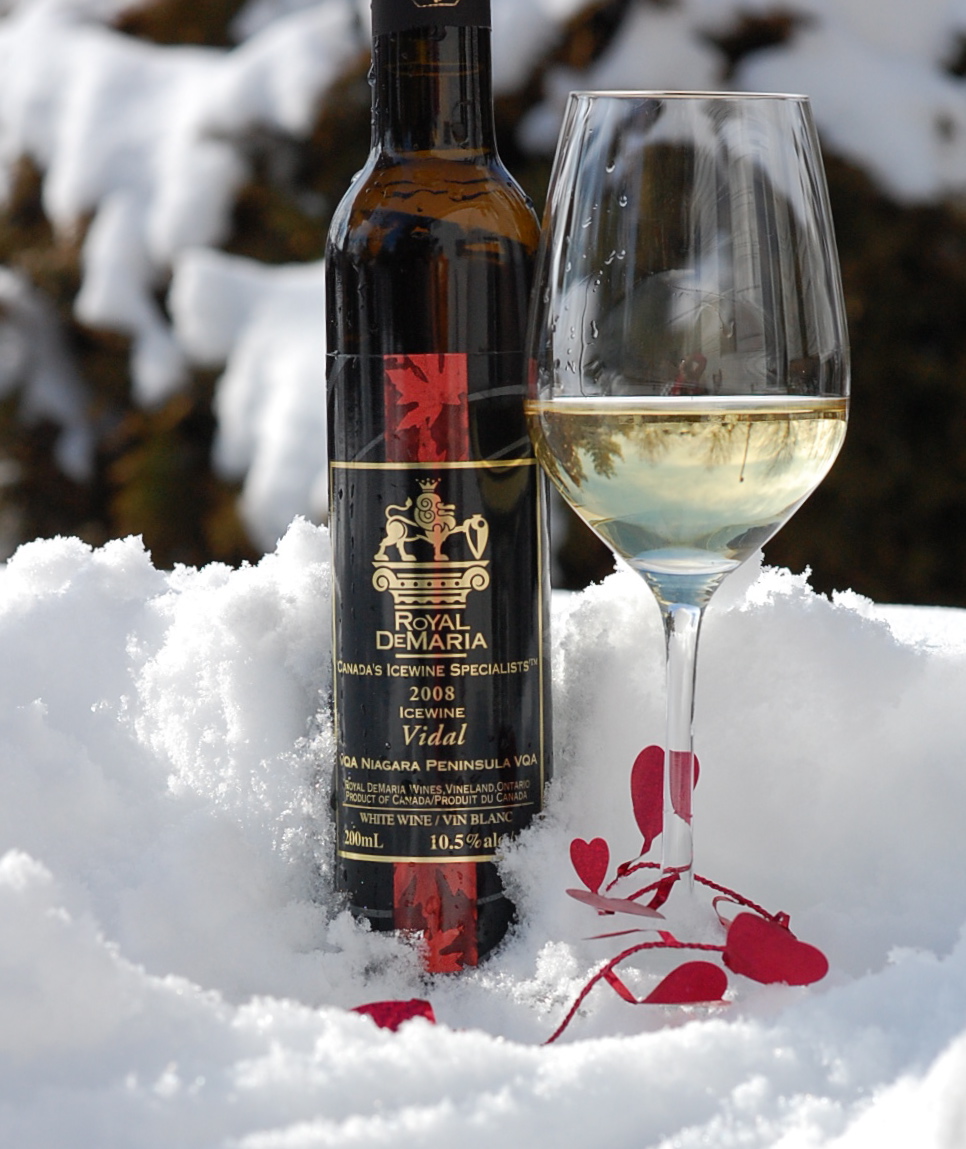
At Debonne, we were treated to some ice carving demonstrations and a taste of their Vidal Blanc ice wine with home made cheese. The pairing was nice and brought out the ‘velvet-y’ qualities of both. My friend, Kell, was quick to point out this term, one he had picked up from our discussions about the wine aroma wheel. Learning can be fun! We moved inside to the tasting room and sampled an off-dry to sweet varietal wine selection. It ranged from a blend (Jazz White) to Razzberry Riesling. My pick from this grouping was the Jazz White; a blend of Chardonnay, Pinot Grigio and Riesling. It was a clear, light straw color, very minimal on the nose, but was lightly nuanced on the palate; refreshing with a subtle honey finish. I thought it could be a great sipping wine on a hot summer day and would be particularly good with a mild, white fish. The Riesling Reserve lot 907 was also light and sweet but didn’t have the same complexity as the Jazz White. The Razzberry Riesling, to me, tasted a lot like a Jell-o shot; very sweet and fun.

Ferrante treated us to their Vidal Blanc as well as a delicious Cabernet Franc. I have a soft spot for Cab Franc because it’s fruit forward with a rich, warm vibe (yes, even for an ice wine). And it has a buttery finish that can cuddle you up like a favorite blanket. Ferrante’s 2010 Cab Franc was no exception; it had a rich cherry top note and, true to form, ended with that beautiful butter kiss. You might say it was almost … velvet-y.

The Grand River Valley Ice Wine Festival continues March 10 and again March 17.

Cheers!

Cupid’s Little Cupcake

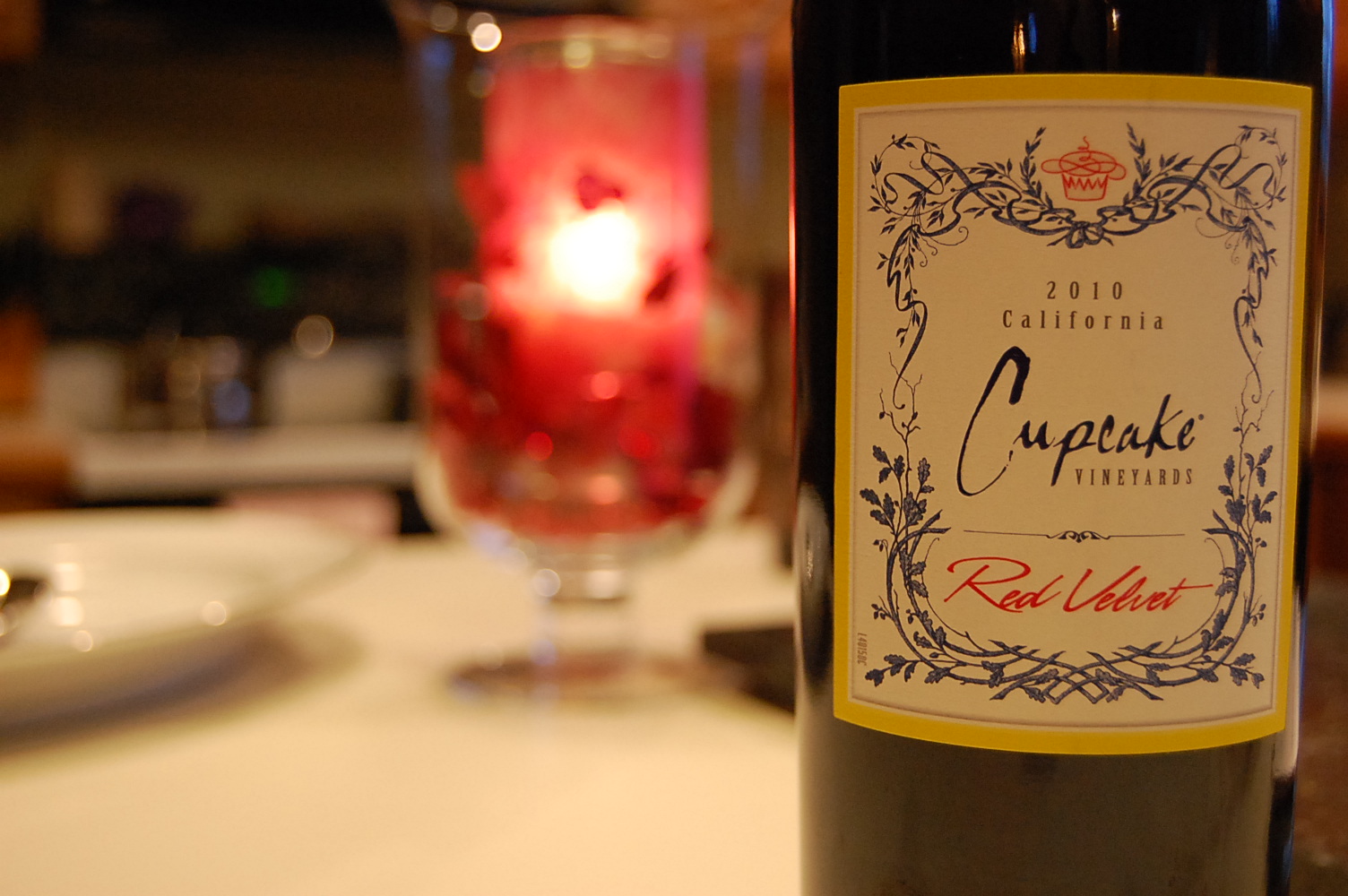
'10 Cupcake Vineyards Red Velvet

'10 Cupcake Vineyards Red Velvet

“Where there is no wine there is no love” ~ Euripides

A wise man that Euripides, at least from my standpoint.  Liquor may be quicker but wine is… divine. It’s Valentine’s night and I wanted to celebrate with a wine that had a real chocolate vibe. I’ve had Chocovine and I liked it, but I wanted something that I could sip with my dinner and would not be so sweet, but would have the rich quality and depth that I associate with chocolate. I was turned on to a ’10 Cupcake Vineyards Red Velvet from California.

I opened it just before a dinner of garlic buttered shrimp with savoury vegetables and rice, sipping as I put the finishing touches on the meal. The Cupcake wine looked very glossy and smooth on the pour and had  an earthy, almost caramel chocolate on the nose. The quick, top taste was of vinyl shower curtain (yep), not that I’ve tasted many shower curtains, but that’s what came to mind. My friend, Terri, added that the shower curtain was “clean and algae free” which gives you more of a visual than you’d probably ever want :). According to the wine aroma wheel,  a vinyl/petroleum taste is legitimate and it doesn’t mean that anything is wrong with the wine.  That said, what I found particularly intrigung about this wine was that the predominant chocolate vibe on the finish lingered with me well after the sip was gone. It was nice.  Many wines I’ve had don’t have this kind of intensity and length.  What was particularly impressive was that it started out light and continued to grow richer in the glass, sip after sip.

For dessert, when I paired it with a dark chocolate  bar with sea salt and caramel, and it grew even more complex in depth and playfulness. A nice finish indeed.

I like to have fun with wine and this one was a great compliment to a lovely Valentine’s dinner.

I wish you all a very happy Valentine’s.  And if  you can’t wine with the one you love, then love the wine you’re with.

Cheers!

Cold Day, Warm Côte

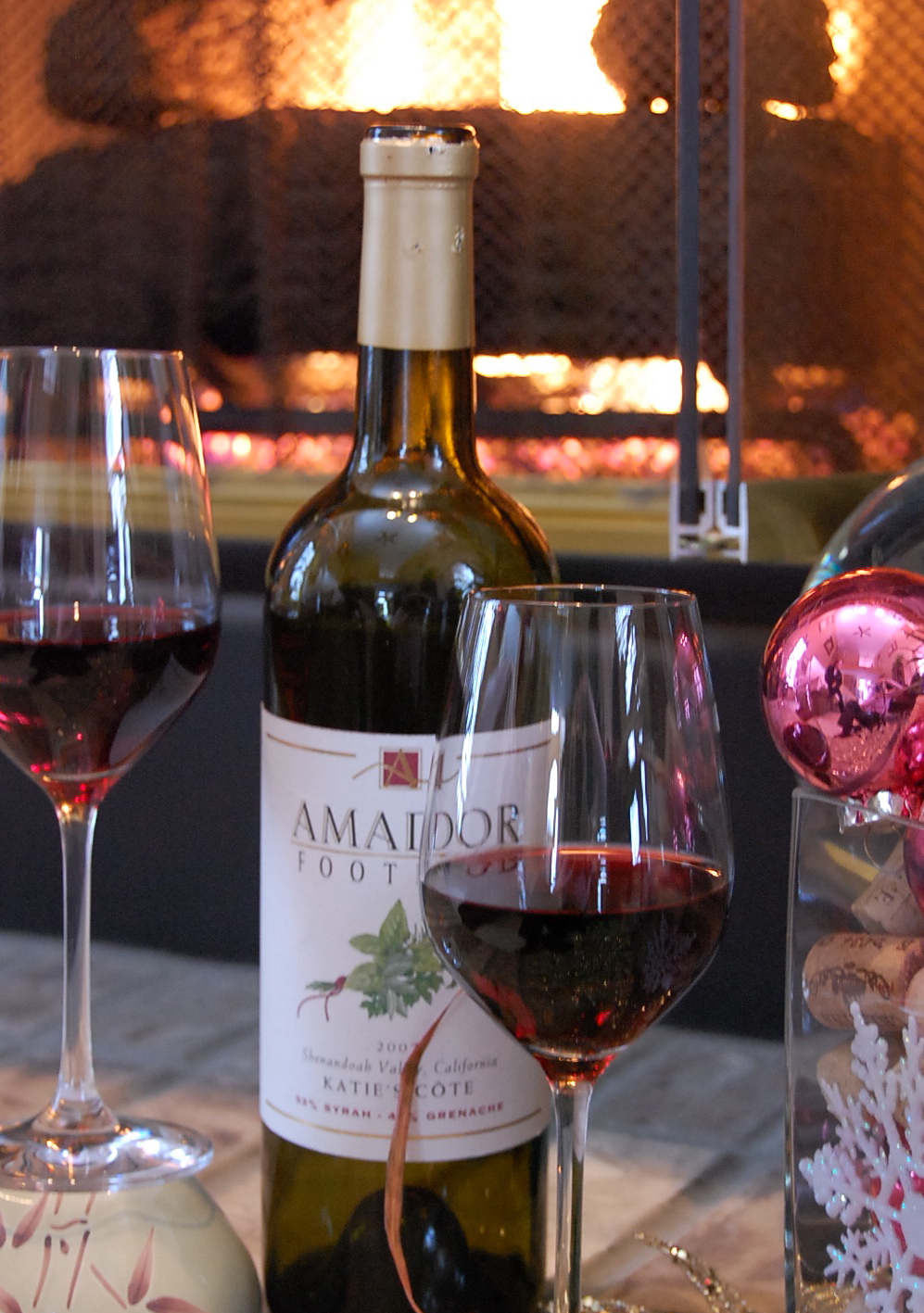
Katie's Côte on a cold winter's night

Katie's Côte on a cold winter's night

It’s been a while since my last post and I have a really good reason: I wanted to finish my spotlight on Icewine with some fabulous pictures of the Icewine Festival here in the Cleve. Old ManWinter has a wicked sense of humor, and blasted us with some nasty weather that made it too treacherous to venture out.

My sister was visiting from Canada and I wanted to share a special wine for her last night here. Not to let a little thing like a winter storm dampen our fun,we decided to end the blustery day enjoying a lovely glow in the fireplace and a bottle of 07 Amador Foothill Katie’s Côtethe lovely Côte du Rhone I enjoyed while I was in Napa. This is a blend of 52% Syrah, 48% Grenache and we found it to be a beautifully complex mixture of berry, spice and plum with a delectable buttery finish. And while it’s a terrific stand alone wine, we paired it with a selection of Belgian chocolates and George Clooney: we watched “The Ides of March” on the dish.

I loved spending time with my sister. I wished we could have gone to the ice wine tasting but  it was great to have a girls night in. The next ice wine event in the Cleve will be in early March and if the weather cooperates, I’ll be there. Why let a little thing like a snow storm ruin a good glass of wine?

Cheers!

The Ice Wine Cometh…

The Sweet Escape: Ice Wine

The Sweet Escape: Ice Wine

It’s sweet and rare, and if you knocked back a whole bottle by yourself, you might need a trip to your local ER to check your blood glucose levels. It’s ice wine and it’s mighty fine.  It’s taken me a little while to put these next couple of posts together. For one thing, there’s so much information about it, for another, I wanted to get it right.  Producers of true ice wine work very hard to accomplish what they do and in some chilly, low temps. Shrinkage is a given. So here we go, into the land of ice wine and snow …

Ice. Wine. Baby.

Ice wine is a rich, dessert wine made from the juice of partially frozen grapes. They must remain on the vine and harvested when temperatures dip to between -8 and -12 degrees Celsius over three consecutive days. The sugar content of the grapes at this time will be at its most concentrated. The water inside the juice is minimal resulting in extreme concentration of flavor, sweetness, aromatics and viscosity.

Iced Vineyard [image via David Boily|AFP|Getty Images]Canada (primarily the Niagara region) and Germany are the leading producers of ice wine (with an increasing number of good producers in Western New York and Ohio)  and yet it is still quite rare; yielding 5-10% of a normal harvest. The brisk temperatures that we complain about when we scrape off our cars are ideal for ice wine, but it’s a delicate balance. The colder the temperatures become, the more the grapes freeze and it can become more difficult to extract the juice. Most ice wine is harvested in late December to mid January when the lower temperatures stay constant. Before the harvest, ice wine grapes must be netted for protection from birds and animals. Picking is generally done by hand and much of the time at night, when the low temperatures stay most consistent.  The crush is also done outside to keep the must at a constant, cold temperature. If any thaw occurs, the water content inside the grapes will increase, potentially spoiling the sugar concentration. It’s these factors that make ice wine a premium wine product and legitimize the price of $30.00+/ 375ml. Think about it: you’ve got to give it up to those who go out in the middle of the night to pick and press grapes for you to enjoy.

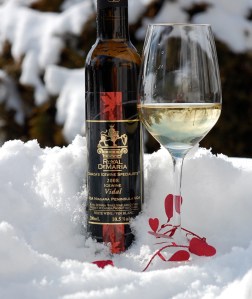
The best grapes for Icewine are those with thicker, more durable skins that will hold together during the freeze ~ thaw cycle common in cold weather. Grapes with higher acid, extremely high sugar yield the best. As with any wine, differing varieties produce different characteristics: Riesling has a green apple and honey vibe; Cabernet Franc produces a rich, berry, buttery character and Vidal, a good, hearty hybrid used commonly because of it’s durability gives a traditional raisin-y essence. Troutman Vineyards in Wooster, Ohio make an ice wine using Chambourcin, a rare, red varietal.

Grapes are 80-90% frozen to give the required concentration of sugar, which is measured by degrees Brix, typically 35 degrees. Brix is measured using hydrometer or refractometer. Both provide vital information about the amount of sugar that been dissolved and that will help the winemaker determine how much yeast to add, since yeast converts sugar into carbon dioxide and alcohol. The yeast used in ice wine must be one that can handle high sugar and not go too high in alcohol.  The yeast must be gradually acclimatized to increase the sugar environment. Fermentation can take 3-6 months and the percentage points in alcohol must progress slowly as this can increase spoilage if progressed too quickly.

After 3-6months, the ice wine needs to be filtered again, and very slowly or you get a fizzy wine. It’s a sticky process. Bottling is also slow so the wine doesn’t end up like fermented Hawaiian Punch.

Storage

Chardonnay, Cabernet Franc and Merlot are best when to drink when young. Gewurztraminer and Ehrenfelzer: 3-5 years maximum. Vidal and Riesling tend to be the most hearty and are best to cellar the longest at between 5-7 years. They make the best bet for long term cellaring because they are able to retain their acidity.

Like revenge and ice cream, ice wine is best served cold:

Ice wine should be served chilled but not frozen; extreme variations in temperature can compromise the quality of wine, so just chill in the fridge. The ideal temperature is around 12 degrees. As with most chilled wine, allow it to stand at  room temp for about 15 minutes to open up the bouquet.

Raise your glass

The glassware you choose is also important. I’ve made the mistake of serving it in liqueur glasses. I was wrong. So very wrong.  The common viewpoint among experts is that ice wine, like any other fine wine, should be served in glassware with a larger bowl (about 9 oz). All the better to sniff and swirl with. When you think about it, it makes sense. By swirling, you can better open up the intensity, bouquet and flavors of the ice wine. You also want to use a glass that has a stem, and hold by the stem or base to not heat your ice wine; it’s very delicate! While you might want it to stay cold as you sip, don’t you dare put ice in your ice wine. Considering what you’re paying for this rich nectar, you don’t want to water it down with melting ice. An option to keep it cold would be  whiskey stones. You can put in them the freezer, and they’ll keep your wine chilled but  won’t dilute it.

The best pairing for ice wine are chocolates, fresh fruit, and delicate, lighter cheeses. Yum.

After it’s been opened, ice wine can be re-corked and stored in the fridge for 3-5 days. But why would there be any left?? If, by chance, you’re looking for another way to use what remains, why not make an ice wine martini?

Ice Wine Martini:

10 large seedless grapes (2 halved grapes for garnish)

2oz Ice wine      (red gives a nice blush vibe to the ‘tini)

2oz Vodka                  (I use the Goose, but any will do)

ice       (yes, here you’re watering it down, so shoot me)

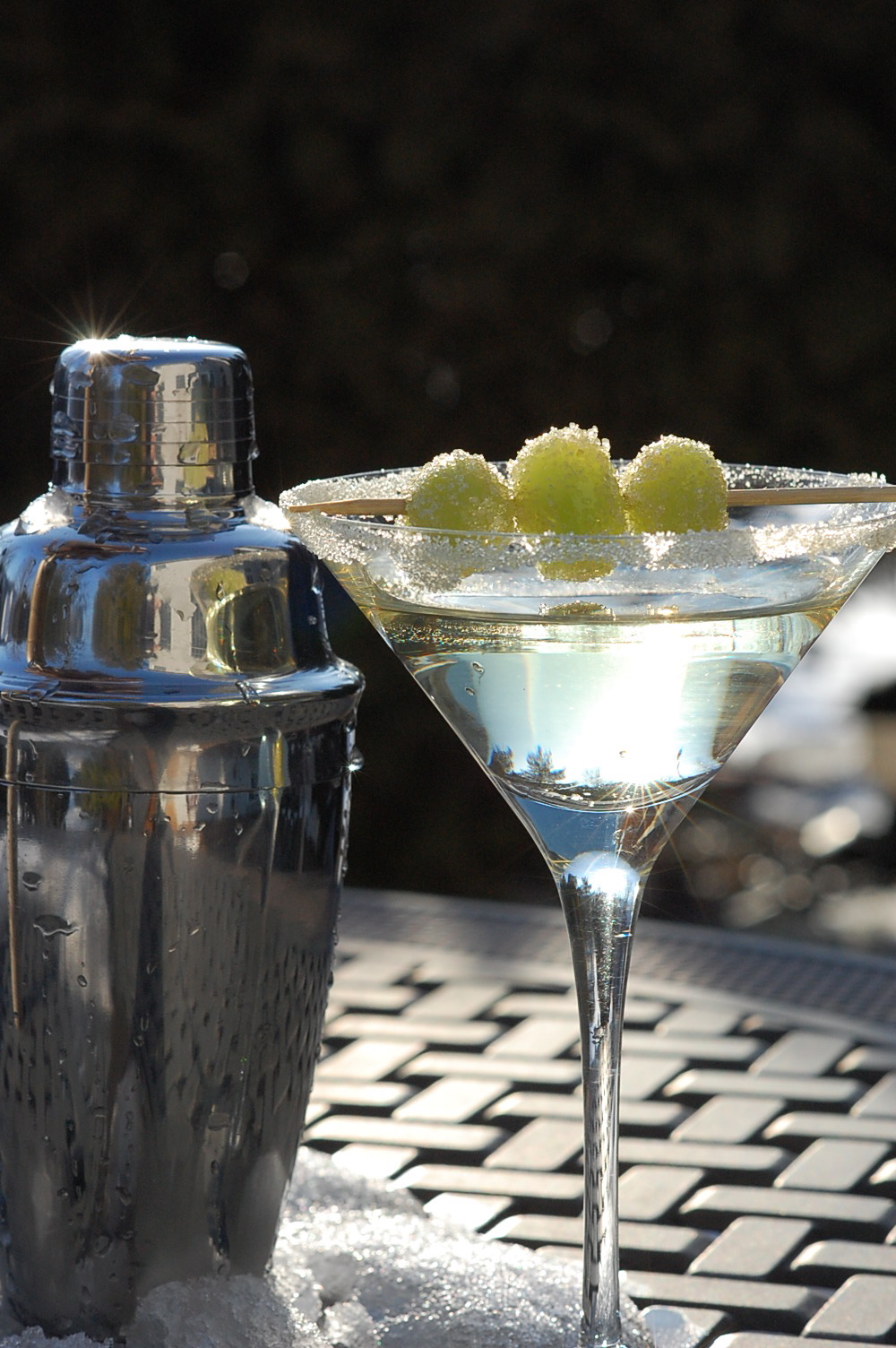
In your blender, puree 10 grapes with ice wine and vodka. Pour through a small strainer into the ice filled shaker. Shake it like you mean it! Strain again into a chilled martini glass and garnish with the grapes that you’ve dipped in lemon juice and sugar. Enjoy!
My Ice wine Martini

My Ice wine Martini

Next post, I’ll talk about the difference between Ice Wine and Iced Wines. And, yes, there is a difference between the two.

In the meantime bundle up, butter cup. We’ve got a little more ice on the horizon.

Cheers!

A Hot Kiss on a Cold Winter’s Night

The Hot Kiss: Chard and Dark Chocolate with Chipotle Pepper

The Hot Kiss: Chard and Dark Chocolate with Chipotle Pepper

I’m spending tonight on my own. It’s cold and blustery here in the Cleve, so I’m settling in with the leftover Enon Chard that I had in my fridge. I had bought some dark chocolate for my research on IceWine, and wondered what it would be like paired with the Chard. I thought if the spicy rice from the other night lit off some fireworks, maybe lightning could strike twice with a sweeter offering.

After the Chard loosened it’s chill (using the 15 minute rule), I took a little bite of the pepper-laced chocolate. As the heat began to swirl, I took a sip of the Chard. Lightning did strike again. And again. The chard took just a slight edge off the heat of the pepper, then sparkled into it’s own flavor; combining sweet and hot. Very nice.

I think tonight I will take my time, pair slowly, and enjoy the watching the snow fall delicately from the night sky.

Cheers!
Vegan and the Big O: Compare and Contrast

This slideshow requires JavaScript.

I must say that I had a little trouble finding Vegan wines, ready to buy, here in the Cleve. While the wine stores I went to were happy to order it for me, I got myself into a conundrum for time; I wanted to post the comparison tasting soon after the initial post. So I took a little trip over to World Market Explorer on the West side, where I found a ’10 Pinot Noir from McManis Family Vineyards.

The Organic wine, an ’09 Bonterra Zinfandel, I found with no trouble at Heinen’s, my local supermarket.

According to the vegan beer, wine and liquor site, Barnivore, McManis is vegan friendly and uses only Diatomaceous earth and paper filtration.

Commenter Natural Ed had some great suggestions and I did take a road trip out the Whole Foods to try to find them. It felt a little like the Amazing Race for wine. Unfortunately, both stores didn’t have any of them in stock. I was pressed for time to order online, so I stayed with the McManis for the tasting. I had wanted to find two of the same varietal, but it was tricky enough to find a Vegan wine much less two Zins. I know that comparing Pinot and Zinfandel is a little like comparing apples to oranges, but I tried to keep an open mind about the quality of the wine itself. That said, I happen to like both Pinot Noir and Zin. For me, I didn’t taste any tangible difference between the organic and traditional; when they’re good, they’re good. And I’d expect the opposite is equally true.

DirtySpicyBerry 

We began with the Vegan Pinot Noir from McManis. The first impression was that it appeared a bit cloudy almost opaque in the glass. It had such a light bouquet that all of us had to get our noses far into our glasses to detect the light berry essence on the nose (which, for me, actually ended up on my nose). Shelly found a spicy, berry vibe that she thought was good. Cindy described a ‘dirty berry’ taste, while Terri found it to have a ‘Gurdy’ or astringent feel as it went down. I thought it tasted grippy, very earthy, young and thin. As a Pinot, I wasn’t expecting it to be as full as a Zin or Cab, and maybe I’ve been spoiled by Pinots from Oregon and Washington, but it did seem too simple and light for one hailing from California. I sipped more to see if it would evolve and gain some depth and it did, slightly, when I paired it with a little green pepper and tomato.

Smooth Operator

Yes, I know it’s a Sade song, but I think I accurately describes the Organic Zin from Bonterra. It was much richer in color (which is true of most Zins when compared to Pinot), with a full bouquet of rich berry that we could smell when I poured. It was a smooth and well-balanced with a flavor of deep blackberry, and a pepper kiss on the finish. Cindy described its quality as ‘full and creamy’ which it was. We agreed that it was very smooth with no bite; more complex by comparison. It was enjoyable on its own or paired with vegetables or crackers and hummus.

I know that our experiment had its flaws; comparing two different vintages and varietals being the most glaring. While we thought the McManis Vegan Pinot tasted young, the Zin had an extra year which could account for the complexity and richness.

The earthy overtones in the Vegan Pinot might be due to the fining process itself: could the earthy clay used to filter the wine, increase that quality in the taste?

My take away from this was that I was not put off Vegan wines at all; I’d like to try more.  I’d also like to test my hypothesis of clay fining’s influence on the final taste of vegan wine.

I enjoy trying new things and this study hall didn’t disappoint. It was a great night to experiment and to catch up with some great friends.

My next posts will be about the wonderful world of Icewine. With old man winter blowing into the Cleve tonight, it seems quite timely.

Cheers!

Thank you to Natural Ed for his great suggestions:

[From Whole Foods:

Pizzolato Prosecco made with Organically grown grapes & Vegan http://bit.ly/a0oSWW

Pizzolato Organic Italian Cabernet No Sulfites Added & Vegan http://bit.ly/a64esp

Biokult Austrian Grüner Veltliner – made with Organically grown grapes & farmed biodynamically http://bit.ly/a1e00e
Spartico Organic Spanish Tempranillo No Sulfites Added & Vegan http://bit.ly/cHbDz8

From Trader Joe’s:

ALBERO, Spanish Wines made with Organically grown grapes & Vegan http://bit.ly/eOQIFu