Sake Night

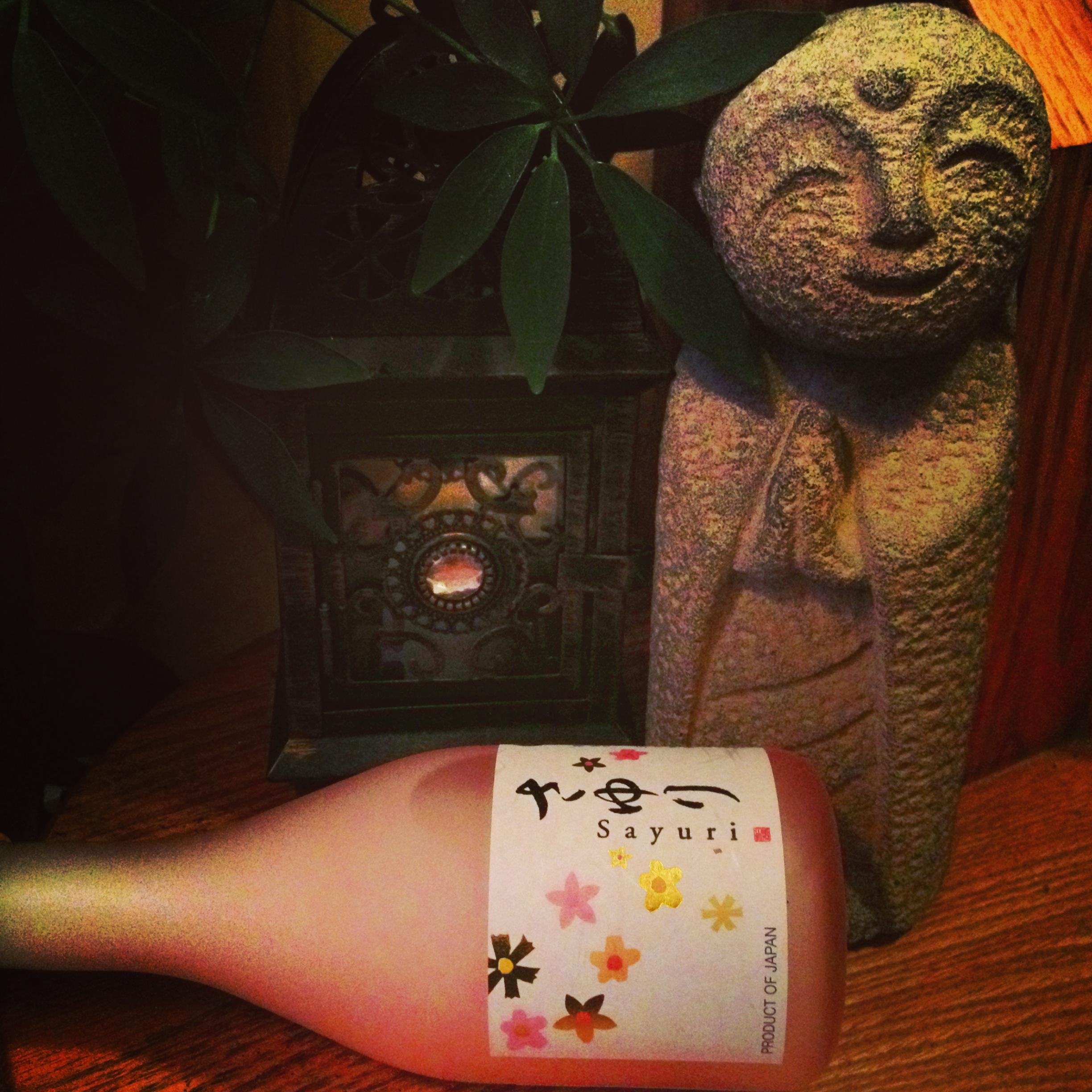
Sayuri Sake

Sayuri Sake

When I go out for Japanese food, it’s one of those bevvies that I think about trying but then I see a cocktail float by in a funky ceramic mug and I change my mind. I promised myself that Friday night would be different. Friday night, I would try Sake. With HubbyDoug as my DD ~ Sake contains between 15-17% alcohol so he’d better be ~ I was curious to see what it was like and whether it’d be something I’d choose more often.

I knew nothing about it and didn’t know whether it had similar ‘rules’ to wine: White with chicken or fish, red with meats. I didn’t know if there was even such a thing as ‘red’ or ‘white’ Sake (there isn’t).

I looked at the variety of premium Sake on the menu and chose one at random: Gekkeikan, which was highly regarded. When I asked the bartender if I could take a photo of the bottle it came from, he replied that I couldn’t because it came from a big box. That didn’t sound good. He served it up piping hot, warning me not to touch the ceramic carafe for quite a while. My research had told me that premium Sake is best served gently warmed. Strike two. When it seemed to have cooled, I took a sip. It was a juxtaposition of thin and strong and made me think of hot nail polish remover. There was no discernible bouquet, just an essence of straight up alcool. Maybe it was an acquired taste but I just wasn’t feeling it. And yet, I didn’t want to give up so easily so I kept a bit to have with my Teriyaki chicken dinner. Maybe the savoury of the soy and delicacy of the chicken would help ease that boozy vibe. It didn’t. And I ended up ordering a cocktail in the funky ceramic mug.

But I refused to be swayed by this experience. With the number of different types of Sake out there, I didn’t feel right about just giving up after one shot. A brand I’d read good things about was Sayuri; a coarse, filtered offering. On the label it said to just shake well ~ no need to warm. The consistency was described as creamy and naturally sweet. This one had a floral bouquet, which was quite nice. It wasn’t nearly as harsh as the Gekkeikan. But I was still not convinced. I suppose you could enjoy sipping it on its own or pair it with a soy-savoury dinner. But what the hell, just pound it into some beer and yell, “KAMPAI!”

Contrary to popular belief, Sake is not really a wine. It’s not really a liquor, since it isn’t distilled like vodka or gin. According to John Gautner of Sake-World.com, it’s a fermented rice alcohol beverage and with rice being a grain, it’s actually more like beer.

Here are some more fun facts about Sake:

  • It’s brewed for about four weeks and then a six-month aging process.
  • It is similar to Beaujolais in that it’s best consumed immediately or within six months of release.
  • It does well stored in a cool, dry place but is best with refrigeration.
  • It doesn’t contain sulfites (so no sulfite issues common with wine). Premium Sake is free from additives/preservatives and has few congeners (a contributor to that pesky hangover).
  • While cool brings out the best, it benefits from gentle warming.
  • It pairs very well with lighter fare such as chicken or fish.
  • Price range: between $18-35, $35-70 for 1.8 litres. The brands I found at World Market began at $13.99.
  • Snake in the bottle? Also known as Habushu ~ is generally not available in the US because there’s a freaking SNAKE IN THE BOTTLE! Enough said.
  • Some other top Sake brands: Juyondai ~ fruity and fragrant

                                                                         Isojiman  ~ balanced and rich

                                                                         Kubota      ~ light and dry

I gave Sake a good, college try and the second choice was much better than I expected. Eventually, I might try a few more. But I think I’ll be staying away from anything that has a snake in the bottle.

Cheers!

©TheWineStudent, 2013

Field Trip ~ Colaneri Estate Winery, Niagara.on.the.Lake ON

@ Colaneri Estate Winery

@ Colaneri Estate Winery

One of the things I love about going home to Niagara for the holidays; apart from seeing family and friends, is picking a new winery to try. Since I left almost 5 years ago, there has been an explosion of great wineries with something to please every palate.

When HubbyDoug and I were walking the main street we slipped into a little bar for a glass to take away the chill. We were treated to a Colaneri Estate Winery ’09 Cabernet Corposo. I noticed a distinctive richness and old world vibe from the very first sip. To be honest, my experience with many Niagara reds has been somewhat disappointing. They have a tendency towards a lightness and a green, vegetal quality that I don’t always care for. While they eventually settle into a pleasant flavor, it’s generally when you get to the bottom of the glass. I like a red to look me in the eye as it gently takes me by the collar and eases me back into my chair. This wine winked as it looked me in the eye.

I had to find out what made it so unique. A trip to the winery became my top priority.

Colaneri wines are made using an appassimento process that dates back to ancient Roman times. Harvested grapes are hung to dry before winemaking, to remove any excess water, thus shriveling the grapes. And why would you want this kind of shrinkage? All the better to concentrate the sugars and flavors in the resulting wine.

  • Recioto ~ also an ancient style of winemaking and also incorpporating the drying of grapes to concentrate the sugar content. Recioto may be red or white, dry or sweet. The dryer wines in this style are Amarone which can be intense at 16% alcohol.
  • Ripasso is a style that means to revisit or go over. It involves a double fermentation process in which additional dried grape skins are added. The sugar content has been heightened by drying and this increases the final alcohol and phenolic content in the wine which is known as passito.

Our winery guide, Pam, explained that Colaneri was one of only three Niagara region wineries to use this process. Their wines are kiln-dried, using both greenhouses with industrial fans and tobacco kilns. ”Since the kilns were no longer being used to dry tobacco, they have been put to use in winemaking”, she said. In the tobacco kilns, the fans push air up through the floor; where the greenhouse fans circulate the air around the fruit. The drying process can take up to two months with skin contact completed within 7-10 days.

After harvest, the grapes for Amarone and Recioto are set aside to dry in trays in kilns, or are hung in lofts ~ the hanging and careful placement in trays allows for complete air circulation so no mold develops. There they stay for approximately four months after which the semidried grapes are crushed and fermented with the grape skins. The grapes not used for Amarone or Recioto are crushed and fermented to be used later.

Once prolonged skin contact has finished, the wine is stored for aging. The additional wine (that had been fermented seperately) is introduced by being pumped over the Amarone | Recioto skins, thus starting the second fermentation. The saturated skins are still quite full of unfermented sugars, making them high in aromatics and tannins.

It was time to began our tasting with a spectrum of lighter fare: Pinot Grigio, Sauvignon Blanc, Gewurtztraminer, Chenin Blanc. The Chenin Blanc was my favorite; it had a taste of pear, pineapple and cotton candy (yum) with lots of citrus on the nose. Pam then took us into the reds starting the Red Blend ~ a combination of Cab Sav, Syrah, Merlot, Cab Franc and Petit Verdot. She mentioned that it was their everyday wine that pairs well with everything from pizza to red meats to chocolate.

We then turned our attention to the Cabernet that we had enjoyed the day before. The scent of rich molasses was prominent on the nose with sweet tobacco, blackberry and raspberry resonating on the palate. Awesome.

The Cabernet Franc was rich and flavorful, with an distinct essence of plum. Pam mentioned that some who tried it but don’t enjoy prunes/plums weren’t always fans. She recommended pairing with tomato-y dishes to counterbalance the prune essence.

We spend a good part of the afternoon sipping and learning a lot about some very special wines. Pam was friendly, knowledgeable and made the field trip to Colaneri so much fun.

I came away from the trip feeling happy to have discovered a jewel of a Niagara wine. I’ll make a point to look for more wines created using this time-honored method.

Cheers!

©TheWineStudent, 2013
Shhhhh!

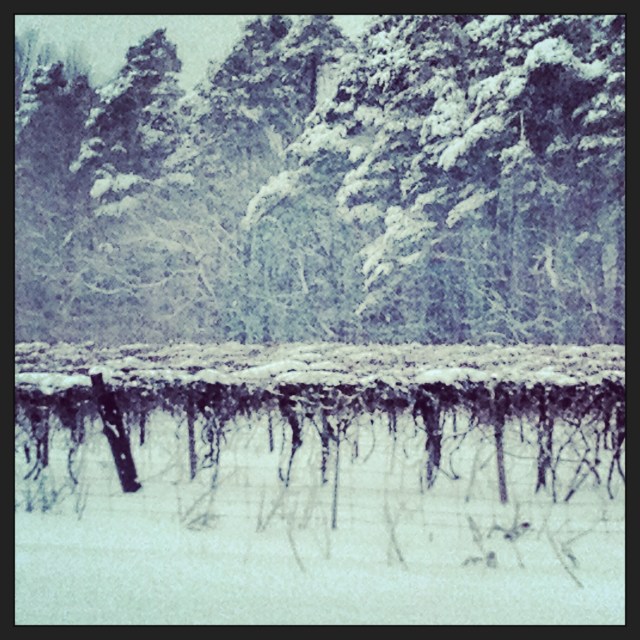
New Years Day: A time for  the making of resolutions and gentle reflection on the year that was. Who am I kidding? It’s a time to sleep and walk around in your jams, drink an awful lot of water and reflect on the night that was. If you’re a grape vine, you’ll be doing some of that today. While you won’t be trying to remember who you kissed at midnight, you’ll probably be sleeping ~ deeply. Your jams will be extra soil or straw, and your water will be the snow accumulating around you.

In the weeks prior to winter, grape vines prepare themselves for the approaching icy blast by ‘hardening off‘.  This is where the shoot of the vines begin to harden up, turn brown and shut their processes down after retrieving/storing nutrients they’ll need for the coming dormant months. The plants goes into energy conservation mode to keep itself intact. A good portion of pruning occurs at this time to get the plant set for the spring and the next growing cycle. If the vines are not properly prepared and pruned through the dormant winter months, the next harvest might be seriously compromised.

So if you’re driving past vineyards this winter, go quietly. You don’t want to disturb what might become your next great bottle.

Cheers!

©2013TheWineStudent

Youth in Revolt: Beaujolais Nouveau

DuBeouf and Drouhin 2012 Beaujolais Nouveau

DuBeouf and Drouhin 2012 Beaujolais Nouveau

Tonight, while most of us are our beds quietly dreaming or, if you’re like me ~ drooling on your pillow, cases of Beaujolais Nouveau are being crated up and shipped hundreds of thousands of miles to worldwide destinations. With the release at 12:01am on the third Thursday of November, the frenzy begins to get this extremely young wine to market. The release is highly anticipated and lauded, traditionally, to celebrate the end of harvest.

Beaujolais Nouveau is the result of a quick reap, fast fermentation and whirlwind bottling. Grapes are generally hand-picked helping to ensure that they are the healthiest with unbroken skins. The must is pressed a mere three days post-harvest. It’s hard to think that you’d get any kind of product at all worth drinking. And some would sniff that what you’re getting psyched for is little better than fermented grape soda. Yet Beaujolais can be surprising. Even in a wine so young, it can have some chops. The 2009 vintage, in particular, trashed the reputation that un-aged wine was merde. There’s no denying,  it runs the risk of being severely compromised by less than subtle chaptalization, and a hurried process to get the product out to consumers. Sometimes, satisfying the masses with high quantities of wine can negatively effect the quality of the wine. That said, I predict many will jump on the Beaujolais party train this weekend, quaff thoroughly and not particularly care about how quickly it took to produce.

Beaujolais is produced from the Gamay varietal; a cross between a Pinot Noir and Gouais, a white from Central Europe. It thrives in the granite laden, acidic soils of Beaujolais. In the days of old, Beaujolais celebrations were local events until the French government found out and wanted to end the party at 11 by putting restrictions in place in 1938.  By 1951, the restrictions were revoked by the Union Interprofessional des Vins de Beaujolais (UIVB) who instituted a November 15th release date. In 1985, the date was changed to the third Thursday of November, which ties it to the weekend ~ thus only ending the party when the police show up to take you in for a drunk and disorderly.

There are four premier types of Beaujolais:

Nouveau/Primeau ~ the youngest of the Beaus ~ very fruit forward with a cherry-berry-floral vibe that should be served lightly chilled and within 6 months of release.

Villages ~ This one can be  has more spice/pepper on the palate and can be cellared between 2-3 years.

Blanc ~ The tall blonde from the North Beaujolais district, it gets its depth from 3 types of soil: granitic, siliceous-clay, limestone-clay. Also an early drinkable.

Cru ~ From one of the finest regions of Beaujolais, it is the creme de la creme. It has the highest character and complexity and can be cellared the longest. Jancis Robinson has said that she enjoyed one that had been cellared 40 years. Cru can be confusing because it seldom says Beaujolais on the label. To find Cru, you’ll be looking for Broully, Chiroubles, Fleurie, St~Amour, to name just a few. Most Beaujolais is produced by Georges DuBoeuf who distribute much of the 65 million bottles that will hit the shelves in 24 hours time. Although, according to Randy Ruitenberg( via Bloomberg Businessweek), this year’s production of Beaujolais and Champagne will be down about 20% due to weather damage and disease.

So what does it taste like? Since there is so little time between harvest, press, bottling and pour into your glass, it will be fruit forward with very little tannin; simple and relatively immature. It pairs very well with lighter fare such as turkey, so is an ideal choice for a traditional Thanksgiving dinner. Many liken a mature Beaujolais to a Pinot Noir, which makes sense. If you like big, beefy, tannic reds, you might want to pass. However, it’s a great transitional choice for white wine drinkers who want to try a reds but are intimidated by the heavy duty varietals.

I’m all set to try my 2012 vintage. I bought a DuBoeuf and a Joseph Drouhin to compare. And I’ll let you know whether they can hold their own against my roast turkey with all the trimmings.

Cheers!

O Tannin Bomb

At dinner with friends the other night, the subject of tannic wine came up. “Tantric wine?” I asked, “That sounds like fun!” I thought it meant we’d just take a really, really, really long time to enjoy a bottle of red. I’ve been to tastings, seminars and parties where one will take a sip and proclaim that the wine is very tannic. But what does that even mean?

The term tannin comes from the long time practice of using plant extracts to ‘cure’ leather. In winemaking, tannins are compounds that bind to proteins ~ proteins that exist both in other chemical components of  wine as well as the salivary proteins within the mouth. This is a very basic description of a very complex process but you get the idea. This complexity is also what makes studying tannin quite difficult as these bonds break and reform several times before the nectar ever comes close to hitting your belly.

You can liken wine tannin to steeping tea ~ look at 4 cups of tea in various stages of brew. The first one is after a few moments, the next after 3 minutes, next after 5 and after 8-10. You’ll notice significant differences in how the tea looks (light to tar-like) and tastes (weak to very strong). A wine high in tannin will look darker and taste stronger.

There are two classes of tannins: one coming from the oak barrels the wine is aged in and grape-derived.

Green and Mean ~

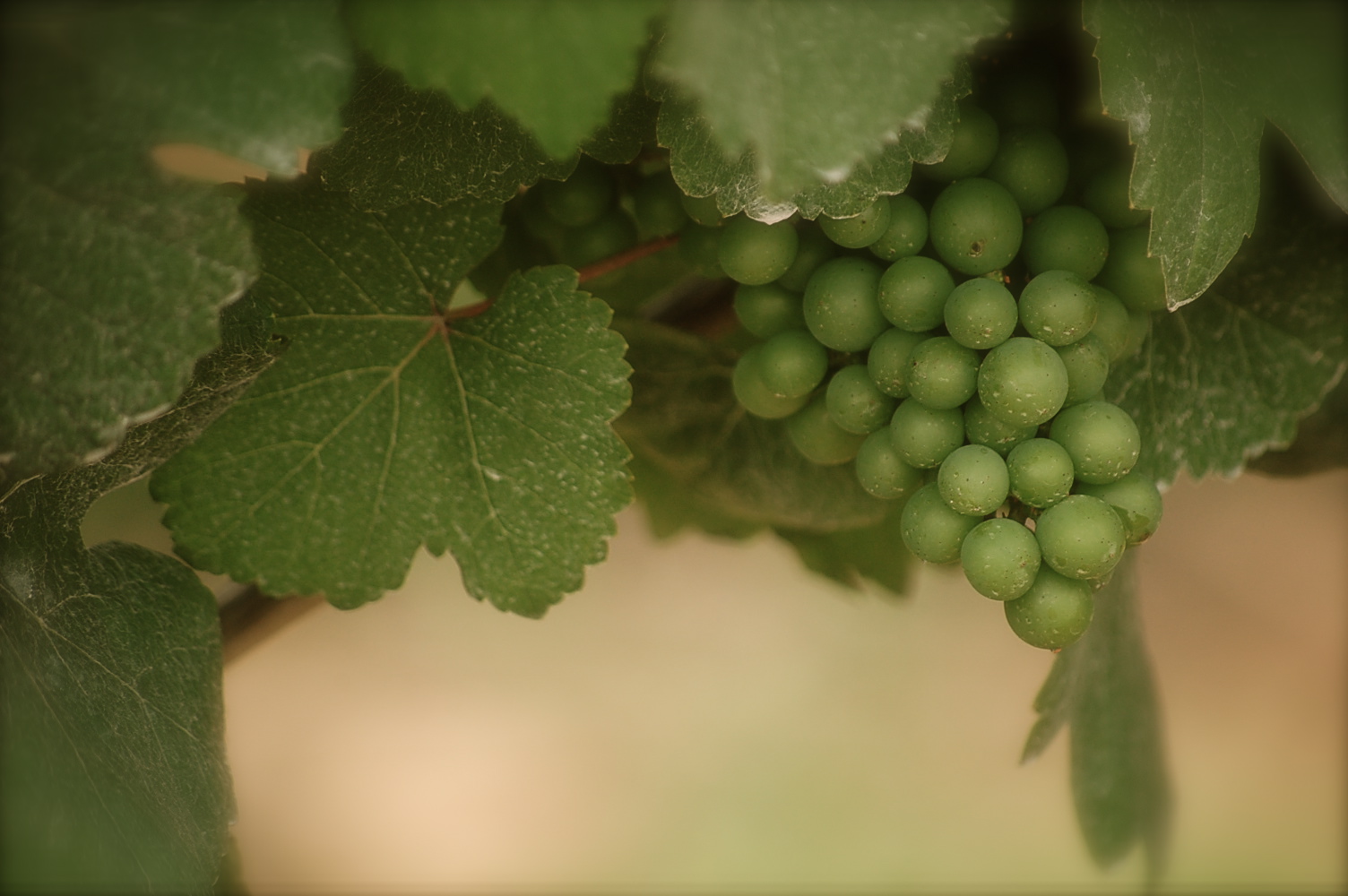
In nature, tannins serve as a kind of defense for the plant. It gives plants an unpleasant taste, discouraging animals from consuming them, allowing them to grow to maturity. Grapes begin tiny and  green in order to match the new stems and are extremely bitter ~ it also keeps the birds from dining too soon. These berries are where the developing seeds are housed, undisturbed until they go to college, hit a few keg parties and then graduate to become adult grapes. When birds consume the mature grapes, they eventually deposit the digested seeds and re-propagation of grapes begins anew. Unless of course the deposits end up on your car. Since the seeds also contribute a great deal of tannin to red wine, they can have a very nasty effect if they are unripe.

 Bitter is the New…Bitter ~

Here we can pull out our trusty mouthfeel wheel. Tannins contribute to both astringency and bitterness; with bitterness being sensed by taste bud receptors located on the very back of the tongue and soft palate.

Rather than being able to smell tannins, it’s more of how it feels on your tongue. Astringency is the feeling because the tannins bind with proteins in saliva, thereby increasing the friction between the mouth surfaces leading to a sensation of dryness or roughness. On the wheel, you might see words like furry, cottony or wooly ~ that’s what astringent ‘feels’ like.

Style meets Substance ~

Light ~ lighter in color and on the palate , thin consistency. Good examples: Gamay, Beaujolais Nouveau

Medium ~ a little more tannin, is richer on the palate and is  not as beefy.  Good examples: Merlot, Pinot Noir, Shiraz

Full ~   has the highest tannin content, more pucker on the palate,  creamy consistency with usually a higher alcohol content. Good example: Cabernet Sauvignon

With high tannic wines, what you see will generally be what you get. You’ll find wines rich in color; deep ruby or claret, purple and maroon.

For many who enjoy wine, tannin really isn’t an issue unless it adversely affects the taste. Choosing wines that have high or low tannin depends entirely on your preference. Just make sure you take a really, really long time to enjoy them.

Cheers!

Night of the Vampire

A couple of years ago, I tried Vampire wine ~ I don’t even remember what variety it was. I wasn’t too sure about it; the taste was metallic, the mouthfeel a bit thick and viscous. It was a little like…blood. Or at least how you might imagine blood might taste.

Did rip my bodice? Not exactly. It wasn’t the worst red I’d ever had but I wasn’t sure it was a wine to constantly search the catacombs for, either. Rather than write it off as a gimmick wine, I thought I’d again check out a couple of newer offerings ~ a lot can change in two years. I scared up my friends Shelly and Terri to sample with me. And, yes, creatures of the night ~ that was a Halloween pun, so raise your goblet and drink.

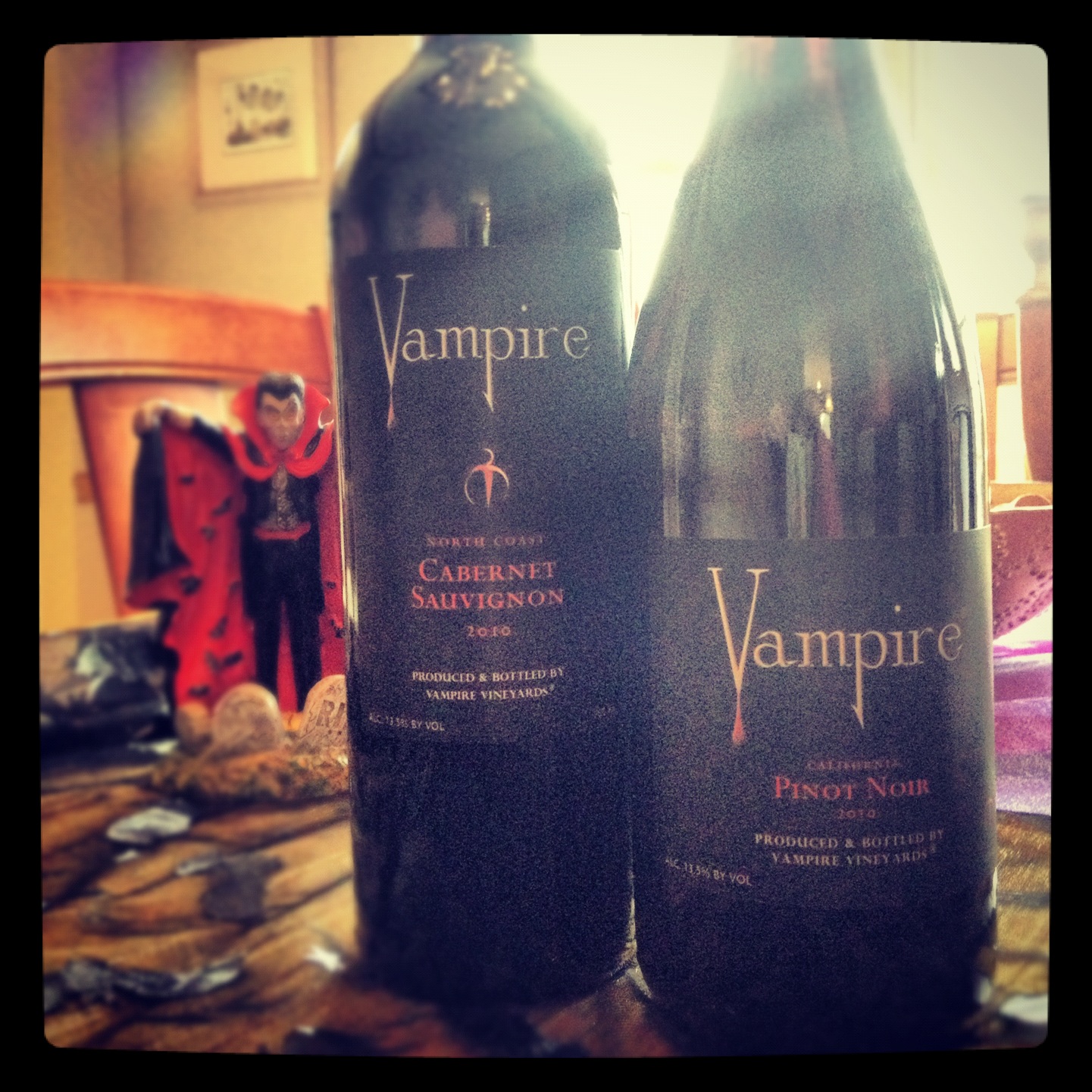
On the menu:  A ’10 Cabernet Sauvignon and a ’10 Pinot Noir.

Vampire Vineyards '10 Cabernet Sauvignon and '10 Pinot Noir

Vampire Vineyards ’10 Cabernet Sauvignon and ’10 Pinot Noir

We cracked open the Pinot first, moving from the lighter wine to full-bodied.  The first pour was without any aeration because I wanted the girls to experience firsthand the difference. It was a clear and bright ruby with predominant jammy top notes. As expected, it had a light, thin mouthfeel, and, overall, was fairly pleasant. Being drawn to a more full-bodied wine, Shelly wasn’t a huge fan but Terri found it easier to drink. When we poured the second taste through the Rabbit, it became much more complex and enjoyable. Pairing it with a creamy Brie and fruit brought even more dimension to what started out as a fairly basic Pinot.

The Cabernet was deep blood-red in color and beefier; everything you’d expect from a Cab. It had a distinct, almost heavy spice vibe to it before aerating and the mouthfeel was velvety with a bit of bounce. After we Rabbit-ized the wine, it softened,gradually developing a flavor that became more sophisticated. Shelly mentioned that she really enjoyed it the more she sipped.Terri found that by aerating the cab, she was able to enjoy it without any reflux-like side effects. We paired it with a sharp Wisconsin cheddar, sweet peppers and tomato.

I was impressed that the wine I’d sampled a couple of years before was not like what we tasted tonight. Overall, we found the Cabernet to be a willing beauty that we could definitely sink our teeth into.

I wanted to take this moment to give credit where it’s due and thank my daughter, Andrea, for all of her hard work producing the first video for The Wine Student blog. I’ll be posting it right after this and, I’ll keep my fingers crossed that it’ll load!

Love you. Now go to bed!

Cheers!


Is That An Aerator in Your Pocket or Are You Just Happy to See Me?

When my husband came home the other day and told me he’d just bought me a ‘rabbit’, I had to think about my response. If you ever watched early episodes of Sex and the City you’ll know what I mean. If you haven’t then, yes, I was concerned about the small, furry animal with the twitchy nose. In this case, he meant the Rabbit aerator.

When you aerate wine, you expose the wine to oxygen. Like decanting, there are clear reasons why:

  • When wine has been closed in a bottle over time, they need a little boost to open up the bouquet or flavors ~ exposing wine to oxygen will help the wine to ‘open’ more quickly.
  • If the wine is heavily tannic, it may be quite strong and unpleasant for the first tastes. The amount of time the wine is exposed to oxygen softens this quality Aeration helps to soften the wine more quickly so you can enjoy the wine at first sip.
  • Wines constantly change after bottling, which is why they are aged but the resulting chemical reactions can produce a gas that may be unpleasant. Different varieties can produce this gassy by-product, noticeable upon first opening ~ yet doesn’t mean the wine has turned. Aeration can help to separate the developed wine from the off-putting gas. I think the rule here is: Classy, not gassy.
  • Aeration can substantially bring out the complexity and expression of a wine that just pouring in a glass (guilty) never can. And it can do it more quickly than letting sit in a decanter or in your glass.

As a caveat: if the wine you’ve poured has, in fact, turned ~ aerating won’t help. We tried that with a recent bottle and it just made it worse.

A Matter of Style

Like decanters, the choice is yours. You can find a multitude of aerator styles, all that work on the same principle: fully oxygenating the wine.  When I go to wineries, most are using them and are loyal to the ones they use ~ and sell~ in the tasting room.

Glass vs. Plastic ~

The choice should be obvious, glass makes sense. Would you prefer wine served in a glass or plastic goblet? There are many expensive aerators fashioned in hand-blown glass and they are beautiful. Being the wine noob that I am, I have plastic.

Keep them separated ~

Do you really need a separate aerator for white and red wine? Many experts agree that decanting should be used for all wines; oxygenation can clearly benefit all. So, too, does aeration. But I wondered if having two different aerators was more marketing tool than necessity. In thinking it through, it would make sense; over time and use, you’d have residue from the red wine that might transfer flavours to any whites that are poured through. That wouldn’t be as much of an issue with glass, as it would rinse more completely. But if you have plastic, better get two.

We decided to take advantage of the wine we had on hand for Thanksgiving and put the aerators to the test. This wasn’t very scientific, we didn’t do a double blind tasting but we did have the two main variables, some nice wine to try. Carefully rinsing between tastings, we each had two glasses, one to try the unaerated and one poured through the Rabbit, then the Trudeau.

  Rabbit Trudeau Classic
Vineland ~ Pinot Meunier 3 0
Strewn ~ Cab Merlot 2 1
Inniskillin ~ Cab Shiraz 3 0
Lailey ~ Vidal 3 0
     

I admit, I was somewhat skeptical about how the aerators could actually affect the taste of the wine. When we tried the Vidal through the Rabbit, it immediately opened up, making the wine more complex and flavourful.  After testing three other wines, it was almost unanimous (except for Strewn) that the Rabbit was the better aerator. Clearly, design made all the difference: The Rabbit was almost shower head like; allowing rivulets to flow down and slide off the curve of the bowl to cascade more specifically in the glass. While the Trudeau brought good amount of air into the pour, it streamed in a way that was similar to just a straight pour from the bottle.

I didn’t know what to expect from my aerator experiment. To taste a distinct difference in one sip after aeration was really surprising and cool. And I enjoy being surprised out of my skepticism, even if this Rabbit was very different from what I expected.

Cheers!

Decant ~ Be Serious

I’ve been a bad girl. Not in the Fifty Shades way but as a wine student. Lately, I’ve found myself simply popping a cork and pouring my reds just in the glass. No decanting, no mandatory two hour plus wait time. Sometimes, I aerate but not every time. Most aficionados would slap my wrist (ooh!) and tell me that by not decanting, or at least aerating, my wine is not all that it could be. And they’d be right. So I dusted off my crystal decanter and became very curious about decanting and why it’s important.

Historically, decanters were important because most wines weren’t filtered prior to entering the bottle, sediment was more prevalent and needed to be separated out before drinking. Wine drinkers of yore probably didn’t want crunchy bits in the wine they sipped. Who would?

i heart decanter - image via lh5.googleusercontent.com

i heart decanter – Image via lh5.googleusercontent.com

Decantation is used for the separation and transfer of mixtures. Especially consequential with reds, the wine is separated from sediments or crystals that are a natural component of aging. Another benefit is the removal of any unwanted bitterness and pungent flavors. A certain amount of oxygenation will happen with the transfer from bottle to decanter but it isn’t the same as aeration, which intertwines oxygen into the wine to improve the taste. I’ll write more about aeration in my next post.

Decanting can be applied to white wine but it isn’t as necessary as decanting reds, especially those aged 5+ years that require more delicacy when serving. There usually isn’t as much sediment in younger wines but they can benefit greatly from decanting by enhancement of the flavours, bouquet, and by bringing the character into full effect.

Slow and steady ~ the art of the pour

As important as the decanter is, the way in which wine is poured matters. I’m sure that even doing the quick pour can provide some of the required oxygenation, it might not leave the all sediment out. The slower pour is more deliberate and accurate. And don’t forget, you want to hit that sweet spot, or the curve of the decanter, for maximum distribution.

Joseph Nase from New York Magazine recommends decanting all wines, even whites and that younger wines can be poured directly into the decanter and left to sit for as short a time as 20 minutes. But if you want to do it the old school way you’ll need two items, as well as the wine:

  • a wine cradle
  • a light source such as a flashlight or candle(very old school and romantic)
      • place wine in the cradle and carefully open the bottle ~ Nase says if the mouth stays above the level of liquid it shouldn’t spill
      • begin to rotate the cradle and slowly pour wine into the decanter while shining the light on the neck of the bottle ~ you should see sediment begin to creep up the neck
      • stop pouring! At this point, the wine in the decanter should be clean and clear

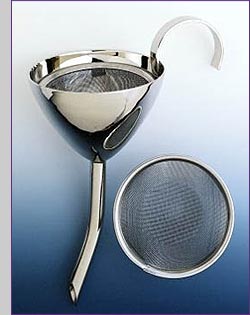
An easier approach involves using a wine funnel and sieve.

Wine Funnel and Sieve - Image via Artisans on Web

Wine Funnel and Sieve – Image via Artisans on Web

  • Insert funnel with sieve into the decanter
  • pour and let stand
  • enjoy

The sieve will take care of any sediment and bits of cork that may have found their way into the bottle. The funnel is usually shaped with a gentle curve to cascade the wine towards the sweet spot of the decanter. The slower the pour, the more oxygenation and the better the release of the flavors and character of the wine. You can also swirl the wine inside the decanter to provide more aeration before serving.

Keeping it Clean:

Don’t use detergent. The design of most decanters makes it very difficult to rinse away the residue. And any that remains may effect the taste of the next vintage you pour into it. You pay enough for a good bottle and don’t want it tainted with soapy residue. Ew.

All you need is some coarse sea salt (I’ve used fine equally well) and crushed ice. Place both in the decanter and shake (or swirl) until it’s clean.

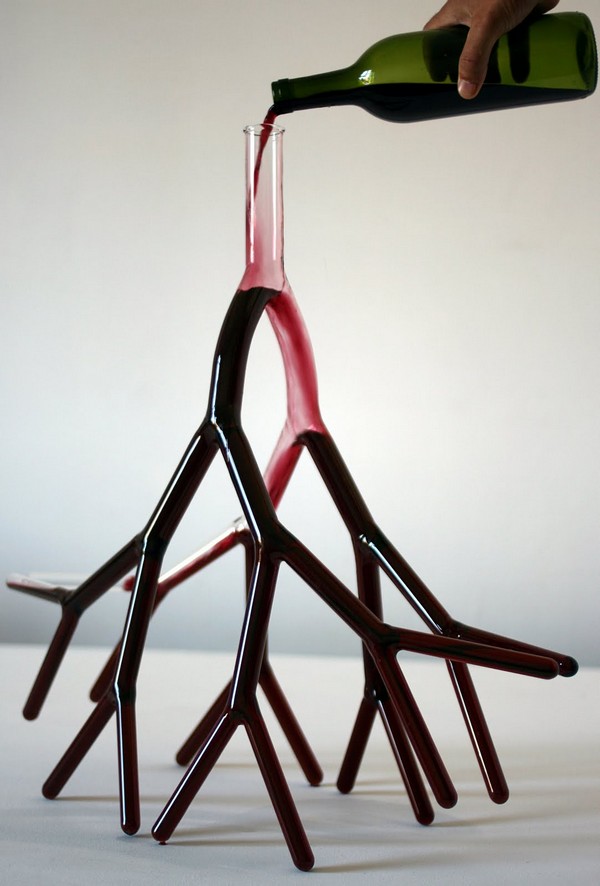
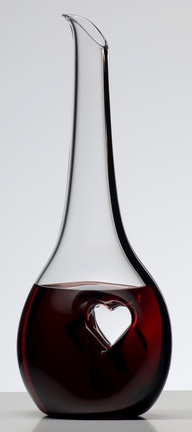
Decanters come in myriad shapes, styles and colors from the classic to the bizarre. I once saw one that had the unfortunate shape of a hand-held urinal, so I  just couldn’t buy it. It’s usually recommended that clear crystal or glass is best, that way you can see the color and clarity, but the choice is up to you.

Also works as a Vuvuzela - image via Riedel.co.uk

Also works as a Vuvuzela – Image via Riedel.co.uk

Antlers or Arteries? - Image via Etienne-Meneau

Antlers or Arteries? – Image via Etienne-Meneau

Wine is a thing of beauty and meant to be enjoyed at a slower pace, not rushed through. Part of the experience is the presentation of your chosen wine, slowly poured and displayed in a decanter that reflects your individual taste and style.

Cheers!

Hot Child in the Vineyard

The last little while, I’ve been hitting the study hall, partly to get a break from the heat, but mainly to learn about the first two components of the growth cycle of the grape: spring and summer.  And with August quickly approaching, it’s pretty clear, we’ve passed one season and are well into the next. So here we grow ~ remember, every time I make a bad pun you have to sip some wine. Since that was particularly bad, make sure you have a big glass.

After hibernating from mid December to April, we come into a time when the newest tendrils of the vine shake off the winter shroud and wake up ~ too flowery? Okay, I’ll keep it real. The first stage of the cycle is known as bud break ~when the initial shoots start to grow. This happens around May 1st through May 24th. If the temperatures are warmer earlier, the buds will pop a little sooner. Early bud break can be a positive because there is the potential for a longer growing; season and riper fruit. The downside is there is an increased vulnerability to late spring frost. Early shoots will not regrow if exposed to 0 C (frost). While this can be fairly tragic if the shoots are damaged, all is not necessarily lost. The crop size will decrease but quality of wine can increase..

In Ohio and most of the mid-west and Southern Ontario, this spring was particularly complex, with temps in March hitting in the 80’s and then diving back down to seasonal cool in April. It’s kind of like waking up on Mr. Toad’s wild ride when you’ve been having really long nap. For the newly emerging buds, it’s not something they want to ride too often.

Every fruit begins with a flower

Summer in the vineyard begins approximately June 21st when flowering occurs; this is usually a reference date because harvest is approximately 100 days after flowering. The flowering cycle in June, is typically 10-14 days. Flowers are delicate and really need clear weather to set. Fruit set happens in July and means that everything that is going to happen to the plant has happened, and all usable fruit is set to grow to be harvested and made into wine.

August or late summer is the last time the crop size can be affected. As I mentioned before, a smaller crop size gives greater quality fruit, but to a point. Again, it’s a fine line to tread when making a high-caliber wine from a less than ideal start.

Thinning on top

The deliberate harvesting of unripe grapes to encourage concentration of flavor or character in the remaining bunches is called grape thinning or green harvest

The percentage of fruit removed depends entirely on the grape variety; some ripen all the grapes and some only half. It also depends on the vigor or how much fruit the plant can support. Grape thinning also depends on the vintage, variations in the growing season, the style of wine and the philosophy of the winemaker and grower. Thinning involves removing any unhealthy fruit on the plant. This allows for the remaining fruit to receive all the nutrients. The concentration of energy of the plant moves from the inside, or main stock, to the outer fruit and leaves. It’s around this time that veraison occurs. Veraison marks the onset of ripening, when grapes soften and change color. This happens around 6-7 weeks after flowering.

Hanging loose

Canopy management of the current year’s fruit keeps the growth loose and separate to prevent disease and to maximize airflow and sunlight. I could liken it to wearing boxers versus briefs but I think that would be all kinds of wrong. And while it isn’t a bad pun, per se, feel free to quaff now. Canopy management is also employed to control the height of the plant; maximum canopy height is based on spacing, vintage and vigor. In September, leaf thinning occurs. This also promotes airflow and increased exposure to maximum sunlight to advance ripeness. The inefficient leaves that take vital nutrients from the efficient ones are removed.

There’s so much to look after and nurture throughout the growing season, and that’s before you even get to the harvest. With the hot, dry growing season this year, my prediction is that harvest may begin well before September.

With the plants stressed as they are, and knowing that sometimes stressed grapes can create more complex wine, I’m really looking forward to seeing what this year’s vintage tastes like.

Cheers!

This slideshow requires JavaScript.


Put A Cork In It?

What’s with the screw cap? And what kind of wine are you giving me? is what  I thought the first time a friend unscrewed a bottle of wine. My assumption was wrong. And probably a little snobby. You have to understand that for years, a screw cap meant the wine you were getting usually came in a six-pack and somewhere on the label ‘apple’ was prominently featured. It was the kind of wine you could open and chug easily and throw up even easier.
Over time, the screw cap has gained and, for some, surpassed the cork in prominence and respectability. Increasing research into its’ benefits are emerging to support the screw caps’ validity as a high quality closure in high quality wines.

All Corked Up
For generations of winemakers, cork had been the go-to material for wine closure. If you see wine making as an expression of tradition among other things, cork would naturally be the logical choice, even with arrival of synthetic and screw caps.
Much care goes into producing a good quality cork. According to Wineanorak.com, the bark from cork Oak trees in Spain and Portugal is harvested every nine years when the trees have reached maturity, with no harm to the tree. The harvested bark is boiled to soften and cleanse it. To evade cross-contamination, the used water is cleaned, filtered and replenished regularly to withdraw any volatile elements. The cork planks are then graded, cut and either hand or machine punched. Great care has to be taken during the inspection phase because damaged or faulty corks can’t be used. Once the corks are punched, the surrounding cork material can be granulated and processed to make less expensive agglomerate corks. These corks are frequently used for champagne or sparkling wine.
Once at the winery, a ‘corker is used to compress and insert the cork into the neck of the bottle. Corks can be made in different sizes; the smallest (7) being used for wine that is not intended to be stored long. The larger (10) is thicker and longer, allowing less air into the bottle over time and is used for wine requiring long-term cellaring.

Just Screw It
A recent two and a half year study by the Hogue Cellars, found that wine sealed with screw caps tended to be remain fresher for longer periods of time than wine sealed with synthetic or natural cork. They tested all three types with their Chardonnay and Merlot and found that because of cork’s natural imperfections, they crumble, break, leak and while cork allows wine to ‘breathe’ it was inconsistent. Some corks would allow too much air; others, not enough.
As well, approximately 15% are contaminated by 2,4,6-Trichloranisole (TCA) a cleaning agent used to sanitize cork before bottling.  TCA is what can give the wine a musty and moldy taste. That said, sometimes, part of the ‘finish’ of a wine can be due to cork and may be part of the essence the winemaker is wanting to include.
Synthetic corks, derived from plastic, were found to cause wine to age too rapidly, decreasing shelf life by the inability to halt oxidation.
Stelvin screw caps, were shown to have a capability to preserve the quality of wine more consistently, oxidizing at a lower rate. This allowed for better long term aging and increased the maintenance of flavor and quality.
Of course, another benefit to the screw cap is that you can easily reseal your wine for storage (but why would there be any left). I can’t tell you the number of times I’ve re-corked and stored my wine, only to find a massive leak in my fridge the next day. Taking a straw to it just didn’t seem right somehow. Ick.

Pros and cons for both cork versus screw caps exist yet many are quite vehement about which side they fall on. I admit, I’m still a bit on the fence. While I’ve become more aware and accepting of the differences in wine closures, there’s nothing quite like that ‘pop’ when you open a beautiful bottle; it’s part of the experience of wine. A twist off just doesn’t have the same zing. But I’ve been put in my place and have found that what ends up in the glass can be sublime no matter how it’s sealed.

Cheers!

If you’re interested in learning about the environmental debate about corks vs. caps, click on the link for a great article by Lynn Siegel.