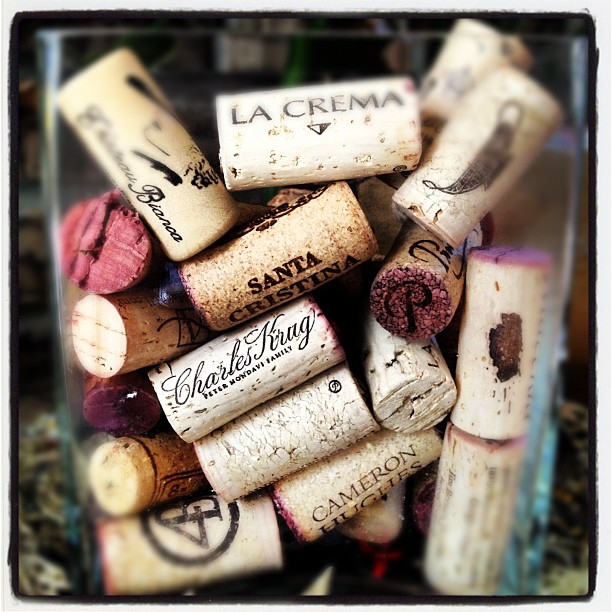
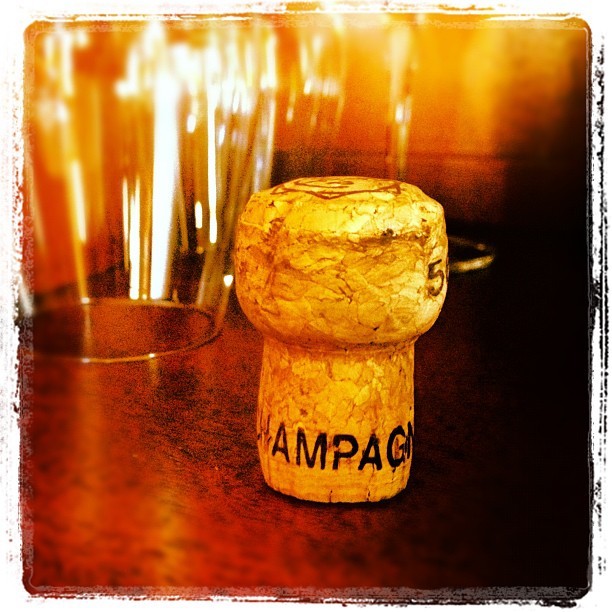
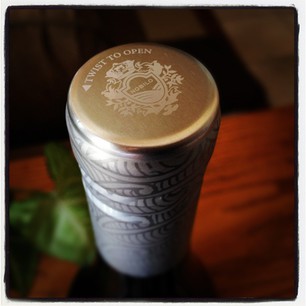
Happy New Year!

Happy New Year!

Happy New Year!

It’s been another busy holiday season! I’ve had a great time visiting friends, family and enjoying the opportunity to taste some fantastic new wine. I’ve been working on some posts for the new year, and have felt much more energized by the past few days.

I want to wish you all a very Happy New Year and I hope that your 2013 is full of good things, wonderful friends and great wine.

Cheers!

Is That An Aerator in Your Pocket or Are You Just Happy to See Me?

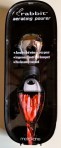
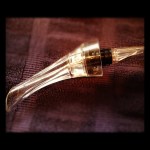
When my husband came home the other day and told me he’d just bought me a ‘rabbit’, I had to think about my response. If you ever watched early episodes of Sex and the City you’ll know what I mean. If you haven’t then, yes, I was concerned about the small, furry animal with the twitchy nose. In this case, he meant the Rabbit aerator.

When you aerate wine, you expose the wine to oxygen. Like decanting, there are clear reasons why:

  • When wine has been closed in a bottle over time, they need a little boost to open up the bouquet or flavors ~ exposing wine to oxygen will help the wine to ‘open’ more quickly.
  • If the wine is heavily tannic, it may be quite strong and unpleasant for the first tastes. The amount of time the wine is exposed to oxygen softens this quality Aeration helps to soften the wine more quickly so you can enjoy the wine at first sip.
  • Wines constantly change after bottling, which is why they are aged but the resulting chemical reactions can produce a gas that may be unpleasant. Different varieties can produce this gassy by-product, noticeable upon first opening ~ yet doesn’t mean the wine has turned. Aeration can help to separate the developed wine from the off-putting gas. I think the rule here is: Classy, not gassy.
  • Aeration can substantially bring out the complexity and expression of a wine that just pouring in a glass (guilty) never can. And it can do it more quickly than letting sit in a decanter or in your glass.

As a caveat: if the wine you’ve poured has, in fact, turned ~ aerating won’t help. We tried that with a recent bottle and it just made it worse.

A Matter of Style

Like decanters, the choice is yours. You can find a multitude of aerator styles, all that work on the same principle: fully oxygenating the wine.  When I go to wineries, most are using them and are loyal to the ones they use ~ and sell~ in the tasting room.

Glass vs. Plastic ~

The choice should be obvious, glass makes sense. Would you prefer wine served in a glass or plastic goblet? There are many expensive aerators fashioned in hand-blown glass and they are beautiful. Being the wine noob that I am, I have plastic.

Keep them separated ~

Do you really need a separate aerator for white and red wine? Many experts agree that decanting should be used for all wines; oxygenation can clearly benefit all. So, too, does aeration. But I wondered if having two different aerators was more marketing tool than necessity. In thinking it through, it would make sense; over time and use, you’d have residue from the red wine that might transfer flavours to any whites that are poured through. That wouldn’t be as much of an issue with glass, as it would rinse more completely. But if you have plastic, better get two.

We decided to take advantage of the wine we had on hand for Thanksgiving and put the aerators to the test. This wasn’t very scientific, we didn’t do a double blind tasting but we did have the two main variables, some nice wine to try. Carefully rinsing between tastings, we each had two glasses, one to try the unaerated and one poured through the Rabbit, then the Trudeau.

  Rabbit Trudeau Classic
Vineland ~ Pinot Meunier 3 0
Strewn ~ Cab Merlot 2 1
Inniskillin ~ Cab Shiraz 3 0
Lailey ~ Vidal 3 0
     

I admit, I was somewhat skeptical about how the aerators could actually affect the taste of the wine. When we tried the Vidal through the Rabbit, it immediately opened up, making the wine more complex and flavourful.  After testing three other wines, it was almost unanimous (except for Strewn) that the Rabbit was the better aerator. Clearly, design made all the difference: The Rabbit was almost shower head like; allowing rivulets to flow down and slide off the curve of the bowl to cascade more specifically in the glass. While the Trudeau brought good amount of air into the pour, it streamed in a way that was similar to just a straight pour from the bottle.

I didn’t know what to expect from my aerator experiment. To taste a distinct difference in one sip after aeration was really surprising and cool. And I enjoy being surprised out of my skepticism, even if this Rabbit was very different from what I expected.

Cheers!

Celebrity Skins: The Grapes of RUSH

Finally! I had to take a step away from working on my aeration post to give a hearty congratulations to RUSH on their Rock Hall nomination. After so many years of not even being a bridesmaid ~ much less the bride, they are being recognized. And it’s about time.

While their reputation as a preeminent rock band is legend, it’s the commitment that both Geddy Lee and Alex Lifeson have to Grapes for Humanity Global Foundation that’s very cool indeed.

Founded in 2001 by Arlene Willis, who lost a brother to a land mine accident, GFHGF works to support land mine survivors by  building prosthetic clinics and aiding survivors in welfare issues. Their chief means of fundraising is putting on wine related activites such as wine tastings, wine pairings and wine auctions. Over the years, their philanthropic endevours have expanded and direct proceeds of the events go to specially selected projects that strive to make the world a better place.

It was seeing the direct effect of the money raised from the events that appealed most to Lee. He tells Samaritan magazine (via ultimateclassicrock and noisecreep), “I was very drawn to it because we did small projects. If we raised $50,000, we’d go to Honduras, build a clinic, and you saw the direct result of that money in action.  And that’s something, to me, that makes you feel really good because you know there’s no waste there.”

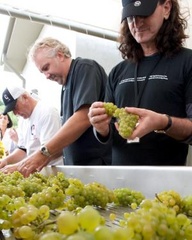
Geddy sortin' da grapes @ Tawse Winery, Grimsby ON ~ image via John Gundy

Geddy sortin’ da grapes @ Tawse Winery, Grimsby ON ~ image via John Gundy

He and Lifeson hosted the maiden “Excellent Adventure ~ Grapes Under Pressure Tour”  in 2009 at Tawse Winery in the Niagara region. The excursion featured a day trip to the winery in a private car generously supplied by VIA rail. There, participants spent the day out in the vineyard picking and sorting grapes, then enjoyed a luscious lunch with wine while bidding on items in the silent auction that featured RUSH memorabilia. The event raised $37,500.

The venue changes each time to feature a different local winery in a different Canadian wine region. Huff Estate Winery in Prince Edward County played host in 2011. The Excellent Adventures have raised over $350,000 for Grapes for Humanity Canada which is awesome. Touring this way is a great way for the GFHGF to gain more exposure to a wide variety of communities, and for the participating wineries to gain new visitors.

I’ll definitely keep good thoughts for RUSH next spring for the Rock Hall induction. I’ll keep even better ones for the their continued success raising funds and awareness for Grapes for Humanity.

Cheers!

Decant ~ Be Serious

I’ve been a bad girl. Not in the Fifty Shades way but as a wine student. Lately, I’ve found myself simply popping a cork and pouring my reds just in the glass. No decanting, no mandatory two hour plus wait time. Sometimes, I aerate but not every time. Most aficionados would slap my wrist (ooh!) and tell me that by not decanting, or at least aerating, my wine is not all that it could be. And they’d be right. So I dusted off my crystal decanter and became very curious about decanting and why it’s important.

Historically, decanters were important because most wines weren’t filtered prior to entering the bottle, sediment was more prevalent and needed to be separated out before drinking. Wine drinkers of yore probably didn’t want crunchy bits in the wine they sipped. Who would?
i heart decanter - image via lh5.googleusercontent.com

i heart decanter – Image via lh5.googleusercontent.com

Decantation is used for the separation and transfer of mixtures. Especially consequential with reds, the wine is separated from sediments or crystals that are a natural component of aging. Another benefit is the removal of any unwanted bitterness and pungent flavors. A certain amount of oxygenation will happen with the transfer from bottle to decanter but it isn’t the same as aeration, which intertwines oxygen into the wine to improve the taste. I’ll write more about aeration in my next post.

Decanting can be applied to white wine but it isn’t as necessary as decanting reds, especially those aged 5+ years that require more delicacy when serving. There usually isn’t as much sediment in younger wines but they can benefit greatly from decanting by enhancement of the flavours, bouquet, and by bringing the character into full effect.

Slow and steady ~ the art of the pour

As important as the decanter is, the way in which wine is poured matters. I’m sure that even doing the quick pour can provide some of the required oxygenation, it might not leave the all sediment out. The slower pour is more deliberate and accurate. And don’t forget, you want to hit that sweet spot, or the curve of the decanter, for maximum distribution.

Joseph Nase from New York Magazine recommends decanting all wines, even whites and that younger wines can be poured directly into the decanter and left to sit for as short a time as 20 minutes. But if you want to do it the old school way you’ll need two items, as well as the wine:

  • a wine cradle
  • a light source such as a flashlight or candle(very old school and romantic)
      • place wine in the cradle and carefully open the bottle ~ Nase says if the mouth stays above the level of liquid it shouldn’t spill
      • begin to rotate the cradle and slowly pour wine into the decanter while shining the light on the neck of the bottle ~ you should see sediment begin to creep up the neck
      • stop pouring! At this point, the wine in the decanter should be clean and clear

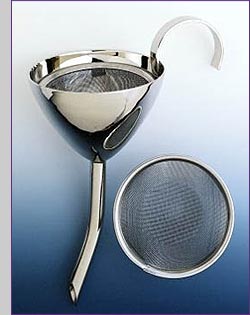
An easier approach involves using a wine funnel and sieve.
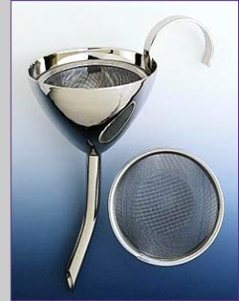
Wine Funnel and Sieve - Image via Artisans on Web

Wine Funnel and Sieve – Image via Artisans on Web

  • Insert funnel with sieve into the decanter
  • pour and let stand
  • enjoy

The sieve will take care of any sediment and bits of cork that may have found their way into the bottle. The funnel is usually shaped with a gentle curve to cascade the wine towards the sweet spot of the decanter. The slower the pour, the more oxygenation and the better the release of the flavors and character of the wine. You can also swirl the wine inside the decanter to provide more aeration before serving.

Keeping it Clean:
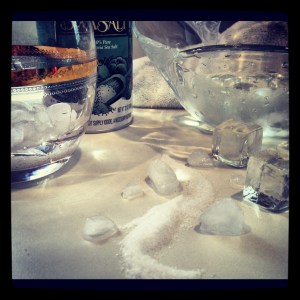
Don’t use detergent. The design of most decanters makes it very difficult to rinse away the residue. And any that remains may effect the taste of the next vintage you pour into it. You pay enough for a good bottle and don’t want it tainted with soapy residue. Ew.

All you need is some coarse sea salt (I’ve used fine equally well) and crushed ice. Place both in the decanter and shake (or swirl) until it’s clean.

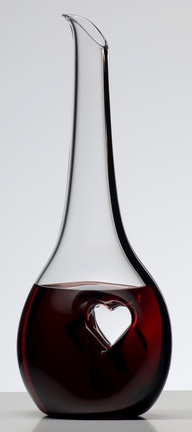
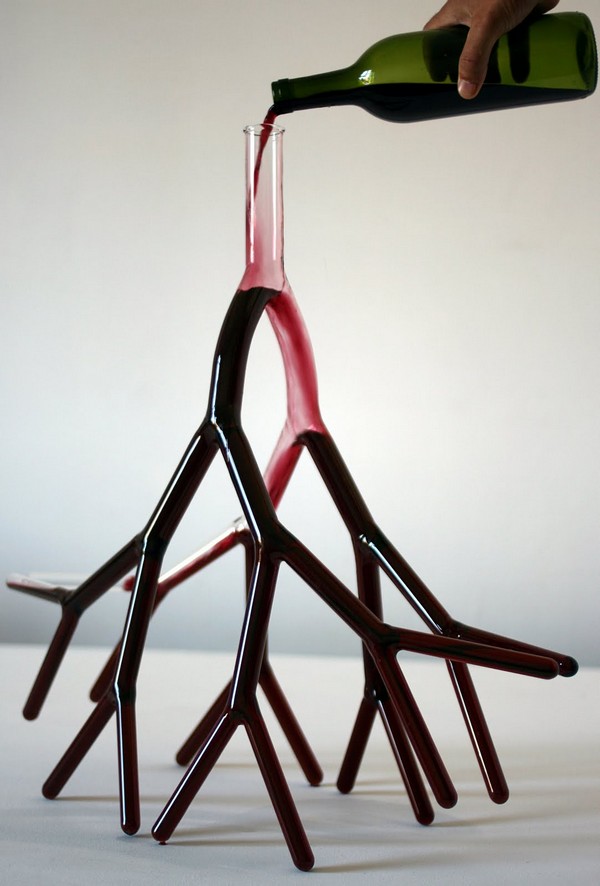
Decanters come in myriad shapes, styles and colors from the classic to the bizarre. I once saw one that had the unfortunate shape of a hand-held urinal, so I  just couldn’t buy it. It’s usually recommended that clear crystal or glass is best, that way you can see the color and clarity, but the choice is up to you.
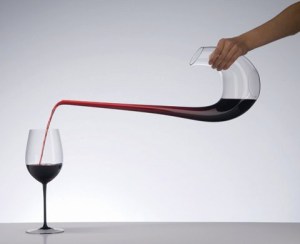
Also works as a Vuvuzela - image via Riedel.co.uk

Also works as a Vuvuzela – Image via Riedel.co.uk
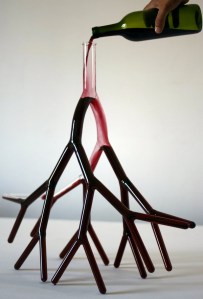
Antlers or Arteries? - Image via Etienne-Meneau

Antlers or Arteries? – Image via Etienne-Meneau

Wine is a thing of beauty and meant to be enjoyed at a slower pace, not rushed through. Part of the experience is the presentation of your chosen wine, slowly poured and displayed in a decanter that reflects your individual taste and style.

Cheers!

Back to the Books!

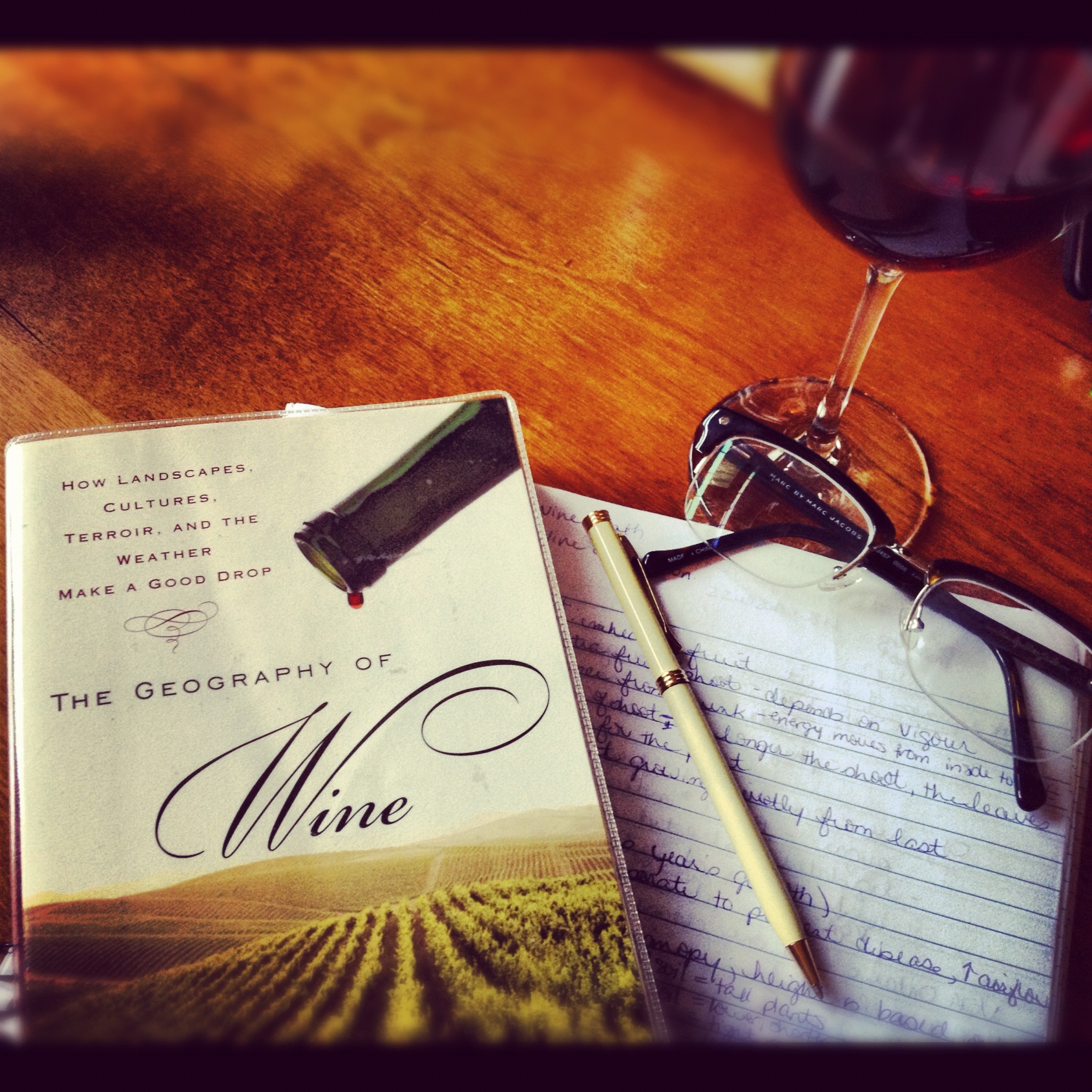
books and wine: homework can be fun!

books and wine: homework can be fun!

Summer, what summer? It’s been crazy busy and now that my daughter is safely into her new school routine ~ I still can’t believe she’s actually in high school ~ I thought I would do a little reading to help me come back to earth, so to speak. ‘The Geography of Wine” by Brian J. Sommers was a great exploration of various world wine regions and what makes them unique from a geographer’s perspective. What I liked about his approach was he took a subject that had the potential of being very dry (wait ~ was that a pun? you know my policy on puns ~ bottoms up!) and boring but made it very accessible and interesting.

If you’ve ever been curious about terroir and the role geography plays in the concept, this book summons all aspects. In a way that’s easily read for the lay person, Sommers deftly explores the biogeography of the grape, how urbanization affects wine geography, and economics ~ including the politics of wine with respect to its’ unique growing regions. In the last chapter, he discusses his own love of wine and how in each glass,  not only do you taste the grape but you taste a great deal about the culture of where it’s grown, nurtured and loved.

I’ll write more about terroir in another post but in the meantime, I’d like to recommend this book as a great reference for discovering that what goes into your glass is so much more than just fermented grapes.

Cheers!

2012 Cleveland Wine Festival ~ Sun, fun and wine

I didn’t think we’d make it downtown. The forecast was shaping up to be rain with a chance of more rain. But the thing about Cleveland weather is what might be happening in one ‘burb might not be happening in another. On the other hand, there’s nothing worse than trying to quaff when your glass is filling with rain instead of wine. As luck would have it, when we arrived at the Giant Eagle Cleveland Wine Festival at Voinovich Park, the clouds parted and we were treated to great sunshine, a warm lake breeze and some interesting wine to sample.

Cheers!

This slideshow requires JavaScript.

Hot Child in the Vineyard

The last little while, I’ve been hitting the study hall, partly to get a break from the heat, but mainly to learn about the first two components of the growth cycle of the grape: spring and summer.  And with August quickly approaching, it’s pretty clear, we’ve passed one season and are well into the next. So here we grow ~ remember, every time I make a bad pun you have to sip some wine. Since that was particularly bad, make sure you have a big glass.

After hibernating from mid December to April, we come into a time when the newest tendrils of the vine shake off the winter shroud and wake up ~ too flowery? Okay, I’ll keep it real. The first stage of the cycle is known as bud break ~when the initial shoots start to grow. This happens around May 1st through May 24th. If the temperatures are warmer earlier, the buds will pop a little sooner. Early bud break can be a positive because there is the potential for a longer growing; season and riper fruit. The downside is there is an increased vulnerability to late spring frost. Early shoots will not regrow if exposed to 0 C (frost). While this can be fairly tragic if the shoots are damaged, all is not necessarily lost. The crop size will decrease but quality of wine can increase..

In Ohio and most of the mid-west and Southern Ontario, this spring was particularly complex, with temps in March hitting in the 80’s and then diving back down to seasonal cool in April. It’s kind of like waking up on Mr. Toad’s wild ride when you’ve been having really long nap. For the newly emerging buds, it’s not something they want to ride too often.

Every fruit begins with a flower

Summer in the vineyard begins approximately June 21st when flowering occurs; this is usually a reference date because harvest is approximately 100 days after flowering. The flowering cycle in June, is typically 10-14 days. Flowers are delicate and really need clear weather to set. Fruit set happens in July and means that everything that is going to happen to the plant has happened, and all usable fruit is set to grow to be harvested and made into wine.

August or late summer is the last time the crop size can be affected. As I mentioned before, a smaller crop size gives greater quality fruit, but to a point. Again, it’s a fine line to tread when making a high-caliber wine from a less than ideal start.

Thinning on top

The deliberate harvesting of unripe grapes to encourage concentration of flavor or character in the remaining bunches is called grape thinning or green harvest

The percentage of fruit removed depends entirely on the grape variety; some ripen all the grapes and some only half. It also depends on the vigor or how much fruit the plant can support. Grape thinning also depends on the vintage, variations in the growing season, the style of wine and the philosophy of the winemaker and grower. Thinning involves removing any unhealthy fruit on the plant. This allows for the remaining fruit to receive all the nutrients. The concentration of energy of the plant moves from the inside, or main stock, to the outer fruit and leaves. It’s around this time that veraison occurs. Veraison marks the onset of ripening, when grapes soften and change color. This happens around 6-7 weeks after flowering.

Hanging loose

Canopy management of the current year’s fruit keeps the growth loose and separate to prevent disease and to maximize airflow and sunlight. I could liken it to wearing boxers versus briefs but I think that would be all kinds of wrong. And while it isn’t a bad pun, per se, feel free to quaff now. Canopy management is also employed to control the height of the plant; maximum canopy height is based on spacing, vintage and vigor. In September, leaf thinning occurs. This also promotes airflow and increased exposure to maximum sunlight to advance ripeness. The inefficient leaves that take vital nutrients from the efficient ones are removed.

There’s so much to look after and nurture throughout the growing season, and that’s before you even get to the harvest. With the hot, dry growing season this year, my prediction is that harvest may begin well before September.

With the plants stressed as they are, and knowing that sometimes stressed grapes can create more complex wine, I’m really looking forward to seeing what this year’s vintage tastes like.

Cheers!

This slideshow requires JavaScript.


Summer Lovin’

I think it’s safe to say that old man winter has put on his hat and taken his crotchety, blustery self back to where he came from. To celebrate,  I’m going tonight, with my friend Shelly, to the Summer Wine and Beer Feast at Heinen’s in Strongsville.

It’ll be nice to put on my white jeans (gasp! before Memorial Day and everything) and see what is trending this season for summer wine fun.

I’ll post some pics and our picks of the night’s offerings.

Cheers!

Put A Cork In It?

What’s with the screw cap? And what kind of wine are you giving me? is what  I thought the first time a friend unscrewed a bottle of wine. My assumption was wrong. And probably a little snobby. You have to understand that for years, a screw cap meant the wine you were getting usually came in a six-pack and somewhere on the label ‘apple’ was prominently featured. It was the kind of wine you could open and chug easily and throw up even easier.
Over time, the screw cap has gained and, for some, surpassed the cork in prominence and respectability. Increasing research into its’ benefits are emerging to support the screw caps’ validity as a high quality closure in high quality wines.

All Corked Up
For generations of winemakers, cork had been the go-to material for wine closure. If you see wine making as an expression of tradition among other things, cork would naturally be the logical choice, even with arrival of synthetic and screw caps.
Much care goes into producing a good quality cork. According to Wineanorak.com, the bark from cork Oak trees in Spain and Portugal is harvested every nine years when the trees have reached maturity, with no harm to the tree. The harvested bark is boiled to soften and cleanse it. To evade cross-contamination, the used water is cleaned, filtered and replenished regularly to withdraw any volatile elements. The cork planks are then graded, cut and either hand or machine punched. Great care has to be taken during the inspection phase because damaged or faulty corks can’t be used. Once the corks are punched, the surrounding cork material can be granulated and processed to make less expensive agglomerate corks. These corks are frequently used for champagne or sparkling wine.
Once at the winery, a ‘corker is used to compress and insert the cork into the neck of the bottle. Corks can be made in different sizes; the smallest (7) being used for wine that is not intended to be stored long. The larger (10) is thicker and longer, allowing less air into the bottle over time and is used for wine requiring long-term cellaring.

Just Screw It
A recent two and a half year study by the Hogue Cellars, found that wine sealed with screw caps tended to be remain fresher for longer periods of time than wine sealed with synthetic or natural cork. They tested all three types with their Chardonnay and Merlot and found that because of cork’s natural imperfections, they crumble, break, leak and while cork allows wine to ‘breathe’ it was inconsistent. Some corks would allow too much air; others, not enough.
As well, approximately 15% are contaminated by 2,4,6-Trichloranisole (TCA) a cleaning agent used to sanitize cork before bottling.  TCA is what can give the wine a musty and moldy taste. That said, sometimes, part of the ‘finish’ of a wine can be due to cork and may be part of the essence the winemaker is wanting to include.
Synthetic corks, derived from plastic, were found to cause wine to age too rapidly, decreasing shelf life by the inability to halt oxidation.
Stelvin screw caps, were shown to have a capability to preserve the quality of wine more consistently, oxidizing at a lower rate. This allowed for better long term aging and increased the maintenance of flavor and quality.
Of course, another benefit to the screw cap is that you can easily reseal your wine for storage (but why would there be any left). I can’t tell you the number of times I’ve re-corked and stored my wine, only to find a massive leak in my fridge the next day. Taking a straw to it just didn’t seem right somehow. Ick.

Pros and cons for both cork versus screw caps exist yet many are quite vehement about which side they fall on. I admit, I’m still a bit on the fence. While I’ve become more aware and accepting of the differences in wine closures, there’s nothing quite like that ‘pop’ when you open a beautiful bottle; it’s part of the experience of wine. A twist off just doesn’t have the same zing. But I’ve been put in my place and have found that what ends up in the glass can be sublime no matter how it’s sealed.

Cheers!

If you’re interested in learning about the environmental debate about corks vs. caps, click on the link for a great article by Lynn Siegel.