According to lore, on a dark and stormy night in 1816, Mary Shelley and a few of her friends (including Lord Byron, natch) set out on a quest to create their own ghost stories. As often happens at parties, when maybe a bit of wine has been consumed, she drew a blank. Yet several nights later, she dreamt about a ‘pale student of unhallowed arts’ kneeling beside his creation — who was a total monster!
And with that her classic gothic novel Frankenstein was unearthed.
For this Halloween, I’d like to suggest a disturbingly dark, yet flavorful, 19 Crimes Frankenstein Cabernet Sauvignon. The fun talking label (scan the QR code to make Frankie come alive) is your invitation to come up to the lab and see what’s on the slab.
Click the video below for some more spooky fun!
As towering in flavor as Frankie is in height, this is a wickedly robust red. Flavors of dark cherry, black currant, and rich chocolate will electrify your taste buds, pulling them out of the doldrums, across the moors and into the light.
Its tannins and medium-high acidity help cleanse the palate, balancing rich or fatty foods. It’s a bold and hearty creature and can deftly handle peppery sauces, marinades, and spices such as turmeric, caraway, and coriander.
Pairs well with: rich grilled meats — beef, lamb, venison, and cheeses such as aged Cheddar, smoked Gouda, Muenster.
Price point: $18.00
So put down your torches and pitchforks and take some time to enjoy this wine for your monster chiller horror night. And when you turn off the lights, you’ll see how the label glows in the dark. Too fun!
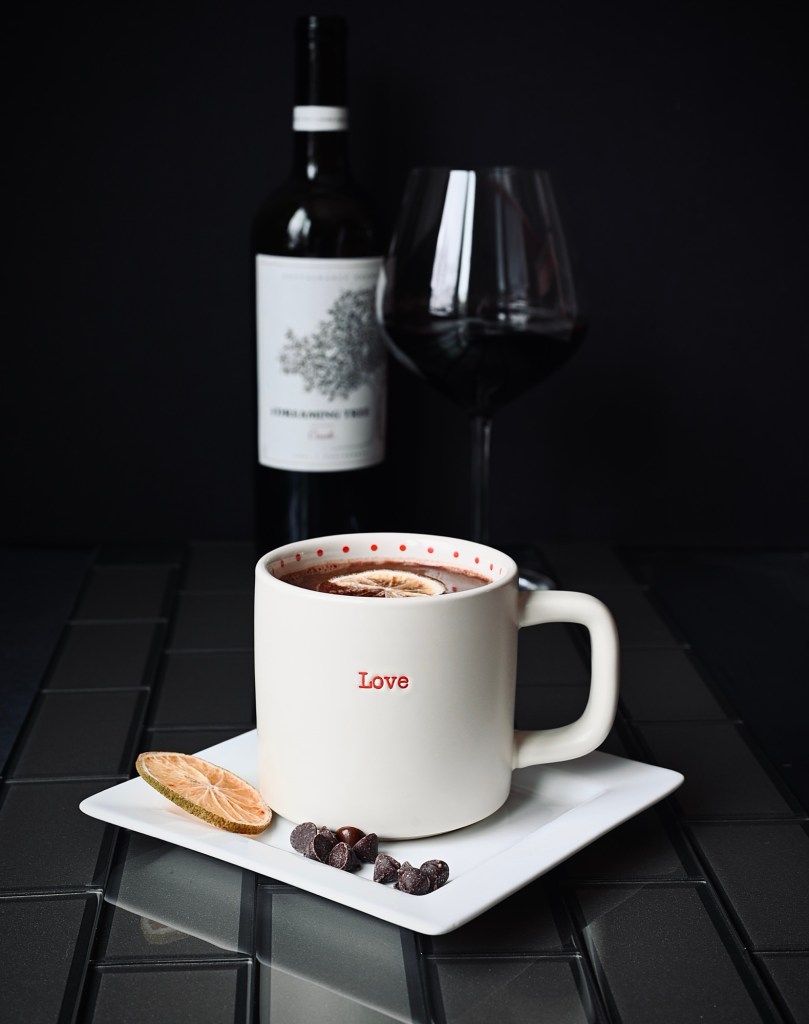
January 31st is National Hot Chocolate Day and I’m celebrating early with a little kick. Choosing mindfulness over a dry January, I’m combining two things that I love: hot chocolate and wine. 🍫🍷
So yesterday, I took a test run to make a rich, delicious treat I could enjoy and savor on the day, and while waiting for the snow to melt.
Cutting right to the chase, below is the yummy Red Wine Hot Chocolate recipe from Wholefully :
Ingredients
2/3 cup semisweet chocolate chips {recommended: Ghiradelli}
2/3 cup dry red wine (merlot, shiraz, cabernet sauvignon)
1/2 cup milk
1/2 cup half and half
2 tablespoons sugar, optional (see notes)
Pinch of salt
1/2 teaspoon vanilla extract
Instructions
Combine the chocolate chips, wine, milk, half, and half and sugar (if using), in a small saucepan over medium-low heat. Heat, stirring constantly, until chocolate chips are melted and the mixture is hot.
Remove from heat and stir in the vanilla and salt. Pour into mugs and serve!☕️☕️
As for the wine, since the recipe called for Merlot, or Shiraz or Cab why not simplify and use a dry red blend? This Dreaming Tree Crush was a perfect combination of everything I enjoy: 59%Merlot, 16% Petit Sirah, 15% Zinfandel, 4% Syrah and… whatever the ‘other’ is… no problem!🍇
Since I find this wine rich but not super sweet, I added a pinch of sugar to taste which helped to balance things out. Stirring the mixture gently became almost meditative. When it was ready, I slowly poured it into my cup, letting it stand for a few moments, allowing it to thicken into a rich, dark and creamy treat.👇
I took my time sipping and savoring watching some of the icicles sluggishly begin to melt. Since they were taking their time, I did too. Pouring myself another cup I leisurely sipped and flipped through a vintage fashion magazine.
The weather might still be a little frightful this week, but it’s so easy and delightful to make yourself a decadent, warm little hug. 🤗
It’s suddenly that time of year again, where one’s fancy turns to… cleaning. 🧽🪣
If we don’t often use decanters, we tend to forget about them, and they sit in the back of a cupboard or cabinet. If you’re like me, you might leave them on a countertop where they are exposed to dust, and kitchen grime.
Sure, you can try to blow the dust out of your decanter right before you fill it with wine, but trust me, this is not a good plan. 😶🌫️ Kitchen dust and wine do not mix. The ‘earthy’ vibe that you think will enhance the wine? Nah. Not a chance.
Help is on the way!
Click the video below to see an easy way to clean your decanter before your next wine dinner! 👇
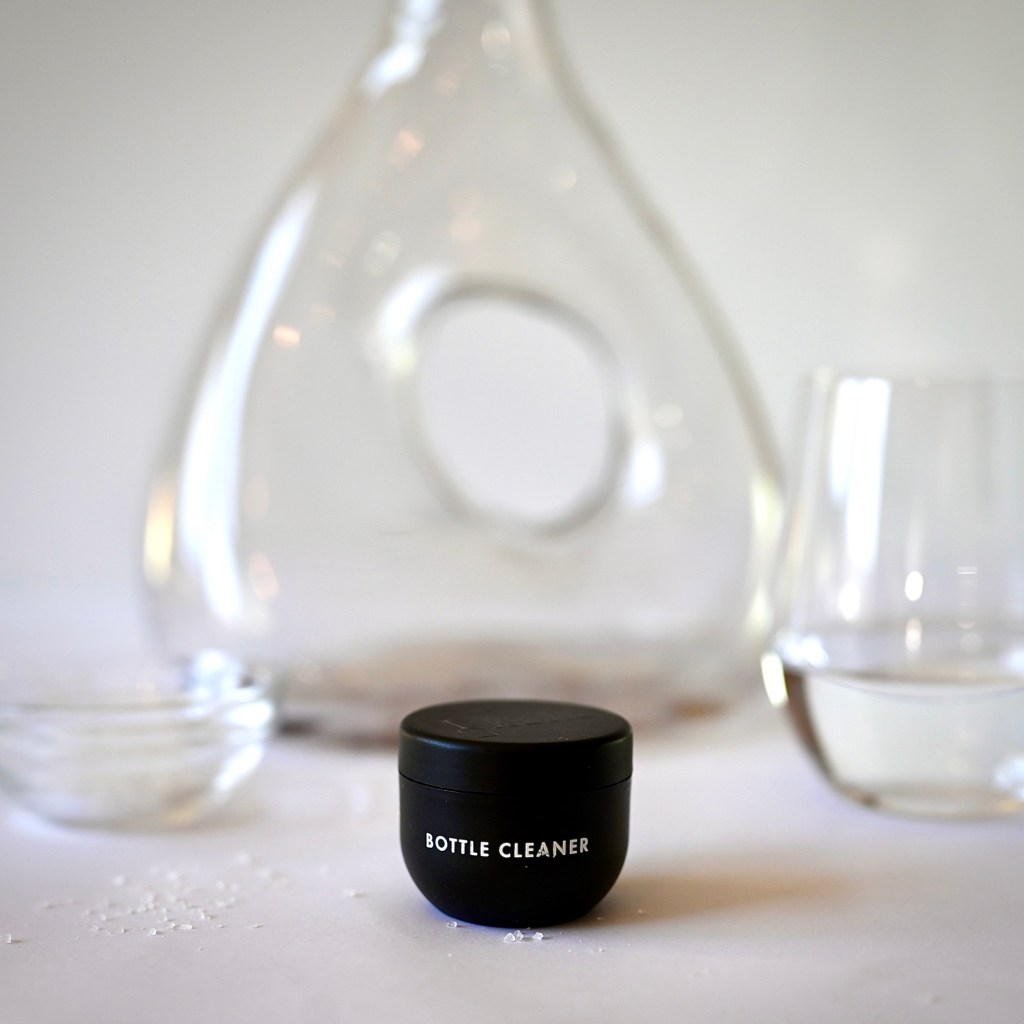
There are a few methods out there but I found the Riedel Bottle Cleaner to be one of the best, natural cleaners.
I had a decanter that had a lot of old wine sediment that water and salt alone couldn’t seem to loosen.
Carefully pouring the little stainless steel balls into the decanter (with water and about 2Tbsp of coarse sea salt) I swished for a full 2 minutes. Like magic, all of the stubborn sediment from the bottom and sides was loosened. After a good rinse, the decanter looked sparkling clean!✨
At $15.99 this cleaner is reusable, non-toxic and very user-friendly.
To be clear, this post is not sponsored content. I just found this was a cool product I purchased few years ago and wanted to share with you.
Every December 31st, many of us resolve to change a few things for the new year. Maybe we’re getting back on the treadmill; maybe it’s the promise to cut back on those indulgences we allowed ourselves over the holidays.
For many, we go cold turkey – cutting out alcohol in all its forms = Dry January. But every so often we reach for a bottle without thinking. It’s automatic. Maybe it’s a part of a nice dinner or celebrating the end of a day.
One of the things I love about wine is its sensual nature. I like the feel of the glass in my hands, the scents on the nose, the complexity of flavors as they caress the palate. The buzz isn’t always the attraction (tho it can be fun).
The challenge with many dealcoholized wines is experiencing the same essences, flavors and mouthfeel of wine with alcohol. It usually just tastes like grape juice. Which is fine but…it just doesn’t have the same vibe. And pairing with food can be even more tricky.
Alcohol is often what gives wine its body and texture, creating that nice bounciness (or solid gravitas) on the tongue.
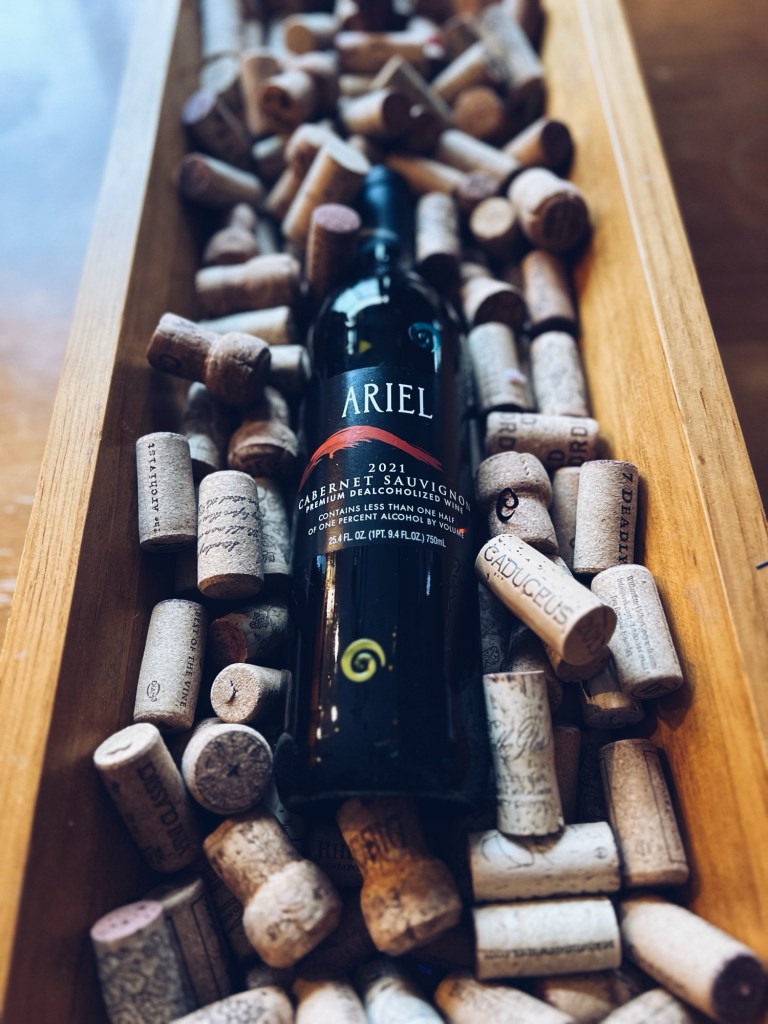
Dealcoholized wines contain the exact grape varietals as its boozy counterpart. The difference in the processes used to remove the alcohol. This wine is created using the cold-filtration method.
Health Benefits of Dealcoholized Wine:
*Contains resveratrol, the component in red wine that has anti-oxidant properties
*Decreases stroke – promotes HDL (the good cholesterol) and decreases LDL (bad cholesterol)
*Anti-aging
*Anti-inflammatory – protecting cells, especially in the heart and brain from damage
It had a lighter mouthfeel, bright essence of cherry with underlying earthiness that lingered for a bit on the finish. It’s refreshing little vibe is fun with a sweetness that’s not cloying. In the glass it has the clarity and deep ruby color of a Cab. HubbyDoug was fooled! He thought I’d already blown off my dry January pledge! Lol Such little faith.
Most dealcoholized winemakers make it pretty clear that their wine will taste different than what wine drinkers are typically used to. And that’s true. But for the pure enjoyment of a beverage with all the benefits of red wine ( and none of the side effects) it’s a nice change.
So raise a glass to Dry January to all those who participate!
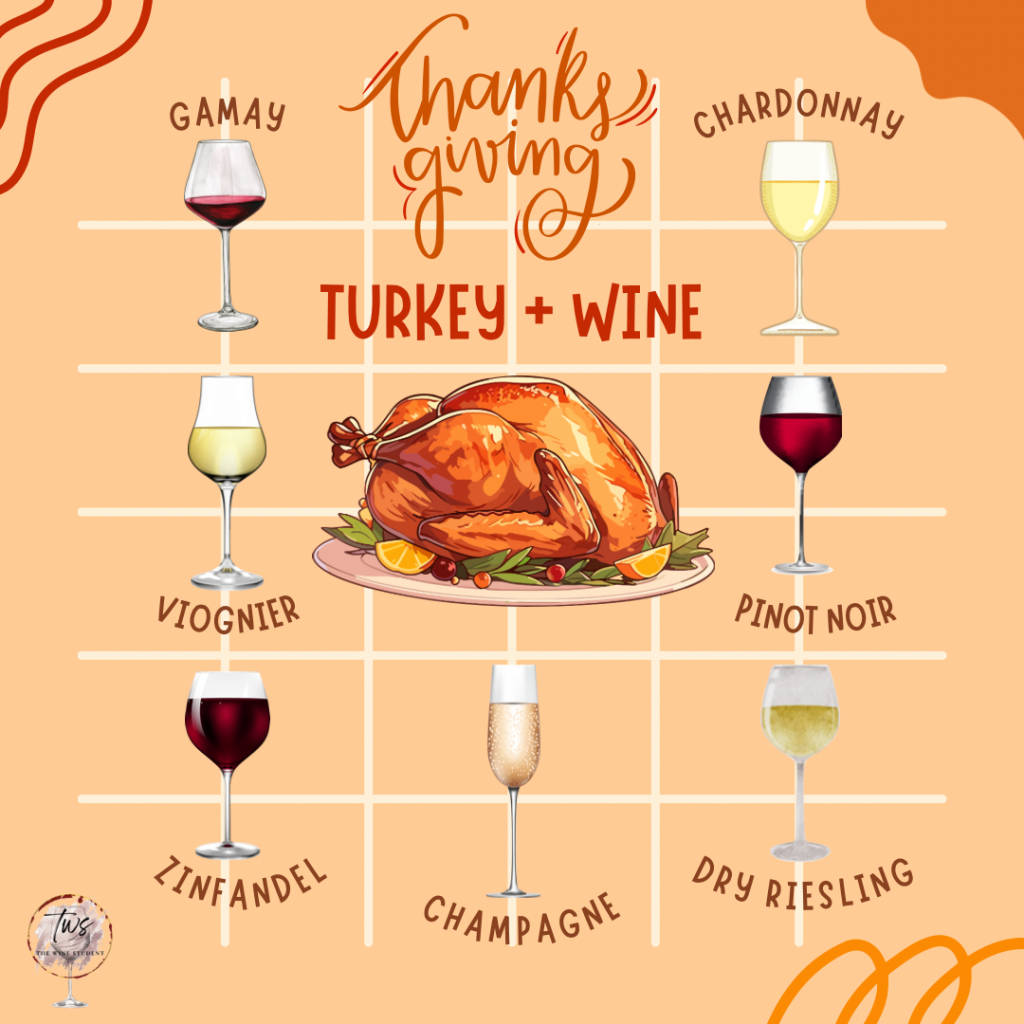
Now I know you’re not going to have just a turkey on your table. But I wanted to keep it simple and spotlight the star of the show (though maybe it’s a featured player, as we all know the real star is you).✨
According to Food and Wine magazine, turkey’s rich flavor profile; light and dark meat, and its juicy texture matches well with a wide variety of wines and traditional side dishes.
Keep in mind that what’s good for the turkey is probably going to be good for the side dishes.
•Dry Riesling– OK… wait a minute, this isn’t the sugar bomb you think it is. Many have the view that riesling always equals cloyingly sweet. But this dry offering is the riesling you never knew you wanted. High acidity and plentiful minerality make this a most agreeable turkey companion.
•Chardonnay – Sometimes chosen because of its name recognition, Chardonnay can be a wonderful pairing with turkey. Crisp acidity, and fuller-bodied vibe make it a pleasure to sip. Old World offerings, particularly from France, are more citrus-forward with a stalwart mineral heart. New World Chards from the US, Australia and South America have a juicier, stone fruit vibe. Hint: Add a little to the turkey as you baste.
•Gamay – The Beaujolais grape, but skip past the Nouveau and head straight for a more mature offering to enjoy. Pleasant high acid, lo tannin, and a satisfying grippy mouthfeel make this wine one of the best pairings with turkey.
•Pinot Noir – A classic, Pinot Noir’s playful flavors of cherry make this a great pairing for both turkey and your favorite sides. Pinots from France have a grounded, earthy, mushroom-y, tart cherry gravitas where New World Pinots brings forth a brighter complex cherry vibe. 🍒
•Viognier – An excellent, but not as well known match, Viognier’s whispers of honey and rich ripe stone fruit essences are wonderful with the tender turkey. Look for amazing offerings from Northern Rhone, South Africa and Australia.
•Zinfandel – Jammy, juicy and fruit forward, this wine is a boss pairing with both light and dark turkey meat, and many traditional Tgiving sides. A big hit on turkey day, you might want to splurge and buy a couple of bottles. 😉
•Champagne – Bubbles and high acidity make this wine a merry treat to cut through the richness of the turkey and all side dishes. And it makes your holiday table scape even more festive and fun! 🥂
When all is said and done, these are simply suggestions to dial back some of the guesswork when picking your wine. In the end, it’s really about sharing time with family and friends. And whatever wine(s) you choose to adorn your Thanksgiving table this year, I hope you have happy and healthy holiday!🧡
•Eco-wine tour w/ Owen’s Hiking & Adventures @ Vineland Estates
•Ice Wine Cocktail Party
•Lazy Saturday Tasting @ iCellarsEstate Winery
They say you can’t go home again. I’m happy to report that’s not always true. I went home to Niagara this past weekend. And it was wonderful!
Click the video below for more fun!
🗓️Friday – At Vineland Estates, my friend Deb and I got out on the vineyard (and part of the Bruce Trail) with Owen Bjorgan of Owen’s Hiking and Adventures. We learned about the Niagara bench ecosystems, how they affect the vineyards and the resulting wine. It was awesome to taste the wines in the spot they were grown.
Winding our way from the Riesling vineyard through a small nearby forest, Owen explained how the forest, in close proximity, provides numerous ecosystem benefits to vineyards, such as increased whole-farm yield, increased soil water-holding capacity, reduced erosion, cleaner watersheds. With this being a natural agroforest ( it was there first), set a little away from the vines, there is little to no competition for nutrients, resources and light. All the benefits and no fighting.
It was incredible to leisurely hike, enjoy the cool of the forest, and end our tour back in the sunny warmth of the vineyard. It’s very healing spending time in nature… the wine didn’t hurt, either!🍷
Hailed as the ‘event of the summer’ and held at Hiscott House, a private residence in Niagara-on-the-Lake, my friend Steffanie and I enjoyed, of course, fabulous Ice Wine cocktails. 🍸 Add to that a diverse menu of savory and sweet treats, ending the evening with a chocolate Ice Wine shot. It was the place to see and be seen, and was a great evening for great causes. ✨
•
🗓️Saturday – with Friday being so busy, it was great to slow down, chill and have a lazy Saturday. Deb, Shiona and I met for a leisurely wine tasting at iCellars Estate Winery. This is a favorite spot, especially during harvest. We meditated on our flights of Chardonnay, Rose, the Arinna Red Blend, and Cabernet Sauvignon. This year’s pick – the Cab Sauv!
We spent some time after our flights enjoying a glass outside on the patio, gazing out as the golden sun warmed the vineyard.
And as we drove away, I saw a motorcycle with two dogs in goggles in the sidecar. And I know what you’re thinking… what do they put in their wine? I asked Deb if she saw it too. She did.
Luckily, I got a picture.
If you’re in the Niagara region, make a point of experiencing these great wineries. There are so many to choose from, and each with their own unique style.
I love Rosé. I love it in summer. I love it in my picnic basket. But I was looking for a change. I wanted a couple of wines that were light and refreshing but not my usual go to. I circled back to a couple of wines that I’ve not had in a while: Pinot Gris and Beaujolais.
Made from Gamay grapes, this is no Beaujolais Nouveau,which is consumed right after harvest, and of which I’m not generally a fan. It’s way way too young. This wine was light-bodied, fruity and earthily floral. Paired with the Asian ramen salad, it brought out more of the fruit and had a lovely finish that lingered. Often, I find Beaujolais a little too fleeting but this pairing was both lively and light, highlighting the ripe peach flavors in the salad.
I paired the Pinot Gris with both the dill deviled eggs and the grilled cauliflower. While starting out with subtle flavors of white peach, cantaloupe and lemon zest, I liked the brightness and acidity that picked up nuances in the Dijon mustard and seasoning, while cutting a nice little swath through the creamy richness of the dill/egg mixture. With the cauliflower, its subtle vibe melded well with the creamy feta and brought out the heat of the red pepper, especially on the finish. It was like little fireworks on the tongue, an unexpected but nice surprise. It was a totally different wine with this pairing.✨
And I guess that goes to show you; first impressions are not always what they seem. Sometimes circling back can help you discover what you may have missed the first time around.
I think that’s one of the many things I love about wine – the flavors and characteristics they possess on their own, and how that can completely change when paired with food. Textures, protein, fruit, vegetal vibes can bring out so much more depth on both sides of the equation. Food + wine = awesome!
Whatever you choose to pair with your holidays, may they be safe and happy.🏖️🎢🎡
Visiting the Biltmore Estateis like taking a journey back in time. An awesome example of both architecture and design, its esthetic influenced by the great chateaux of France.
Click the video below to tour with me!👇
We’d originally planned this trip with our friends Carl and Deb, in May 2020… and we all know what wasn’t happening then. So it was wonderful to finally have all our schedules reconnect!
When I first researched Biltmore, I was pleasantly surprised to learn about their winery. Documents dating back to 1916 show that George Vanderbilthad begun collecting wines for his cellar. Jump forward to the early 1970’s, William Cecil, George Vanderbilt’s grandson, established vineyards on the property. The first Biltmore wines were made available for sale in 1979 under French winemaster Phillipe Jourdain’s direction. In May 1985, Biltmore Estate Winery opened its doors to the public for tours and tastings. Building on the original French-American hybrid plantings, Jourdain planted additional vinifera varietals to ensure the future of their wine cultivation.
Sharon Fenchakjoined Biltmore in 1999, eventually becoming winemaker in 2003, then head winemaker in 2018, further crafting on the foundations laid out by previous winemakers, Jourdain and Bernard Delille. She now oversees an annual production of approximately 150,000 cases.
Situated in the Blue Ridge Mountains, at an elevation of 2,500 ft, growing conditions in this part of North Carolina can be challenging, especially with rapidly fluctuating temperatures during growing season. Days here are warm yet humid, with cooler nights, a high incidence of rainfall, and risk of late-harvest frost. This combination makes growing more delicate varieties difficult. Heartier varieties flourish here. Polk County, just south of the estate, has a lower elevation and a ‘thermal belt’ micro climate, reducing the risk of damage to the fruit.
Locally sourced wines include robust varietals including Chardonnay, Cabernet Sauvignon, Cabernet Franc, Petit Verdot, and Merlot. Their Biltmore Reserve NC Rosé is a home-grown, balanced blend of heartier Cab Sauv and Cab Franc of both estate and lower elevation North Carolina vineyards.
To produce a wide array of offerings, grapes and juice are sourced from not only North Carolina but California and Washington. Their American Series wines reflect this diversity.
The winery also maintains a commitment to sustainability; using locally sourced water from nearby Long Valley Lake, and recycling their plastic, glass, paper and steel. Adjacent to the Winery, is a nine-acre, 1.7 megawatt system that includes more than 7,000 solar panels to help counterbalance estate energy usage. Grape byproducts such as crushed stems and skins are used for mulch and compost. Retired barrels become planters and used corks are repurposed as wine racks to display their wines in retail stores. Biltmore has also partnered with Cork Reharvest and the Cork Forest Conservation Allianceto reuse corks and help decrease the depletion of cork trees. Visitors are encouraged to drop off used corks at the winery, all estate restaurants, andWhole Foods stores throughout North Carolina.
Out of town? You can mail your used corks to: Biltmore Estate Wine Company Re: Cork Recycling 1 North Pack Square Asheville, NC 28801 👍
We tasted some wonderful wines on our tour but here are the three we took home:
2021 Biltmore Estate Grenache Blanc
My pick: The 2021 Limited ReleaseGrenache Blanc.While it’s not from indigenous grapes, I loved the bright, refreshing and flavorful alternative to Rosé. I’m used to grenache as a lovely red so this was a treat. a nice, bouncy alternative. Tropical flavors of banana, melon, citrusy mandarin, and a light, playful mouthfeel. I can’t wait to pair with some delicate cheeses, fruit or charcuterie.
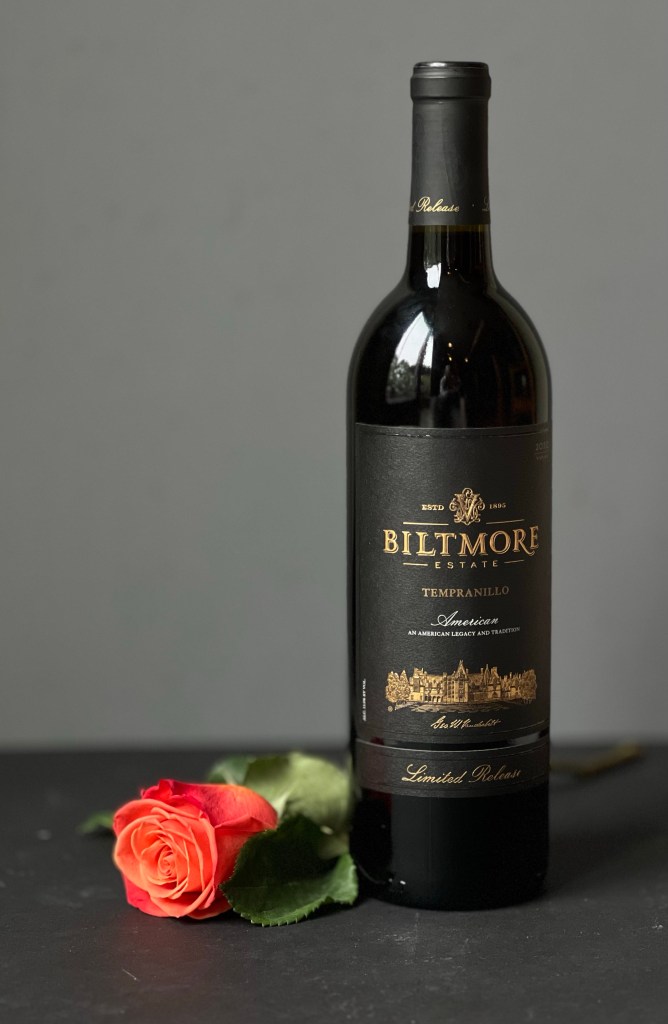
2020 Biltmore Estate Tempranillo
Dougie’s pick: The 2020 Limited Release Tempranillo. American Appellation with flavors of dark fruit, fig, and nice grippiness from the tannins. Aged 16-20 months in oak.
13% alcohol. $24.00
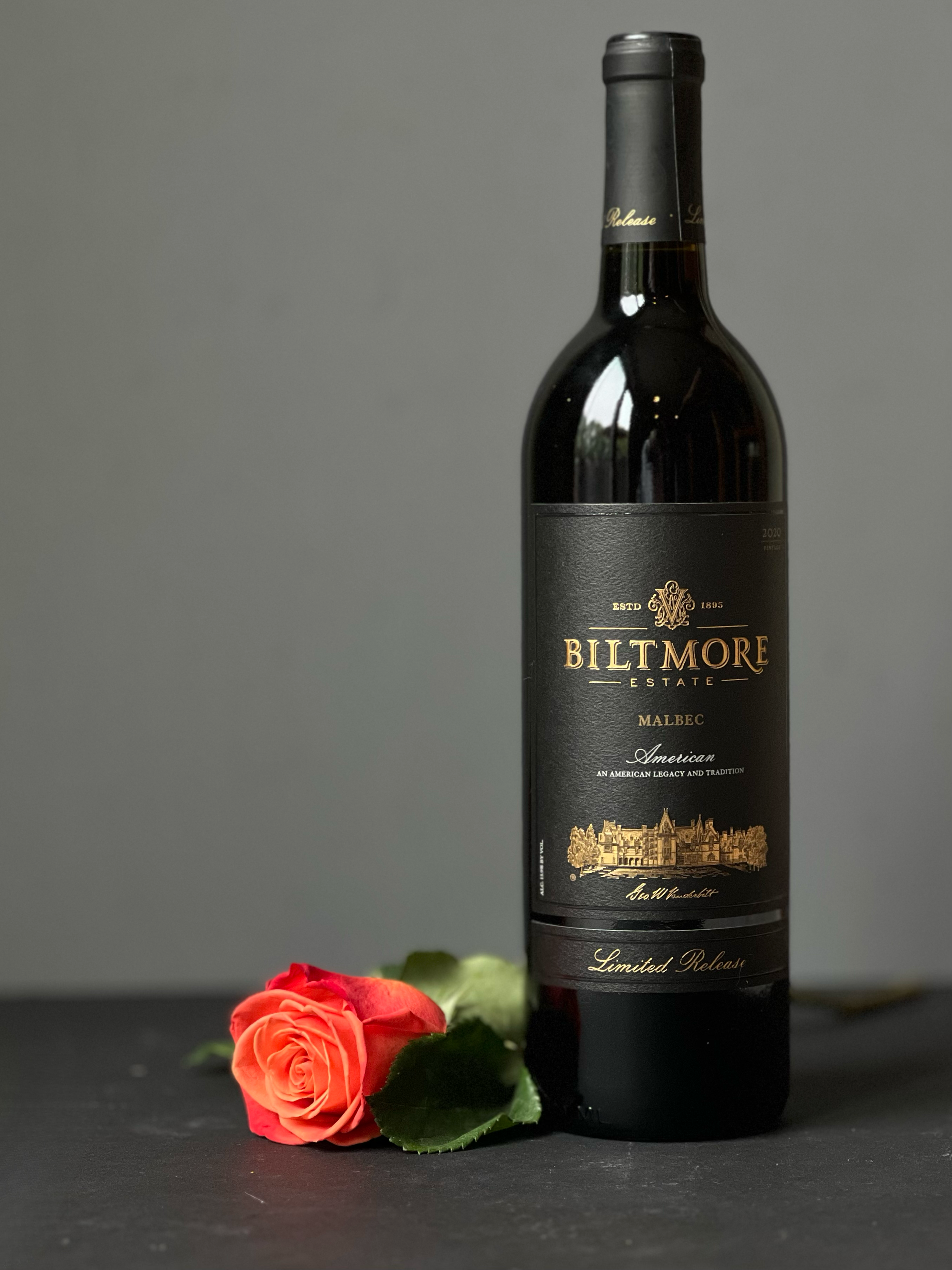
2020 Biltmore Estate Malbec
Our pick: The 2020 Limited Release Malbec.Something fun for Malbec Mondays! We haven’t had Malbec in some time so this was a nice change from our go to Pinot Noir. Rich blueberry, blackberry and plum with a hint of spice on the finish. Also aged 16-20 months in oak. It’s one to savor slowly and enjoy with maybe a nice beef brisket. Yum!
13% alcohol. $ 22.40
The best part about the trip was finally reconnecting with our friends again, and to take a little step back in time. ♥️
Biltmore is definitely worthy of a place on your bucket list; and the wine makes it even better!
With the luck o’ the Irish at yer back, may you find health, happiness and a pot of gold. Okay, that’s not really a blessing but a mashup of a few.
St. Patrick’s Day is a sure sign that spring is on its way. And spring is often viewed as a season of magic and alchemy. Wine is also a blend of magic and alchemy. Especially Irish wine.
Growing conditions in the Emerald Isle can pose many challenges to winemaking. And that’s where the magic comes in.
Established in 2002 by fruit alchemist David LLewellyn, Lusca cultivates several varieties of grapes including Cabernet Sauvignon Merlot, Dunkelfelder and Rondo – a grape that can heartily withstand Ireland’s damp, misty weather.
Click the video to learn more about Irish wine and how its made!👇🍀
A few years ago I was determined to find my little pot of gold, and I did. To read more about my search click here. Since then this lucky bottle has remained, relatively undisturbed, in my little cellar wine fridge. I hope it’s been enough to ensure its good condition. All told, it has aged about 9 years. I had many thoughts before opening: has it already peaked? Is it a delightful vinegar? But maybe luck would be on my side.
There was only one way to find out…
Time to release the wine!
To be safe, I decanted for about 2 hours. I wanted to let it open up as fully as possible to make a fair assessment. So how was it?
It didn’t turn to vinegar! I wasn’t as concerned about the wine as my storage. I don’t have a fancy wine cellar, and occasionally had to move the bottle around. I had been worried that after all this time, maybe some oxygen had gotten inside. But I was so happy that all seemed to be well. Magic!
It was a lighter bodied Cab/Merlot. I enjoyed delicate notes of blackberry, dried herbs, and a pleasant, earthy cedar undercurrent. I found myself swirling my glass often to coax out every essence. It had a clear, deep ruby color giving way to a slight brownish rim variation (the outer edge of the wine). This suggests aging of the wine. I didn’t notice any nutty or toffee flavors that indicate an oxidized wine.
As I tasted, I noticed the sun was shining – here in the Cleve we catch it while we can- so I bundled up, sipped my glass outside.
To celebrate International Women’s Day, I popped open this bottle. I toasted all women with a beautiful glass that filled my senses with the scents and flavors of rich blackberry, black cherry, and a hint of chocolate on the finish. But what really intrigued me was the story and vision of this wine company.
As well as producing some pretty incredible wines, their roles as visionaries, innovators, leaders and advocates led to the development of the SHECANWines Fund initiative. It was created to promote the professional advancement of women in the wine industry in an effort to help close the gender and race gap.
To date, the SHE CAN Fund has invested more than $3 million in the professional advancement and career growth of high-potential, professional women, with a specific focus on women of color.
This year’s focus: Women learning and excelling in the business of wine.🎉









 The Wine Student