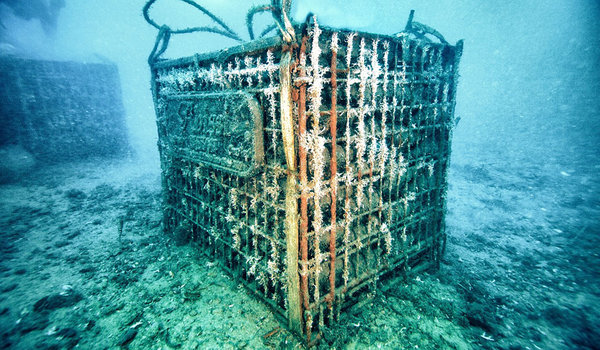
Photo credit: Alessandro Beltrame/AGB Studio Video, NY Times
The natural temps are near-perfect, there are no light effects to compromise the integrity, and the gentle rocking of the current keeps the lees (yeast particles) moving through the wine. And if you’re Charlie the Tuna, you’d have a veritable pirate’s booty for your drinking pleasure. Cellaring wine under the sea is becoming the new frontier. Since 2007, Winemakers from Spain, Italy, Greece and France have been sinking their vintage lots.
In 2009, Piero Lugano had to find a creative solution to the lack of storage space for 6,500 bottles of his 2008 Bisson Abissi Prosecco. At a depth of about 200 feet, his bottles remained in non-corrosive stainless steel cages for 13 months ~ great care was taken to ensure that nothing about the process was harmful to the environment. What they found was that the wine was beautifully aged. Since the bottles were surrounded by water, obviously no air could penetrate the corks and compromise the wine inside.
According to Recipeidol.com, Mira Winery in Napa this past spring underwent a test run of the underwater cellaring process. They took 48 bottles of their 2009 Cabernet Sauvignon and submerged them in the Charleston Harbor in S. Carolina. Registering a temp of 51 degrees, they were left to age for 3 months; and have just broken the surface to be tested. So far, the reviews of the first attempt are quite promising.
Yet it seems a fairly expensive propositon, unless your winery is close to a large body water, and a large body of water that is in no danger of freezing, like Lake Erie. The hit- or-miss nature of winter weather might be why, in Ohio, not much experimentation is yet being done with water cellaring. Still, it could be something worth exploring even with the natural limitations.
In theory, it sounds like a great way to cellar. But the question remains: Will it be a process that will ultimately increase the price point for the consumer? And does it make the wine that much better that the consumer will want to continue paying once the barnacles are brushed from the novelty?
In what I’ve read so far, the benefits seem good but still fairly general. There a plentiful tales of wines lost at sea garnering high prices at auction; but is that because it’s been cellared in sea water or because of the rarity of the bottle and the history behind it?
It’ll be interesting to see where this will go; perhaps water cellaring will become the gold standard. There’s no doubt that as more and more wineries continue to produce great wines, storage space may be at a premium.
Hmmm, maybe I should get that diver’s certification after all.
Cheers!
©TheWineStudent, 2013

 The Wine Student