Sake Night

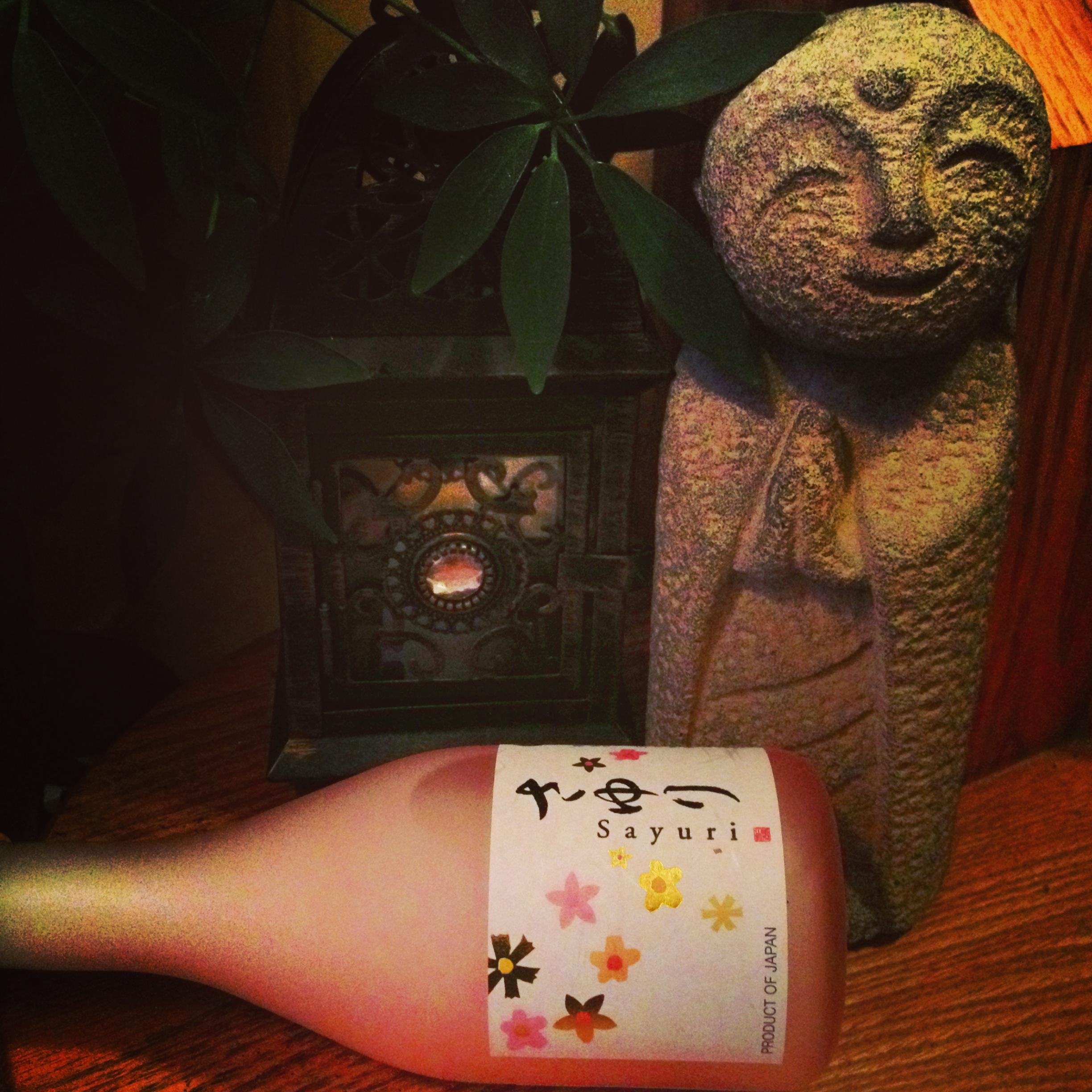
Sayuri Sake

Sayuri Sake

When I go out for Japanese food, it’s one of those bevvies that I think about trying but then I see a cocktail float by in a funky ceramic mug and I change my mind. I promised myself that Friday night would be different. Friday night, I would try Sake. With HubbyDoug as my DD ~ Sake contains between 15-17% alcohol so he’d better be ~ I was curious to see what it was like and whether it’d be something I’d choose more often.

I knew nothing about it and didn’t know whether it had similar ‘rules’ to wine: White with chicken or fish, red with meats. I didn’t know if there was even such a thing as ‘red’ or ‘white’ Sake (there isn’t).

I looked at the variety of premium Sake on the menu and chose one at random: Gekkeikan, which was highly regarded. When I asked the bartender if I could take a photo of the bottle it came from, he replied that I couldn’t because it came from a big box. That didn’t sound good. He served it up piping hot, warning me not to touch the ceramic carafe for quite a while. My research had told me that premium Sake is best served gently warmed. Strike two. When it seemed to have cooled, I took a sip. It was a juxtaposition of thin and strong and made me think of hot nail polish remover. There was no discernible bouquet, just an essence of straight up alcool. Maybe it was an acquired taste but I just wasn’t feeling it. And yet, I didn’t want to give up so easily so I kept a bit to have with my Teriyaki chicken dinner. Maybe the savoury of the soy and delicacy of the chicken would help ease that boozy vibe. It didn’t. And I ended up ordering a cocktail in the funky ceramic mug.

But I refused to be swayed by this experience. With the number of different types of Sake out there, I didn’t feel right about just giving up after one shot. A brand I’d read good things about was Sayuri; a coarse, filtered offering. On the label it said to just shake well ~ no need to warm. The consistency was described as creamy and naturally sweet. This one had a floral bouquet, which was quite nice. It wasn’t nearly as harsh as the Gekkeikan. But I was still not convinced. I suppose you could enjoy sipping it on its own or pair it with a soy-savoury dinner. But what the hell, just pound it into some beer and yell, “KAMPAI!”

Contrary to popular belief, Sake is not really a wine. It’s not really a liquor, since it isn’t distilled like vodka or gin. According to John Gautner of Sake-World.com, it’s a fermented rice alcohol beverage and with rice being a grain, it’s actually more like beer.

Here are some more fun facts about Sake:

  • It’s brewed for about four weeks and then a six-month aging process.
  • It is similar to Beaujolais in that it’s best consumed immediately or within six months of release.
  • It does well stored in a cool, dry place but is best with refrigeration.
  • It doesn’t contain sulfites (so no sulfite issues common with wine). Premium Sake is free from additives/preservatives and has few congeners (a contributor to that pesky hangover).
  • While cool brings out the best, it benefits from gentle warming.
  • It pairs very well with lighter fare such as chicken or fish.
  • Price range: between $18-35, $35-70 for 1.8 litres. The brands I found at World Market began at $13.99.
  • Snake in the bottle? Also known as Habushu ~ is generally not available in the US because there’s a freaking SNAKE IN THE BOTTLE! Enough said.
  • Some other top Sake brands: Juyondai ~ fruity and fragrant

                                                                         Isojiman  ~ balanced and rich

                                                                         Kubota      ~ light and dry

I gave Sake a good, college try and the second choice was much better than I expected. Eventually, I might try a few more. But I think I’ll be staying away from anything that has a snake in the bottle.

Cheers!

©TheWineStudent, 2013

Field Trip ~ Colaneri Estate Winery, Niagara.on.the.Lake ON

@ Colaneri Estate Winery

@ Colaneri Estate Winery

One of the things I love about going home to Niagara for the holidays; apart from seeing family and friends, is picking a new winery to try. Since I left almost 5 years ago, there has been an explosion of great wineries with something to please every palate.

When HubbyDoug and I were walking the main street we slipped into a little bar for a glass to take away the chill. We were treated to a Colaneri Estate Winery ’09 Cabernet Corposo. I noticed a distinctive richness and old world vibe from the very first sip. To be honest, my experience with many Niagara reds has been somewhat disappointing. They have a tendency towards a lightness and a green, vegetal quality that I don’t always care for. While they eventually settle into a pleasant flavor, it’s generally when you get to the bottom of the glass. I like a red to look me in the eye as it gently takes me by the collar and eases me back into my chair. This wine winked as it looked me in the eye.

I had to find out what made it so unique. A trip to the winery became my top priority.

Colaneri wines are made using an appassimento process that dates back to ancient Roman times. Harvested grapes are hung to dry before winemaking, to remove any excess water, thus shriveling the grapes. And why would you want this kind of shrinkage? All the better to concentrate the sugars and flavors in the resulting wine.

  • Recioto ~ also an ancient style of winemaking and also incorpporating the drying of grapes to concentrate the sugar content. Recioto may be red or white, dry or sweet. The dryer wines in this style are Amarone which can be intense at 16% alcohol.
  • Ripasso is a style that means to revisit or go over. It involves a double fermentation process in which additional dried grape skins are added. The sugar content has been heightened by drying and this increases the final alcohol and phenolic content in the wine which is known as passito.

Our winery guide, Pam, explained that Colaneri was one of only three Niagara region wineries to use this process. Their wines are kiln-dried, using both greenhouses with industrial fans and tobacco kilns. ”Since the kilns were no longer being used to dry tobacco, they have been put to use in winemaking”, she said. In the tobacco kilns, the fans push air up through the floor; where the greenhouse fans circulate the air around the fruit. The drying process can take up to two months with skin contact completed within 7-10 days.

After harvest, the grapes for Amarone and Recioto are set aside to dry in trays in kilns, or are hung in lofts ~ the hanging and careful placement in trays allows for complete air circulation so no mold develops. There they stay for approximately four months after which the semidried grapes are crushed and fermented with the grape skins. The grapes not used for Amarone or Recioto are crushed and fermented to be used later.

Once prolonged skin contact has finished, the wine is stored for aging. The additional wine (that had been fermented seperately) is introduced by being pumped over the Amarone | Recioto skins, thus starting the second fermentation. The saturated skins are still quite full of unfermented sugars, making them high in aromatics and tannins.

It was time to began our tasting with a spectrum of lighter fare: Pinot Grigio, Sauvignon Blanc, Gewurtztraminer, Chenin Blanc. The Chenin Blanc was my favorite; it had a taste of pear, pineapple and cotton candy (yum) with lots of citrus on the nose. Pam then took us into the reds starting the Red Blend ~ a combination of Cab Sav, Syrah, Merlot, Cab Franc and Petit Verdot. She mentioned that it was their everyday wine that pairs well with everything from pizza to red meats to chocolate.

We then turned our attention to the Cabernet that we had enjoyed the day before. The scent of rich molasses was prominent on the nose with sweet tobacco, blackberry and raspberry resonating on the palate. Awesome.

The Cabernet Franc was rich and flavorful, with an distinct essence of plum. Pam mentioned that some who tried it but don’t enjoy prunes/plums weren’t always fans. She recommended pairing with tomato-y dishes to counterbalance the prune essence.

We spend a good part of the afternoon sipping and learning a lot about some very special wines. Pam was friendly, knowledgeable and made the field trip to Colaneri so much fun.

I came away from the trip feeling happy to have discovered a jewel of a Niagara wine. I’ll make a point to look for more wines created using this time-honored method.

Cheers!

©TheWineStudent, 2013

Shhhhh!

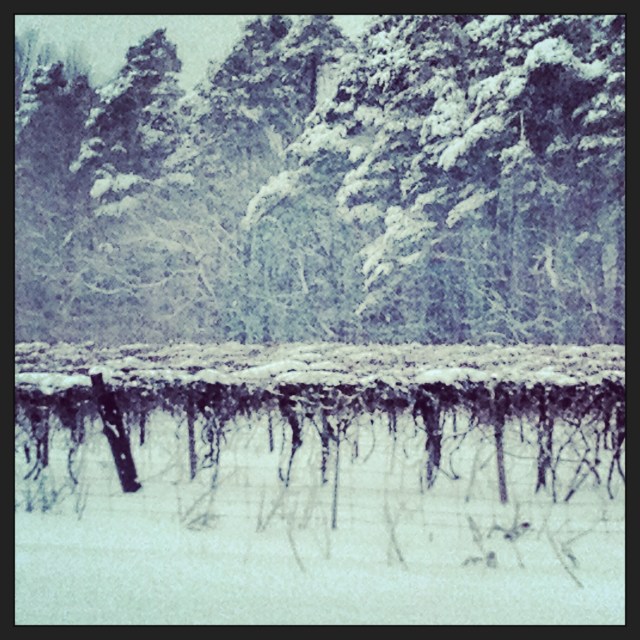
New Years Day: A time for  the making of resolutions and gentle reflection on the year that was. Who am I kidding? It’s a time to sleep and walk around in your jams, drink an awful lot of water and reflect on the night that was. If you’re a grape vine, you’ll be doing some of that today. While you won’t be trying to remember who you kissed at midnight, you’ll probably be sleeping ~ deeply. Your jams will be extra soil or straw, and your water will be the snow accumulating around you.

In the weeks prior to winter, grape vines prepare themselves for the approaching icy blast by ‘hardening off‘.  This is where the shoot of the vines begin to harden up, turn brown and shut their processes down after retrieving/storing nutrients they’ll need for the coming dormant months. The plants goes into energy conservation mode to keep itself intact. A good portion of pruning occurs at this time to get the plant set for the spring and the next growing cycle. If the vines are not properly prepared and pruned through the dormant winter months, the next harvest might be seriously compromised.

So if you’re driving past vineyards this winter, go quietly. You don’t want to disturb what might become your next great bottle.

Cheers!

©2013TheWineStudent